
Plant a pear tree, reap the fruit; except there’s no fruit on the pear tree; just empty branches. You watered it, pruned it, but nothing. What’s wrong? Drought, probably not; disease, unlikely. Usually its simply lonely.
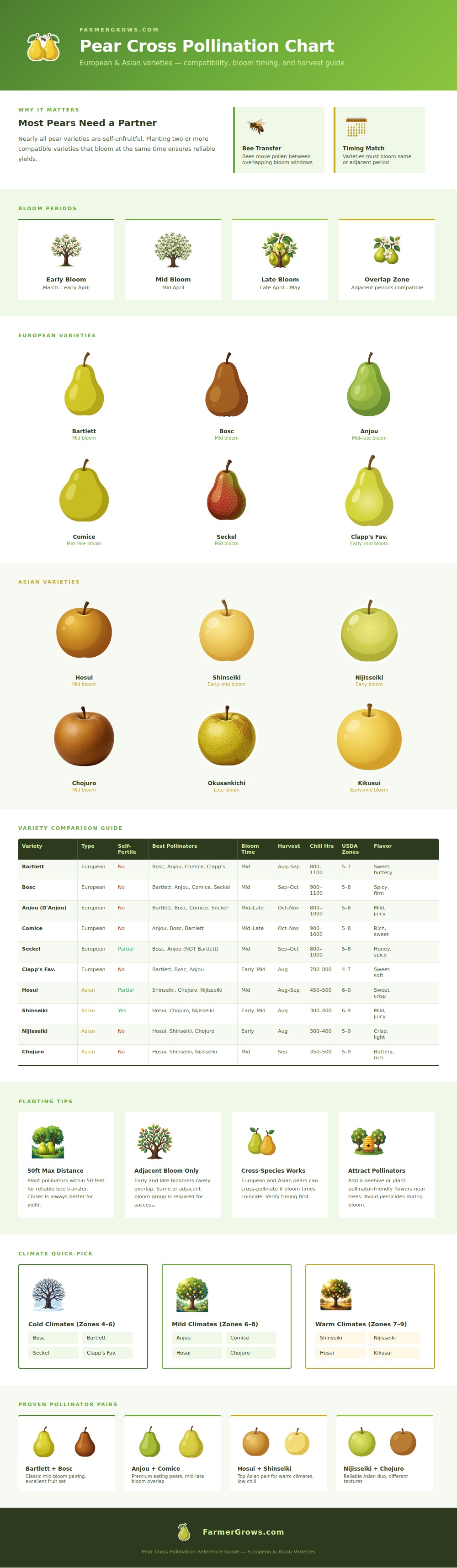
Many pears is not self-fruitful and need a partner to produce fruit, unlike apples which can generally pollinate themselves. Which ones go with what others? Here’s the chart. Use it when shopping to prevent getting trees that won’t cooperate. For instance, it lists compatible Asian and European kinds, so you’ll know who makes good neighbor.
How to Grow Pear Trees
This is how it works: it’s simple, but strict. The bees has to carry the pollen from one tree to another. So the trees need to be in bloom at the same time. One can’t finish flowering before the other begin. The infographic categorizes them by bloom window: early, mid, and late. Ideally you’d want some overlap between windows. For example, pairing an early-blooming variety like Clapp’s Favorite with a mid-blooming Bartlett would work, since their bloom times touch. Planting two extreme opposite will result in failure.
The closeness of the trees doesn’t matter, either; it’s all about timing. In old-fashioned fruit orchards, European pears are typical. The Bartlett, Bosc, Anjou, and Comice varieties does fine if given company. For example, Bartlett is a good complement to Clapp’s Favorite, or it can be planted with Bosc or another variety. Partially self-fruitful, the Seckel will produce better with a partner such as a Bosc. “Requires pollination” is all catalogs write, leaving you hanging. In fact: The chart explains that the Seckel will carry on without anyone but would of been happy with company.
Picking companions that ripen at different intervals extends your feast from late August into November. Less chilling: Asian varieties are adapted to warmer areas since they require fewer chill hours. In fact, Zone 8 and 9 offer hospitable homes for such trees as Shinseiki and Hosui, where European types struggles to break dormancy. Fewer hours of cold is required to get an Asian pear out of its dormancy. Although Shinseiki will pollinate itself (it’s full-on self-fruitful), growing it alongside Hosui increase yield anyway. Even if cross-pollination isn’t necessary for survival, it results in bigger fruit. A nearby tree, whether self-fertile or not, help.
The visually organized chart distinguishes between the two so that you won’t accidently put a heat-proof Asian pear beside a cold-hardy European, ignoring the potential for flower overlap. Success depends on proximity as well. Fruit trees are not spread out: They get best results if planted within 20 feet of their pollinator. A distance of over 50 feet between two trees decreases fertilization probabilities; bees is good at what they do, but they won’t fly so very far. Within 20 feet, you have maximum overlap of bee traffic, get this: That’s how close together you want your plants to be so that each gets covered by a single bee visit.
It’s all about companionship: All varieties must stick to the same distance. Whether it’s Nijisseiki and Chojuro, or Comice and Anjou, the limit is same. If you’re in a warmer area, plant tried-and-true combinations such as Shinseiki and Hosui (the chart helps eliminate guesswork when it comes to companion planting). To grow pears, you need to match their temperature tolerance (listed below) as well as their space and time requirements. If you don’t, it can cost you big bucks.
How? Check bloom periods ahead of purchase. So how does it become doable? Because then you’re not asking “Why didn’t my one pear tree produce?” but planning your orchard ecosystem instead. Bees do the job, but you create the conditions. Match the bloom period and partner range, and you’ll have fruit each year. Why did you get the harvest? And so on; the harvest is sweeter when you understand how it happned.