
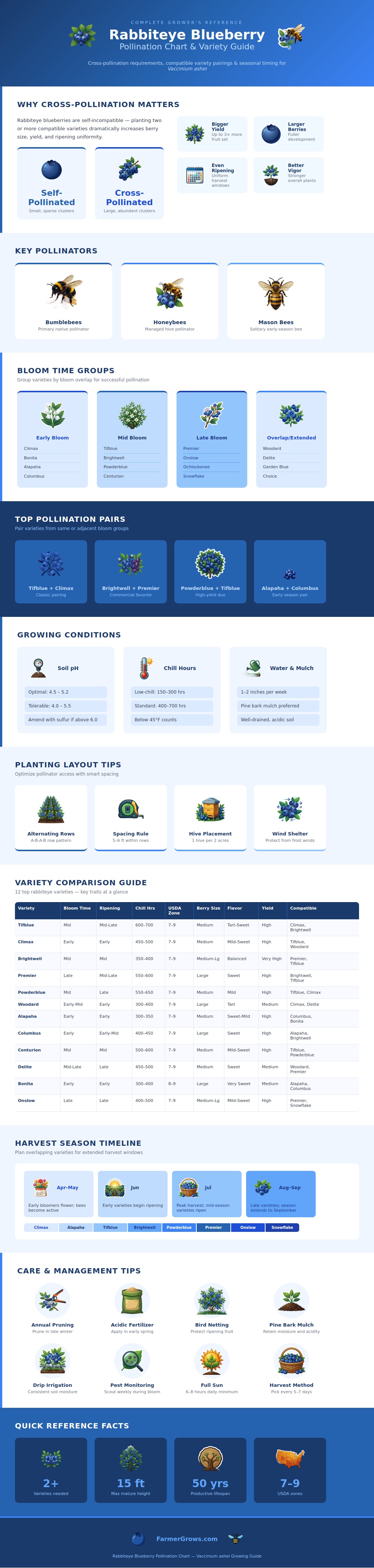
If you are growing Rabbiteye blueberries, you will likely do what I did and what most people do: buy one bush, place it in prime soil, and then wait for fruit that will never come. Why? It is usualy not because of a lack of water or even the type of soil. It is because the plant feel lonely. That’s right: Rabbiteye blueberries are self-incompatible. Translation: If there is no other plant nearby, you won’t get any fruit, though the lone bush will still be happy.
A few plants is needed, and each must have some neighboring kind whose flower time matches its own, since such timing are a necessity. Gardening becomes a compatibility-and-timing puzzle, not just hole-digging. These charts (above) tell you how to combine your bushes for cross-pollination when they’re in bloom: Think of it as arranging a date. Early-bloomers… Say early April, and late bloomers, like late May; totally miss each other. If there is no overlap, there is no pollen and no pollination.
How to Grow Rabbiteye Blueberries Well
How do you know who dates whom? Just look at the visual guide to flowering times of all varieties; it’s right there. For instance, Tifblue and Climax are a classic match-up, since they flower about the same time. That way their pollen transfers well back and forth, causing a big reaction in the plant, too. Fruit set increases up to three times then that of an isolated bush. The fruit is also bigger and more even. It’s not just about the number of berries; it’s about the quality. Because the plant isn’t struggling to make a crop of its own, cross-pollinated fruit tend to be sweeter and firmer.
And then there’s the matter of your mail carrier: Who’ll carry the pollen in for you? The bees, both bumblebees and honeybees and even the little mason bees, is the mailmen of the garden, delivering pollen from one variety to the next. Blueberry plants bloom on bell shapes, and while we’re used to seeing honeybee’s furry faces around here, it’s usually mason or bumble bees that does the best job in cool spring weather when the fruit trees first open their bells. When the temperature is too low for those honeybees to really get going, these native guys are already awake and working hard. Picking the proper variety of bush is essential, and it also matters to make a home for them. Make some space for a bit of bare ground (or plant some clover) for these solitary bees to create a nest. A little effort now lead to better crops later.
Before there’s a single flower, the stage is set by soil chemistry. Acidic soil is best for rabbiteyes; they like a pH from 4.5 to 5.2. An overly alkaline soil can’t provide the iron and other nutrients, causing weak growth and yellowing of leaves. Maintaining that acid balance over time can be done with use of sulfur, or by using pine bark mulch. In addition, mulch will keep the roots cool and moist, minimizing stress in periods of heat. Moisture matter most. The plants’ shallow roots is prone to drying out if not given consistent care. A drip irrigation system can deliver water right to the roots (no wasteful runoff or evaporation).
Though intimidating to novices, pruning is essential for long term. Left unpruned, these rabbiteyes will grow into a tangled thicket of branches up to 15 feet high. This chokes out air circulation and blocks sunlight from reaching all their branches. In late winter, prune out old, non-productive wood to make way for the new, which bears the best fruit. It might seem strange to cut back a plant that wants to produce more fruit, but thinning the canopy result in bigger berries and faster ripening times. Every branch has to have access to sunlight, so that sugars can get going on doing their best work.
If you choose your varieties wisely, there will be something to pick throughout June-September (the earliest and latest that’s possible). You’ll have early blooming varieties for an initial taste of summer (Alapaha here) and then some late varieties that last into early fall (Onslow here). This way you don’t get overwhelmed all at once with one huge load, and instead can spread out enjoying fresh berries for a few weeks. Little things make a big difference: more berries getting to you, fewer rotting on the vine.
Growing rabbiteye blueberries then, is as much a partnership as it is a matter of force. You give them constant watering, and acid soil to grow in. The bees do their part and move the pollen around. And the shrubs reward you with all of this. Planting a pair of matching but different varieties side-by-side isn’t simply planting a couple of shrubs. It’s creating a system that serves both of you, and everyone else involved, too. A single bite of your homegrown rabbiteye reminds you it was all would of been well worth the time spent planning.