
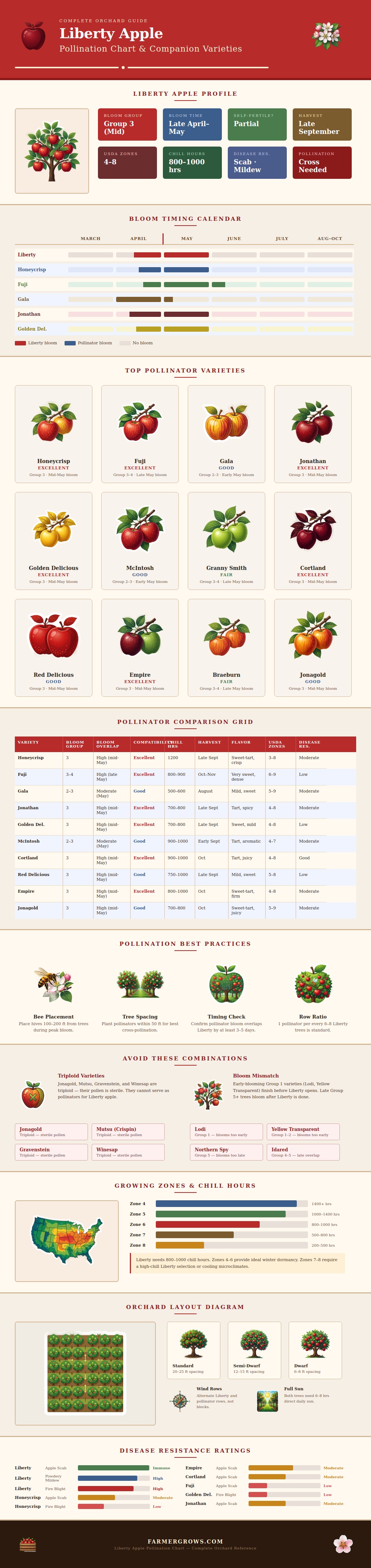
You want A TREE that tastes good, but doesn’t come down with various diseases that apples is prone to. So you plant a Liberty apple tree, which resists both mildew and scab, requiring less spraying (and more peace of mind). But here’s the catch: Most new orchardist find that Liberty is only partly self-fertile. Which means yes, you can grow a single tree, and have some fruit, but for a real harvest, you need a partner: pollination. For a full basket of crisp apples instead of an occasional snack. This visual guide explain it all. By breaking things down into bloom times (and which ones are compatible), there’s no guessing as to who’ll play nicely with whom.
As the chart illustrates, Liberty falls into Group 3, right smack in the middle of springtime. That’s handy, since a lot of other popular varieties overlap timing-wise. Without another tree whose blooms coincides with those of Liberty’s, nothing sets… And those bloom fall off. The single best choice for this is Honeycrisp. That’s likely your favorite apple anyway, and its bloom is just about on point. What’s more, it’s such a good pollinator. Pairing it with another popular apple, like Honeycrisp, give you double the deliciousness. Fuji is another solid choice (though it is a bit farther toward end of season).
Best Trees to Grow With Liberty Apples
Again, the infographic explains the stars in plain terms. Look at those three favorites, Golden Delicious, Jonathan, and of course Honeycrisp, all landing right in sweet spot. At Liberty’s moment, they’re blooming…and their pollen doesn’t get hung up on its way out. This isn’t true of all apple trees, however; some are simply unsuitable for the task. For instance, varieties that has three sets of chromosomes, such as Winesap and Jonagold, produce sterile pollen. The Liberty can pollinate them, but they’ll never be able to return the favor. In other words: planting one next to your Liberty won’t increase your crop size at all.
People commonly think all apples will pollinate all other apples. They don’t. Check the genetics, not just the color of fruit. Genetics aren’t everything; timing of the blooms is equally important. For instance, if you select a variety that’s early blooming (Yellow Transparent), it could of faded by the time Liberty blooms. Or by then, there will be no pollinator in sight. And varieties that are late to bloom (like Northern Spy) simply miss the boat completeley. That’s where the chart comes in.
You can look down a column of your choice and down a row to find compatible partners. You can also see mismatched varieties with gaps between their bars. Avoid planting something that sounds great on paper but flops in real livig. Also consider spacing: If there is lots of flowers right near the bees, they won’t be flying very far at all. Keeping pollinators within 50 feet ensures cross-pollination happen reliably. If you don’t have much room, you don’t necessarily has to alternate each and every tree, but keep them closer together rather than spreading them far apart, as spreading them out reduces fruit set. The “one pollinator to six or eight Liberty trees” ratio seems to work best in most home orchard situation. Think of it as providing a concentrated zone through which bees can fly during bloom time.
How much will climate impact your results? Variety selection matters, but so do conditions. To break dormancy properly, Liberty requires 800-1000 chill hours. This means it is ideally suited for zones four-six, but requires a cool microclimate if you are in zone seven or eight. That range is illustrated well on the infographic. Winter temps can get forgotten as we think about spring.