
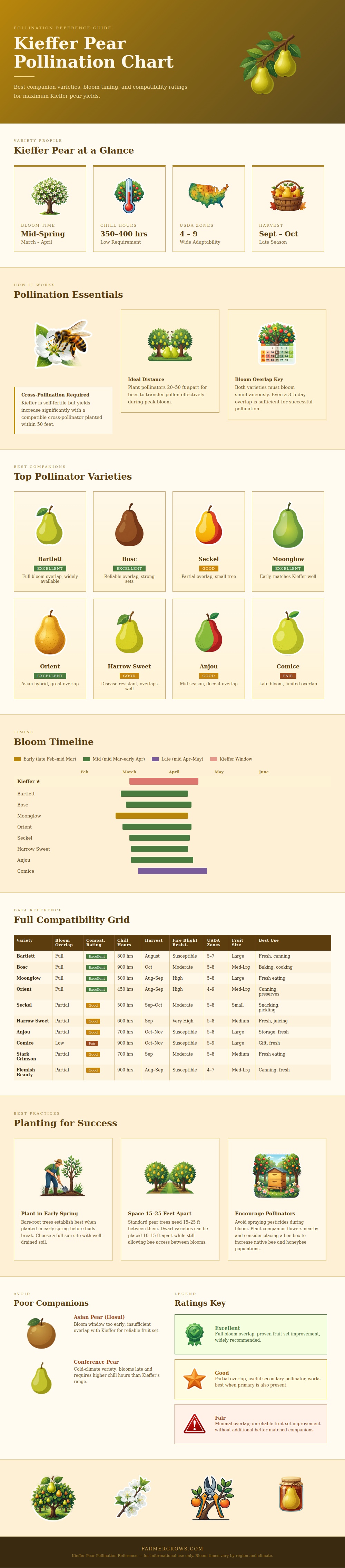
The Kieffer pear produces fruit in many climates, from zone four winters through zone nine summers. It is winter-hardy and resistant to disease. “What’s there not to like about a Kieffer pear tree?” I ask. What is the trouble with growing this kind of pear? A lot of newcomers to growing fruit has found out.
Yes, the Kieffer is self-fertile, meaning it will also set fruit on a single tree. One should of been plenty to get your fill, right? You won’t typically get serious yields. Alone, the tree will sets some fruit, but add a pollinator partner and you’ll see much better results. An additional compatible variety blooming around the same time as yours will mean more yield.
How to Get More Fruit from Kieffer Pears
That’s what the visual guide depicts, and that’s also why its logic is all biology. Timing is everything for pollination. The bees need to carry pollen from one flower to another, and in this case they won’t do that if your partner tree bloom two weeks earlier or later than your Kieffer does. No overlap, no fruit set.
According to the chart, Bartlett and Bosc are great partners; their bloom windows matches up perfectly with Kieffer’s mid-spring timing. And it’s not by chance: Over many decades, breeders chose these characteristics. Choose a variety rated “excellent,” and you’ll get more than just a few fruit (you’ll get a bountiful crop).
A second benefit of choosing one: it reduces your risk in the garden, too. No one wants a single point of failure. Sure, if all you have planted is Kieffers, you’ll be missing out on diversity of flavors available among pears. According to the infographic, two top contenders for alternatives are Moonglow and Orient. Both are smart picks because they are compatible with the Kieffer’s bloom cycle, yet they offer something different.
Moonglow, especially, can be valuable in warmer parts of zone five or six. It has better fire blight resistance than most European varieties. Placing it beside your Kieffer protect you from disease, without compromising on yield.
Distance counts. Not as far as to make them fail to connect from tree to tree (a bee’s preferred travel distance), but not so close that there isn’t any airflow and you run into fungal problems. Twenty to fifty feet seems to be just about right. When there are blooms nearer at hand, bees wants a short commute, and they’re good workers, but they don’t like being too far away. Don’t expect help from a pollinator located halfway across the yard or even in a neighboring garden half a mile distant. Make sure the partners remain in each other’s visual field. That way, all of that pollen will get transferred reliably at those narrow mid-spring moments; a little practical trick with a major payoff in fall.
If you have more than one tree, some of the ones rated “fair” or even “good” may still perform. My Kieffer overlaps only partially with Seckel pears. Seckels are a tiny, sweet variety good for eating fresh or pickled. It also overlap slightly with Bartlett, which is no surprise. If you get two Seckels, maybe one will cover the timing difference?
Comice is a beautiful fruit for dessert use, though it is so late that it just barely touches the Kieffer window. Unless you have other willing participants in the mix, they’re dicey partners. That’s what the data tells me and it makes sense intuitively, too. Overlap trumps prestige. Any old partner who blooms at the right time is better than a hot number who never does.
The first step in avoiding pitfalls is understanding what doesn’t work. For example, Kieffer is no good if you have a pear variety such as Hosui, which blooms more earlier than Kiefer. If you’re located in the South, and you don’t get enough chill hours (many of us don’t), forget about Conference pears. Sounds good on paper…but biology won’t play along. Stick with varieties that fit your local pattern of climate.
Bare-root trees are best planted in early spring, so they have time to get going before the heat settles in. Water well and make sure their trunks is clear of any competitive turf. Prune lightly when they’re established to allow air and light to enter the canopy. And then, when September rolls around, you’ll understand why you bothered with the plan. A properly matched pair makes an orchard; one lonely Kieffer makes a handful of spiky fruit. You’ll fill up your baskets with the golden haul of the former, the latter storing well right through winter. Who do you want sitting next to it?