
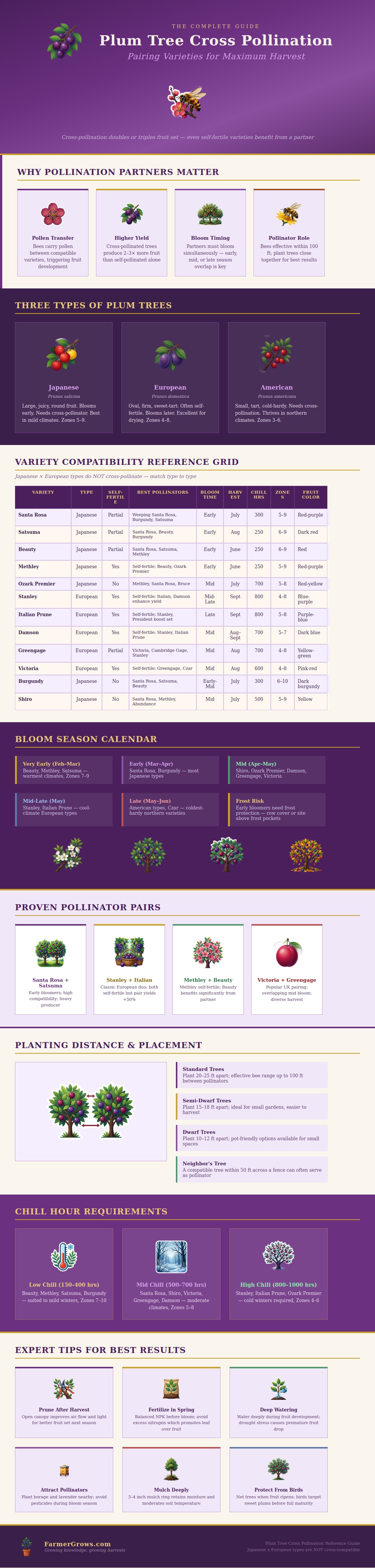
THERE’S A common frustration for the home gardener: plum trees that don’t bear, yet appear quite healthy anyway. Most times the problem isn’t soil or even disease. It’s simply a matter of no suitable pollination partner near them. Here are the mating rules of plum trees: will you get flowers or will you get jam? Which tree varieties should you plant together? You don’t want an empty branch.
It is important to know which plum varieties will pollinate each other. The infographic above shows those compatibility rule. Many first-timers make a big mistake by thinking that any other kind of fruit tree on the property will work as a suitable pollinator. Example: European plums (botanical group Prunus domestica) don’t cross-pollinate with Japanese plums (P. Salicina). So no: Putting a Santa Rosa near a Stanley won’t do the trick, biologocially speaking. That’s the takeaway from the chart. Pick a partner within its family.
How to Get More Fruit from Your Plum Trees
In cold-winter zones, try a European plum like Stanley or maybe Italian Prune. In warm climates with few chill hours, go Japanese with a Beauty or Satsuma. The first consideration: match the tree to your climate zone. Next, check the bloom timing. Two Japanese plums may be compatible, but will bees move pollen from one to the other unless they’re timed to open simultaneously? To that end, the guide groups its trees according to when they break bud in the spring, ranging from very early bloomers in February to late ones in May.
Why does this matter? Because it’s no good pairing an early-blooming tree with a midseason one; by then the earliest ones’ blooms has dropped off. Overlapping bloom dates are necessary. Pairing proven matches like Santa Rosa and Satsuma promises an early yield. Beauty and Methley is also reliable bets. Pollen donors and receivers must match up on the same days.
One more thing: How close together? While bees are hard at work, they don’t move far effectively so keeping those trees no farther than a hundred feet apart guarantees reasonable pollen exchange. Closer is better (especially in small garden spaces). For small yards, choose dwarf or semi-dwarf rootstock, which will fit the tree itself plus its mate into a tighter area while still producing fruit. Even when there’s an amenable tree on the other side of the fence with a cooperative neighbor, it’s helpful to have your own couple; remember, it’s up to you how things turn out.
Pollination determines fruit set; chill hours determine survival. Even if you’ve got a good pollinator partner, no amount of cold-tolerant variety will bud out properly here in a mild climate. That’s why the reference material organize varieties by their cold-requirement: so you don’t end up with a cold-hardy European plum in a warm microclimate. Match the tree biology to the environment, and then maintenance supports the process.
After harvest, pruning opens up the canopy so sunlight gets to inner branches (improving fruit quality next year). Fertilizing in early spring provides the tree with energy for bloom but does not encourage too many leaves (which would shade out the blooms). The last part of the jigsaw puzzle is attracting native pollinators. It is helpful to grow nearby plants like lavender or borage (above). These invite bees to hang around while you’re waiting for the tiny blooms to open and be ready to pollinate. Don’t use any pesticides while the trees are blooming… Those poisons kill the insects you want there!
Also, mulch well under the trees so their roots can keep cool and hydrated through fruit production, no more early drop caused by drought. Master all this, and suddenly you have plenty of fruit to reward all the care, worth it. You should of tried this sooner. No more wondering what’s wrong with the tree; now you’ll know how to save the crop. That plan you made at the nursery will pay off in full baskets in late summer, transforming an ornamental shrub into a reliabel food source for years to come.