
Planting a chestnut tree; waiting 3 years for fruit, and dropping your green burrs before they ever go brown. The soil was right; the sun was right; you watered it correctly…but you didn’t do anything wrong.
But here’s the deal: the tree isn’t producing nuts because it requires cross-pollination, which means that the tree itself are essentially an ornamental shrub. How can this be? Chestnuts cannot pollinate themselves. They require a partner, different genetics and someone whose bloom coincides with yours. Most backyard failures is due to this biological demand. Even if you have best variety, if nobody else is out in bloom while you’re out in bloom you’ll get zero harvest.
Why Chestnut Trees Need Partners to Grow Nuts
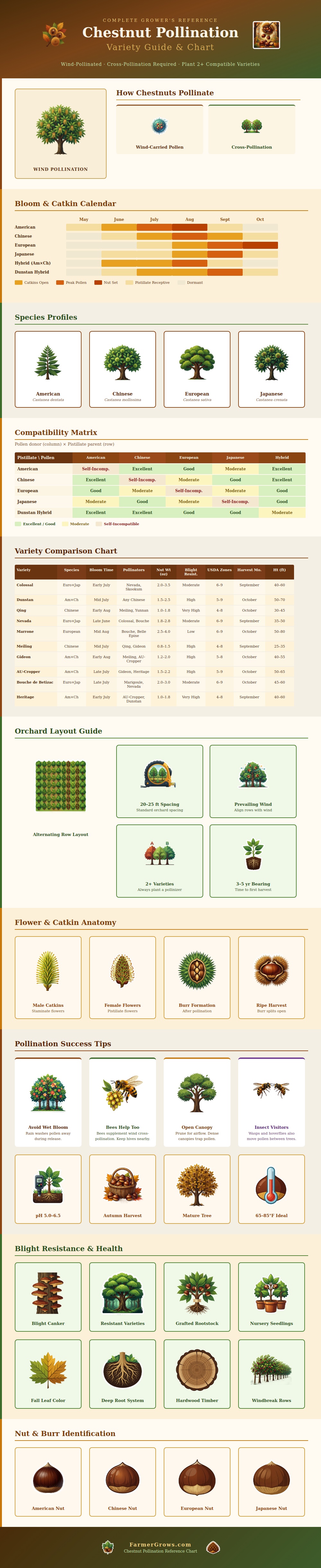
It’s also wind-driven. Light pollen from male catkins are carried by the breeze to the female flowers that hang from those branches lower down. Most popular types is self-incompatible; that means they don’t pollinate themselves. Two tree of the same cultivar won’t pollinate one another. To have successful fruit production, you want genetic diversity in the makeup of your orchard. European varieties tend to be lousy pollinators for some Asian hybrids, while the American and Chinese ones makes great partners. Why do nurseries sells both main crop and pollinizer? This helps explain it, and prevent a sterile grove.
The other half of the equation? Pollen only lasts a few hours, so if your main tree’s bloom period is late June and your partner starts dropping pollen in mid August, you’re toast. Many European varieties holds off until September, though some start as early as May or June. This allows big farms to stretch their harvest time across all those months. For gardeners with limited space at home, it means doing your homework on when each variety will bloom, then matching it up with your local weather pattern. You don’t want a variety that blooms during a late frost because you’ll have no one to pollinate it anyway.
These are small margins. They are even smaller if the weather doesn’t cooperate. This is key since rain washes pollen from stigmas and male dust settles as wet masses. In soggy springtime regions, even careful matching of varieties wouldn’t of improve your yield. Pruning for an open canopy is very important. It lets wind blow around inside rather than just on the outermost branches where the females lurk. This airflow also helps dry out the blooms faster. Pollen will travel better in such breezes different than it will be able to if the air hangs moist and sticky from leafy canopies.
Read more about pollination. The main process of pollen transfer isn’t bee-driven; insects also play a role when the wind subsides, helping pollinate in their own smaller way. You can encourage more insect action by using hives, if you have them, or by adding some companion herbs. This adds a little buffer between you and the days when nature fails.
The trick with an orchard: Think of it as an ecosystem, not a series of unrelated plants. That means thinking about local wind patterns and how different species are genetically compatible. You also has to consider what overlaps in bloom. In short, you must think in groups and in pairs at the same time.
Magic happens in fall when spikey burrs pop open and release the glossy brown nuts inside. Biology meets good planning halfway.