
When spring flowers fade and there’s no fruit, don’t blame bad soil (or even pests). For example, no harvest will happen if you grow just one type of apple tree because it cannot pollinate itself. It blooms but then those flower fall off when no compatible neighbor is around to share pollen with. Knowing that need makes the plant more than just a good-looking thing.
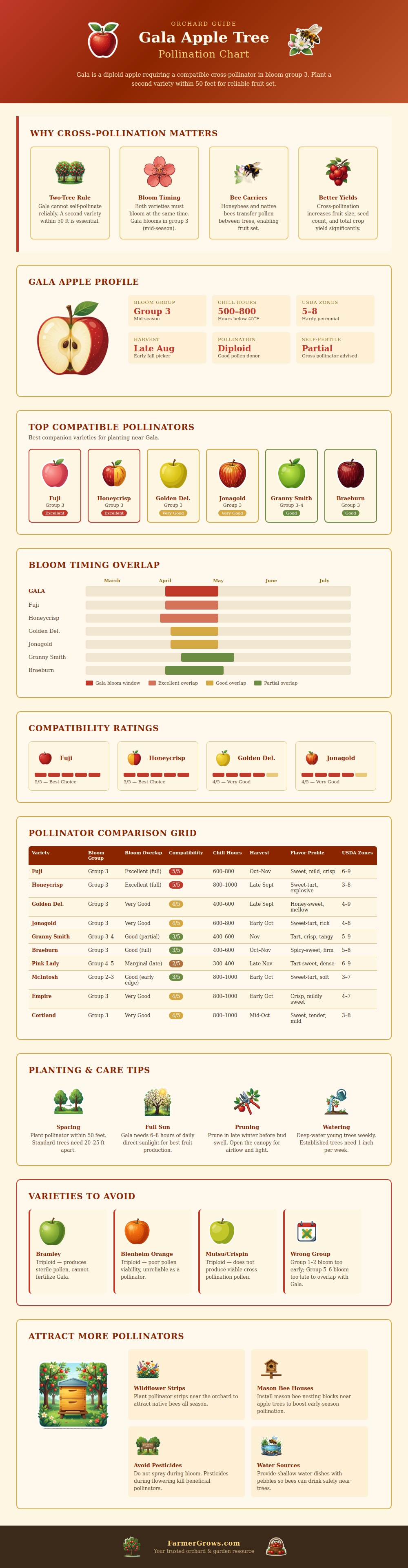
Choose a variety that blooms with your Gala tree. A second tree planted nearby. Midseason varieties, group three… Is best for apples from a tree like Gala. Find another variety whose flowers coincides with those of your tree. If your companion variety blooms two weeks earlier or later, the bees has no one to visit while both trees are receptive.
How to Grow Apples With a Gala Tree
The ideal companion varieties is Honeycrisp and Fuji. Other good choices include Golden Delicious and Jonagold (though in your area there may be a little less overlap). Some apples won’t help pollinate others. Triploid varieties (like Mutsu or Bramley) is sterile. They don’t shed viable pollen.
In other words, you could have one of these variety next to your Gala tree and they’ll still produce fruit, but they won’t help yours. Don’t plant any triploids. Instead plant varieties with viable pollen. Diploid ones.
That said, your selection of partner will be based off not just on what’s convenient or what stores well, but also on when you’d like to pick it. Some years I want them all done together (that would of Granny Smith or Braeburn), while other years I am happy to wait an extra month or two (hence the Fuji, which keeps until November).
The latter varieties are better pollinators and their picking time is also somewhat closer to early fall, meaning they’ll pair nicely for pollen, too. It is a choice between convenience and storage time. But they still need that necessary compatability factor.
Why? Keep your pollinator within 50 feet of that Gala tree you planted, so they can fly back and forth freely. That’s not just an arbitrary number; it’s a good rule of thumb for good pollination. And be mindful of the bees while in bloom. Don’t spray any pesticides, which will kill off bugs that do all the work to help your fruit set.
If you want to help the bees locally, create habitat by installing some mason bee house, or sowing a few wildflowers. Provide shallow water (with stones on the bottom) for weary pollinators to safely satisfy their thirst.
To get good pollination, remember that proper tree maintenance matter. Full-day sunlight (six to eight hours) is necessary for Gala trees. In late winter, prune out branches to allow more light and air flow, better fruit follow. Water deeply weekly on young trees; older trees typically has sufficient water if they receive enough rainfall.
Keep bees and trees healthy, and you’ll reap the rewards come fall. Combine your Gala with another apple like Honeycrisp or Fuji, and don’t mess with the bees in springtime.