
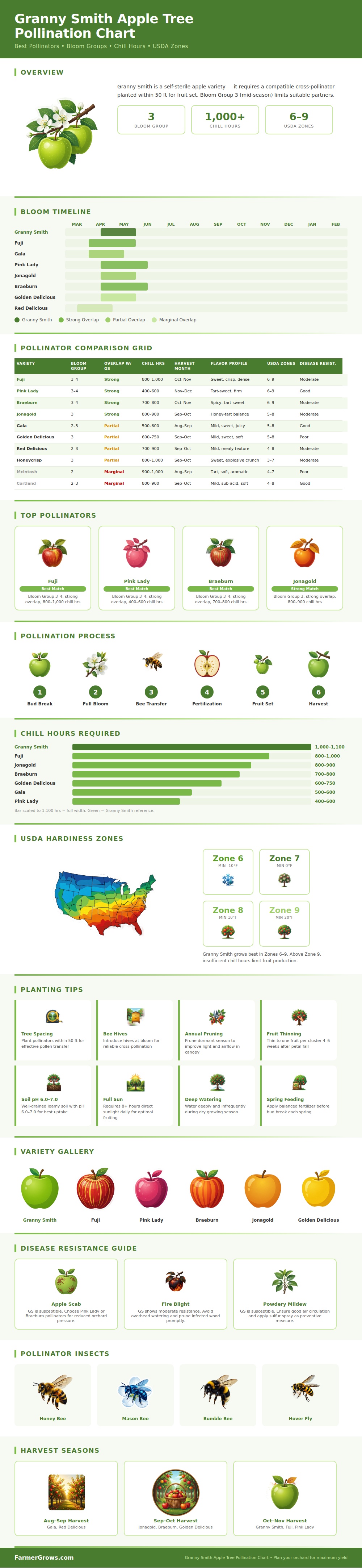
You can plant a Granny Smith apple tree and give it good care, even watering it propery. No apples comes in fall anyhow. Why not? Because tree is naturaly unable to pollinate itself (it’s common). Another compatible variety must be close by, to share pollen with the tree. No apple; just a healthy-looking tree.
Which pairs is good matches? The chart above shows this. It is mid-season for In Bloom Group 3. This matters because the other tree has to flower at this moment, too. Too early or too late, and when yours come into bloom, there will be no bees around to move pollen from your tree to its tree next door.
How to Grow Granny Smith Apples
Overlap is what you want; varieties that overlap includes Granny Smith, Fuji, Braeburn, Pink Lady. Those all come into bloom about the same time. The bees can shuttle pollen back and forth. Golden Delicious and Gala has some overlap (and work, though with slightly higher risk of things going wrong if bad weather throws off bloom times). Red Delicious is a poor fit because it flowers much sooner; so are McIntosh and Cortland.
Choosing a partner for Granny Smith do involve chill hours. For proper breaking of dormancy, this variety require more than a thousand chill hours. In general, it’s best suited to a cooler climate. Its range is considered to be USDA Zones 6-9. However, in milder-winter location (think: warmer), the tree might fail to wake up in springtime despite having a good pollinator. A good pollinator choice for northerly gardens would be Fuji, which has comparable chill requirements. Pink Lady require fewer chill hours, and can be helpful closer to Zone 9, but make sure that your Granny Smith still recieve adequate cold weather.
The real pollinators are bees. Bumble bees, honey bees, and mason bees transports pollen from blossom-to-blossom. One way you can assist: Don’t spray with pesticides around bloom time. If your landscape lack natural bee traffic, consider installing a small hive nearby. Since flowers are only open for a brief period (think: petals!) it’s a race against time. The closer together the trees are planted, the greater opportunity for cross-pollination. Ideally they would be no more than 50 feet apart. Because bees don’t fly great distances to retrieve pollen, proximity matter.
And then there’s the matter of trees. These want soil and light. To produce adequate amounts of fruit, apples requires at least eight hours of daily sunshine and grow best in well-drained loamy soil with a pH between 6.0 and 7.0. Another reason to select an apple partner is disease resistance. Apple scab and powdery mildew will trouble Granny Smith. Reduce issues in your orchard by pairing her with resistant varieties such as Braeburn or Pink Lady. It’s not only about flavor, you’re managing the health of ecosystem.
To prune well: Thin branches to allow for good airflow, which helps bees reach all the blooms and prevents fungal issues. Later in spring when fruit starts to show, reduce excess clusters of fruit, leaving just an apple on each cluster. This promotes healthy bigger apples, not misshapen smaller ones, though I know it feels like a crime to remove possible fruit. But the tree cannot go full-bore supporting every bit, or you’ll have a lot of small fruit and no big, quality ones. You should of had a manageable amount of great fruit rather than a lot of nothing.
Planting an apple orchard is about making a relationship between plants. How do you make it so they gets along? Provide the proper environment for them to work together. Establish the climate requirements, then use nature’s pollinators, the bees, to help. In late October, when there are still green apples on the trees, you’ll know it worked out well.