
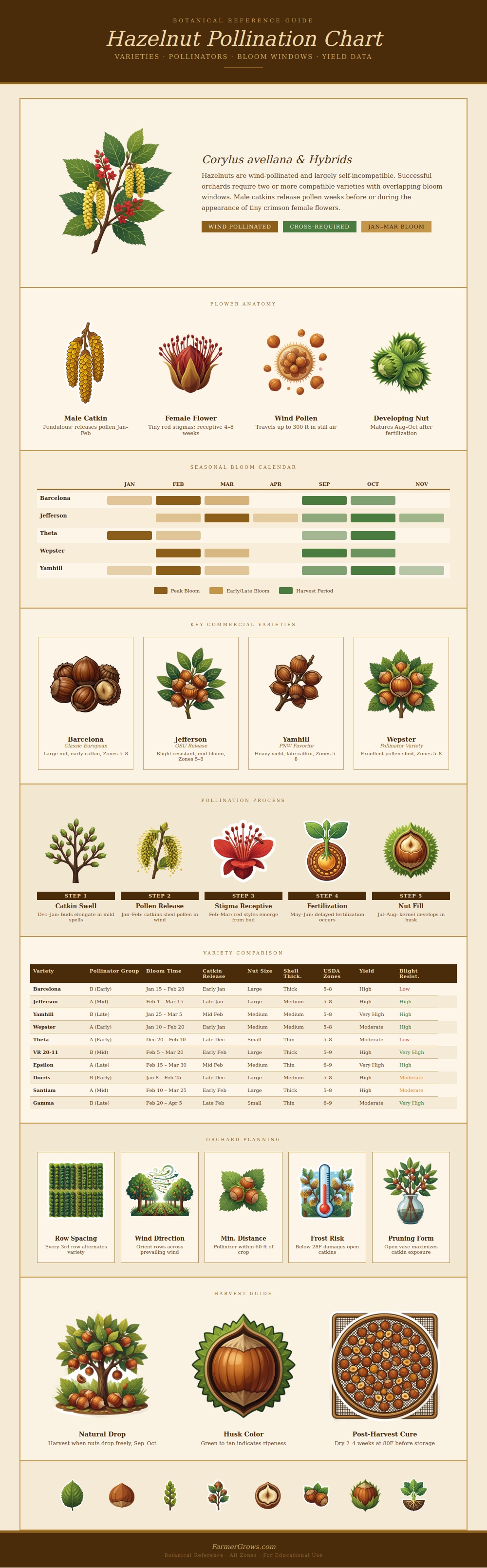
Whether you’re left with empty shells or a harvest depends on whether pollen moves from branch to branch (as it does in the wind), regardless of what you planted where. Until I saw its strict biology, growing hazelnuts appeared easy. Turns out that you can’t plant a mix of Barcelona nuts and hope for a good crop; they are mainly self-incompatible.
The trees require a partner whose bloom window overlaps, and whose genes is compatible. Male catkins sheds their pollen several weeks beforehand, and then tiny crimson female flowers appear. Those two moment must overlap or there’s no crop at all. It’s not just a planting problem, it’s one of synchronization.
How to Grow Hazelnuts Successfully
Why does it matter? Well, look at the structure, which explain the timing aspect. Between January and February, the pendulous male catkins dangles from their branches as if a long brown tassel, shedding clouds of yellow pollen into the air. The female flower hangs unseen within its bud scales until later in the winter through early spring, when those delicate red stigmas poke forth at last and are ready to capture some of those floating grains.
That’s the moment many an amateur grower fumbles, assuming that the trees in one yard will pollinate each other automaticly. But what happens if the male pollen sheds out first, and then the female styles don’t become receptive? The moment passes forever that season. A good infographic shows the timing well (and makes clear just how far pollen can travel, three hundred feet, even on a day with no wind). That’s a liberal distance, but again: Only if the chemistry work.
It’s important to select varieties based off their bloom groups, not just the size of their nuts. You want both early bloomers and late bloomer to create a buffer against unpredictable weather. If it’s too cold, an early bloomer could of had its flowers killed off, leaving no fruit for a later one to pollinate. To achieve this kind of safety net in various time frames, plant a combination of Jefferson and Wepster, or Jefferson and Yamhill. How do they all compare to each other? That’s what this chart is about: how they’ll stack up during early spring and into winter. This way, you hedge your bets by diversifying, as any savvy farmer will tell you. Your crop will be safe in case frost hits one type but not another.
Besides genetics, the way an orchard is laid out matter big-time to success. Plan rows with wind direction in mind; you want the pollen blow-through to be from one row into another (not away from the other). Every third row includes a partner tree, establishing a kind of compatibility lattice where the breeze blows through from several directions. Keeping those partners within sixty feet ensures dense coverage without wasting space on unnecessary duplicate.
The canopy-opening pruning helps here, too. It makes the tree vase-shaped, which expose more catkins to the elements. This increases the likelihood of getting what they’re looking for, releasing it, or finding what they need. Structural honesty beats fullness.
This is all subject to frost, which can be a big threat here. A really nice year can go sour quickly if exposed catkin get damaged by temperatures that dip down into the twenties (below 28). Late-winter freeze-outs are possible in places where the ground collect cold air the way it collects water. These area create frost pockets. Low spots will cause havoc with early flowers. Windbreaks and elevating the plant can help reduce the risk somewhat.
After fertilization, months pass before actually nuts develop fully. They fill out gradually under their protective green husks through summer and fall. Harvest time finally comes when they naturaly drop. This usually signals full maturity when the kernels harden inside tan-colored shells.
If you intend to sell or store your nuts, proper curing is the key to keeping them in top shape. Left too moist after harvest, they will rot or go bad when temperatures drop in winter. Drying at about 80 degrees Fahrenheit for a couple of weeks to a month reduce the moisture and helps preserve the nut.
From bloom to harvest, the proper care means that each ounce of work you put in will pay off; eventually. Because patience is rewarded most of all in the process, you can watch those empty branches slowly transform into fat bunches, and then see the tree fill out. And think back: How did life get from row to row? It was like a breeze rippling through the orchard early one morning.