
You plant your Chippewa blueberry bush and wait for your first harvest. But then it’s only sparsely fruitful (and those fruits is tiny). Why? Many gardeners overlook this fact of life with blueberries: They want to have company; literally, in the form of neighbors. The more varieties of blueberries planted nearby with overlapping bloom times, the greater the crop since bees pollinate from one variety to another. If there are no neighbor, there will be fewer berries and less flavor.
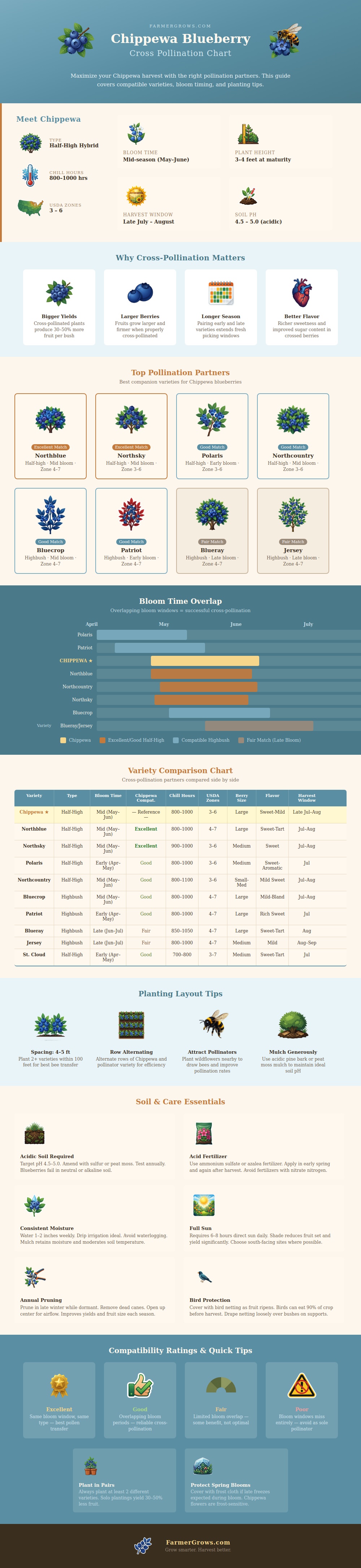
Chippewa is a half-high hybrid, hardy to zone three up to six, and this visual guide details how it pair best with its companions. You want varieties whose bloom times overlap. If your neighbor flowers two weeks before or after Chippewa the bees have nothing to connect. Simultaneous is what’s needed.
Best Blueberry Neighbors for Chippewa Bushes
Northsky and Northblue pair well; these flower about May into June. Both are half-high types, which means they fit in containers or small gardens. They do not require large highbush space. That’s helpful for maintenance, particulary if on fence lines or raised beds. Some pollination assistance come from other bushes that are sometimes later to bloom, depending on whether spring weather is warm (like Polaris and Northcountry). This is why synchronized blooming is so critical.
If your highbush blueberries such as Patriot or Bluecrop flower at the same time, this could work, but remember there size. A Chippewa bush reaches only three or four feet tall, making it easy to harvest. With a bigger one, you’d have to space them carefully so that little guy isn’t shaded out.
Sun, sun, sun: Six to eight hours of direct sun each day is what blueberries requires. Less is less, and less is no good when it comes to fruit quality.
Besides how you’re going to pollinate, there’s another important piece of the equation: the soil. Chippewa require an acid soil (pH of 4.5-5.0). Not maybe, but should of; it cannot absorbs nutrients unless this is so. Have your soil tested prior to planting and correct the pH accordingly with peat moss or sulfur if necessary. To sustain that acidity level, use pine bark mulch, since it breaks down very slowly and helps hold proper conditions in place. Keep soil consistently moist (an inch or two a week when dry) and don’t let soil dry out. A drip system would be ideal, as it never lets the roots sit in water where they will rot.
Patience, please: Dead canes gets hacked off after dormancy in late winter for pruning. That’s how you open up the middle of the bush for better air flow. The downside is that this cuts back on potential fruiting wood; the upside is bigger berries and stronger growth in years ahead. Cut out the weak bits, let the strong parts flourish.
Put bird netting over the crop as soon as the fruit is ripe to protect it; birds will gobble the berries right up. A strong system comes from good planning plus good neighbors: Northblue matches perfectly. Plan well and you’ll be rewarded with heavy crops of deliciousness in late July into August. Having cross-pollination does not only help berry quality but also the quantity.