
An early-blooming shrub like the haskap will flower before the snow dissapears, sometimes even with snow still on the ground. This gives the plant strength but also sets up a challenge for a first-time grower. You might plant one bush and wait two years until it’s mature, only to have the flowers fall off without turning into fruit. It’s not that something went wrong, it’s biology. Haskaps aren’t self-pollinating; they require another plant as their mate in order to set berries.
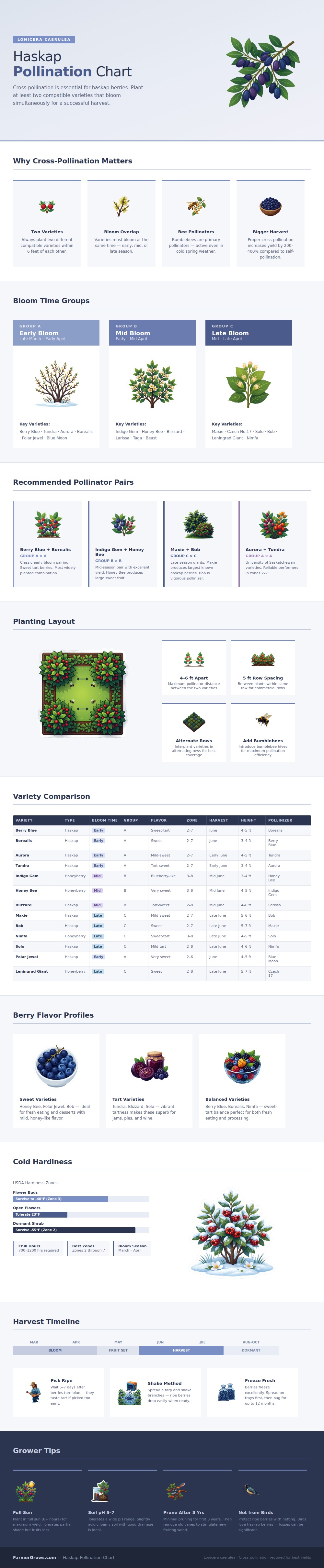
The trick is getting this pairing correct or else you’ll end up with nothing (or maybe much more). Pollination groups are key (and the visual guide explains it all). You cannot plant two plants from different groups side by side and expect them to cross-pollinate, since one may finish blooming well before the other even begins. For instance: One shrub blooms early April; the next one’s blossoms don’t push until late May. The gap in available pollinators? Closed tight. All those flowers have closed and gone by.
How to Plant Two Haskap Bushes for More Fruit
The idea is to pair up your bushes within these three windows of bloom time, where they’ll be open at once, and bees can easily transport pollen from one flower to another. They will dramatically multiply your yield; where one lonely bush gets maybe a handful of fruit, a matched team yields far more. Often it is triple the amount or quadruple.
Beyond the science of it all, which ones should you pick? You’d choose based off intended use (to eat fresh versus making jam or wine). Are they sweet enough to pop right into your mouth? Or are they more tart? These are better for jams or wines, since you add sugar during processing. The infographic offers proven matches, like the classic combo of Berry Blue and Borealis. These two does well in cold zones, which makes them suitable together. They also have overlapping bloom times, making this a good combination for a first-timer.
Later types like Maxie bear bigger fruit. But you’ll want another good match to plant alongside her, someone with similar bloom timing like Bob. An early-bloomer crossed with a late-bloomer might look nice on the diagram page but not out there in the garden…no fruit at all!
Beyond genetic match-ups, there’s also the practical matter of where the plants will go. On a forage trip, bees can only cover so much ground. Pollen movement decreases a lot if compatible partners are planted farther different than 20 feet from one another. To increase cross-pollination, place varieties within four- or six-feet of each other. That way, a bee visiting one shrub gets to visit the other on the same outing (but not too close, leave sufficient space for airflow, to avoid diseases).
Close and not-so-close: Proximity doesn’t mean across-the-yard, just close by. When many home growers forget about this factor it leads to poor yields.
Growing these shrubs is easy after getting the pair started. In fact they are more tolerant of extreme cold than many other plants. To develop sugar, the plants needs full sun and regular watering until the fruit is set. For the first several years there’s no pruning needed, since it takes awhile for the plant to develop its framework. Every couple decades, prune out some of the oldest canes, which will keep production vigorous.
Then comes the difficult part: picking time. The fruit doesn’t mature all at once on a given branch; besides, the birds beat you to it. Once the berries start turning from green to purple, netting is necessary. If left alone to bear fruit, your crop would of been depleted fast.
Growing any kind of fruit-bearing plant can be rewarding, but watching a haskap bush reward your labor seems somehow more special. It’s not about brute force or chemical intervention; it’s about the pay-off for planning and patience. Having some nice-looking, albeit elongated, dark berries on the branch in early summer is validation of the additional step of finding another shrub with whom to group-bloom.
Matching bloom groups is a minor investment with big payoff: the promise of fresh fruit ahead of blueberry season. You’ll never have a full harvest of these plants unless you plant a compatible neighbor.