
The dragon fruit vine make an impressive display with its large white flower clusters that glow in the moonlight and its thick healthy stems all season long. However, once they flowers, the blossoms wilt and fall to the ground. They do not leave even a tiny knob of fruit behind. Failure! You feel personally at fault.
It is not often because you didn’t water it correctly, or feed it the wrong thing. No, it’s almost always due to a missed date: a missed appointment with pollination. Those nighttime blooms is really finicky, on a very tight timeline, and if you miss that brief window, out comes no harvest whatsoever.
Why Your Dragon Fruit Is Not Growing
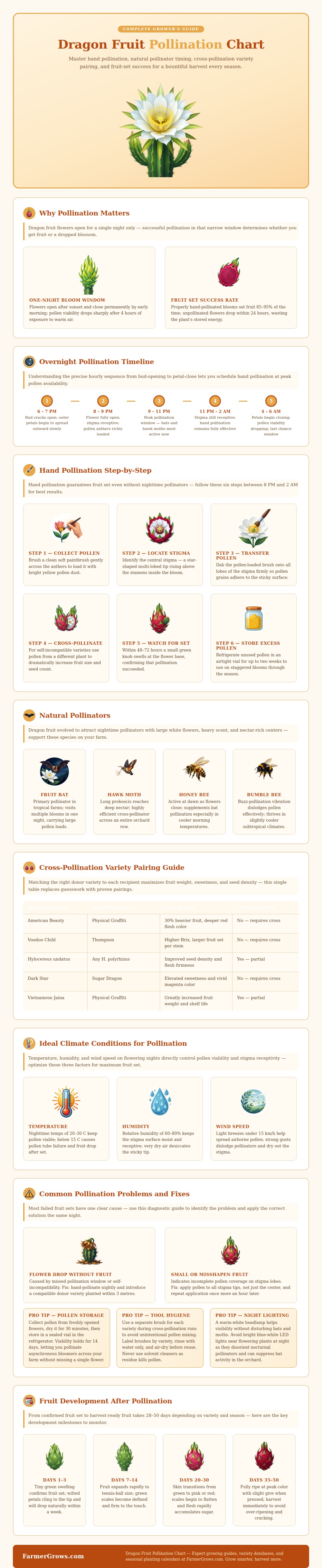
It also mean no more guesswork about what time to do your thing: Here’s exactly how it all unfolds over the course of an hour (the chart is above). Usually flowers will be cracking open from 6-7 in the evening. But don’t try to go to work just yet. Start gathering the pollen around eight-ish or nine-ish at night, when those stamens is nice and full of shining yellow pollen. Most people screw this one up. They either rush it too soon or wait longer. By midnight, the flower’s going to have lost some of its receptiveness; by dawn, the petals seal up for good. The timeline explains why you basically only have a couple hour to work with each night.
To get down to brass tacks, hand pollination may sound like a technical subject but it’s really pretty easy, once you understand how things work. All you need is either a cotton swab or a soft paint brush. Just lightly brush around the anthers to collect some pollen, and then rub it into the middle, on the stigma of another flower.
For maximum results, it helps to mix varieties: Many dragon fruits is self-incompatible, so using multiple varieties makes all the difference in deeper coloring of flesh, and bigger fruit size. Mixing Physical Graffiti with, say, American Beauty will do this, for instance. The graphic shows some of these combinations that will help produce the sweetest and largest fruit, removing the guesswork by using proven pairings.
The environment matters hugely. The night temperature is a challenge for the plant. Below 15C, pollen tubes does not form correctly, which makes it impossible to set fruit even if pollination was successful. Moderate humidity is also a requirement: the surface of the stigma must remain sufficiently damp to pick up the pollen grains. Sticky as they may be, dry weather dries them off before any transfer occurs.
Another factor is wind. While a gentle breeze helps natural distribution of airborne pollen, vigorous gusts blow off petals and knock about those nocturnal insects who might of been assisting you.
Oh, and by the way: Don’t discount the abilities of nature’s other pollinator army, insects! Hawk moths and fruit bats (the original pollination engineers) work in tropics. Each night they fly from flower to flower, packing as much pollen as possible between their legs and wings across vast distances. Where these species aren’t present in cool climates, bumble bees and even honey bees fills in for them. They work at first light, while flowers remain open but aren’t yet fully shut. Your extra support for native pollinators is a safeguard against your own missteps, particularly busy evening.
A common cause of small or otherwise deformed fruit is that you didn’t quite get the pollen everywhere on the stigma lobes. Just make sure you touch all the surfaces of the center tip (maybe do it again an hour later). If you miss even one or two spots, that is probably why it happened.
If you have extra pollen, which is possible if there were more flowers than you expected, store it in an airtight container in refrigerator to use on different bloom dates within a couple of weeks, when it will still be good. That’s a cool little hack: from a moment-by-moment happening, this becomes something you can manage once a week.
Fast-forward to that first successful transfer, and look in about two days’ time for the green swelling at the flower’s base: This is your confirmation that the plant took the pollen aboard and started sending energy toward developing fruit. It won’t be long (a month or so) before it gets really big; then it will turn bright pink as it fills with sugars.
All this seems less like gardening different than orchestrating some moddern intricate clockwork device. Once you get good at this, growing dragon fruit becomes less of a “passive” hobby where you sit back and wait for nature to take its course; and more of a partnership in which you guide it toward producing a big crop.
And when you see that first ripe, perfect fruit hanging heavy on the vine, ready to cut off and eat, you’ll know that all those late nights was worth it. It is literaly and figuratively sweet every time.