
Why are you growing A ROW OF sweet bell peppers alongside hot-as-hell habaneros? It seemed like a good idea: the flavor of one won’t affect the other once the seeds is in the ground, right? The plants look different right before your eyes, and the taste is different when you eat them right now.
But then you go and save the seeds for next year, and whoa, that’s another story. And that’s what most people miss about growing things.
How to Keep Your Peppers Pure
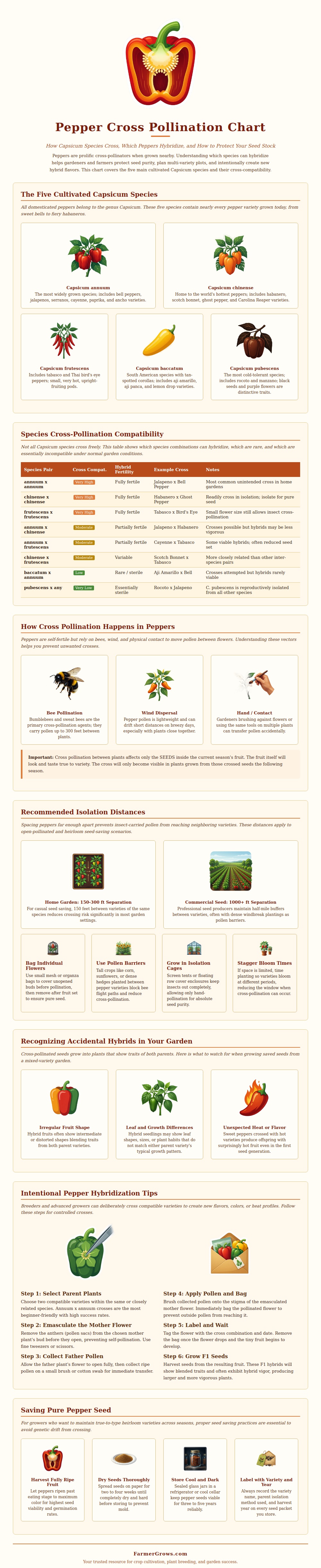
Peppers don’t cross-pollinate in the same way that squash or corn does. Each one’s a self-fertilizer, with both male and female part within each flower. But that doesn’t mean that bees respect your culinary borders. The main culprits here is insects: Sweat bees, bumblebees and others transport pollen from place to place with remarkable ease, across substantial distances.
When a bee buzzes into your jalapenos and out again to visit your bells, say, while both are in bloom, genes gets mixed inside the developing fruits. You’ll still bite right into the fruit on the plant this year and have no idea it isn’t what you think it is. That is because the hybrids are tucked away in the seeds, and won’t show up until next spring when they sprout their first true leaves.
To really understand what crosses and doesn’t, we have to explore the scientific family tree of these chiles. All our common edible peppers fall into group Capsicum. But there are five primary species, and the individuals within each species love to cross. So things that falls into the annuum species (like cayenne, serrano, jalapenos, and bells) will happily interbreed. In fact, if you plant a red jalapeno right next to a green bell pepper, by mid-summer their seed stock is probably well-mixed.
Then there’s chinense peppers, such as the Carolina reaper or the ghost pepper, they don’t tend to cross with annuum types except under duress (in other words: in a lab). Pubescens peppers (such as rocotos) are the real isolation champions. Their unique flower shapes and pollen structures makes them reproductively isolated from nearly everyone else. This means you can go ahead and plant a habanero next to a rocoto without fear of genetic contamination.
What’s the first line of defense? Distance: A buffer of one hundred fifty feet between two variety of the same kind is quite large in most situations. This will keep your seed fairly pure if that is important to you. Commercial growers are pushing for half-miles or more, because their livelihood depends on genetic consistency. Most backyard farmers don’t have half that many acres.
To achieve practical isolation doesn’t take acres of empty space. A couple of mesh bags and some patience would of done the trick. To prevent any insects getting at the flowers, bag each flower before it opens. If you want to control which pollen is used, then bag them and hand pollinate with a soft brush.
You could also stagger your planting dates. Plant a variety that blooms weeks ahead than another. That’s an easy temporal barrier that works remarkly well. The bee can’t cross-pollinate something that hasn’t opened yet.
If you’re saving any seed at all, be sure to label it well with the variety name (and the year). Keep it in a cool, dry spot where it will stay viable for a few years. Don’t freak out if some of your second generation has weird fruit shapes or other oddities; you just made yourself an accidental new family heirloom. That’s how many of today’s peppers began, chance garden crossovers instead of carefuly controlled lab ones.
There are no absolutes in gardening; only probabilities to manage, like how to cope with the bees. They’re going to be here. But you’ll have your plants safely covered (or separated) from their compatible species, and you will be happily harvesting as if nothing happened. Next spring, the seeds will spill the beans…on what was planned or unplanned.