
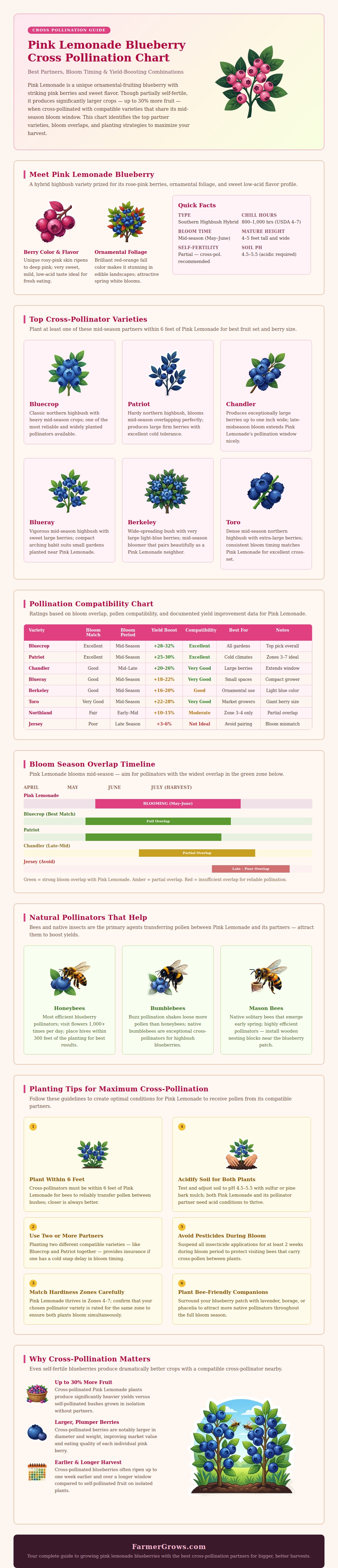
That’s why when shopping for blueberries, if you want fruit, you buy more than one variety. A single blueberry bush will work (at a discount), but it is only partially self-fertile, which means it will produce some fruit, but only if there is a pollen source nearby.
You’d have left all kinds of yield on the table. Without another variety nearby to provide pollen to pollinate the flowers, you would of missed the mark on potential by as much as thirty percent. Many people learns this lesson after seeing their friend who has several plants bear load upon load where they had just barely picked out enough to make a snack from their own lone plant.
How to Get More Blueberries
Which ones to use together? Look at the chart above for the varieties that can be used as companions. Why? Because Pink Lemonade is mid-season blooming (May and early June here). You want one whose flower opens about the same time, so the pollination can occur, but not one whose flower was open weeks before or after. That’s why Bluecrop’s so popular as a companion plant; its bloom period just about perfectly overlaps. It is reliable.
Another great one: Patriot, particularly if your climate is colder, so hardiness matter. These aren’t random suggestions; they are calculated matches based on when the flowers open and how much pollen each variety produces.
Planting two bushes of the same variety is no good, as it would be like planting two Pink Lemonades next to each other. That won’t help with cross-pollination. You want another variety near them. If you’re into big berries and don’t mind waiting a bit longer for them to appear, consider Chandler. It will extend the bee activity in your patch. The visual timeline in the guide makes all of this clear. And shows just how much green overlap there is between Pink Lemonade and its best matches versus those that falls out of step.
The other piece of the puzzle are the acidity of the soil. Blueberries need an acid soil (typically with a pH between 4).5 and 5.5. Neither the Pink Lemonade nor any potential pollinator partner would thrive if your soil is too alkaline. There is no such thing as genetic adaptation to solve that problem. First: test your soil before digging. To maintain good acid levels, add some elemental sulfur or a layer of pine bark mulch. This is a little bit of maintenance to avoid permanent failure.
The system works on bees. Even with carefully placed bushes that shares pollen well, it won’t happen without bees. Bumblebees are great for blueberries. They do a little dance called buzzing (buzz-pollination). This shakes out the pollen better than honeybees do. Early on, mason bees work wonders, too. Native insects like borage or lavender, planted nearby, will help bring in the bees. No need for chemicals, please while things are blooming. Make it a place pollinators would rather be.
Spacing: It’s simple. Keep them about six feet from partner to partner. Bees are smart but not infinite and if the bushes are too far apart, they might not travel between them frequently enough. They may not move back and forth between plants often enough to pollinate everything. Closer spacing is better, but leave some room for growth. Pink Lemonade remains fairly tight, about four or five feet high, so it works nicely among things with a similar growth habit, such as Blueray.
And it pays off: Not only do you get a bigger crop, but those berries are fatter, juicier, and they ripen earlier, too. More than quantity, it’s quality, too. How is that for a payoff? It’s not just about how much stuff you get, but getting the best out of the plant.
Late spring means the white flowers have bloomed and are covered in pollen, humming with life, and you know what? You’ve done something right. Soon there will be sweet pink berries, low and acid-sweet. They are ready to eat right from the tree or to transform into jam. Those busy bees made all those invisible connections between branches, and that large harvest is the reward.
Actualy, it’s the best part of the season. You should of seen how they look when ripe. The moddern varieties grows well if you use correct soil. It makes things much more comfortabley for the plant.