
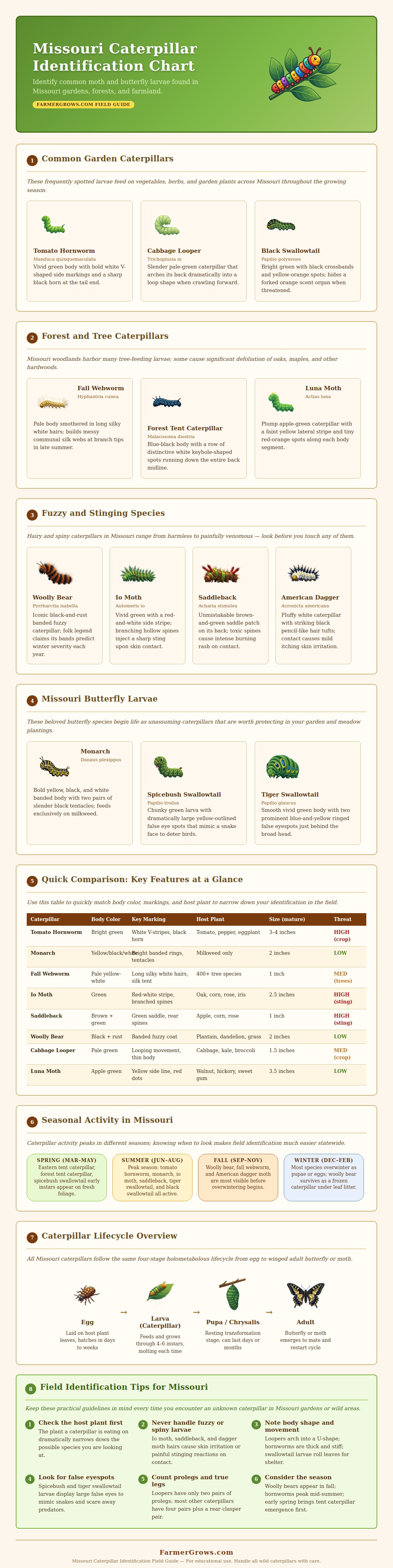
In your Missouri garden: You pull back a tomato leaf and there’s something that looks like a little green snake looking at you. There’s a black horn on its tail, and a set of white diagonal stripes across it. Yes, that’s a tomato hornworm, the baby form of the five-spotted hawk moth (or maybe the other one). Though it’s a hungry, destructive pest to those plants that fall into the nightshade family, they’re not harmful to people in any way, you’ll just get brushed by a bug if you touch one.
Learn who is friend or an enemy, and who is best left alone. And do it without having studied entomology. Always start with host plant. Chances are good that a caterpillar won’t stray too far from what hatches her there.
How to Identify Garden Caterpillars
Find a pale green loop of an insect on your cabbage? You’ve got cabbage loopers: watch them arch their backs to move in a distinctive U-shape, bringing their rear legs up to meet their heads. That’s an efficient way to get around and they leave real holes in brassicas leaves. Or perhaps you notice a fat green caterpillar with yellow spots and black bands on your fennel or dill. If threatened, she will curl her body into a leafy tent to imitate a bird dropping and protect herself from predators. She’s called a black swallowtail larva, and the visual contrast could not be greater. One is your garden nemesis; the other is your next butterfly. Knowing which one is which saves you from squishing any pollinators as you go hunting for pests.
It gets trickier in wooded areas and around ornamental plants. On my maple and oaks, fall webworm, which is also name, spins giant, unsightly silken tents on branch ends, and can girdle them by high summer. Look for hairy, caterpillar-like creatures huddling together; they are actualy fuzzy white spiders. A month or two earlier, forest tent caterpillars appear with special-looking keyhole shapes along their backsides (the chart points out those markings to tell the otherwise-similar pair apart). Don’t mix them up! Their webs look nothing alike, either. And their time frames differ more than months. Knowing when they occur help you know how to handle each one. Webbing on an oak tree in August means fall webworms; in March, it means forest tent caterpillars.
And then some that you don’t dare. Several stinging caterpillars exist here in Missouri, which will give you a painful case of dermatitis. One is the Io moth caterpillar (above), with its bright-green color and characteristic red-and-white stripe running down its side. Its tentacles. Those many branching spines (are hollow), and they’ll inject venom when touched. Another dangerous inhabitant: the saddleback caterpillar, distinguished by an obvious saddle-shaped patch of brown and green on its back. Bold coloring and spines signal “Don’t mess with me,” and you should listen to that message.
A few hairy, seemingly-harmless caterpillars is irritating to the touch when mishandled. Take, for instance, the American dagger moth larva. It resembles a puffy white pencil but has stinging hairs that irritate human skin. Be warned: respect the fluff, because it typically indicates something’s trying to defend itself against becoming dinner, and doesn’t want you as a would-be hunter, either.
The time of year is an enormous clue: Woolly bear? Nope, no woolly bear caterpillar sightings in early spring. Those striking red and black banded caterpillars are fall guys, who overwinter in fallen leaves. Come fall, they re-emerge for one last growth spurt and then go into pupation mode. They have bold bands of black, yellow, and white. That’s a monarch caterpillar. They only show up when milkweed shows up, generally peaking in late summer as they prepare to migrate. Know what month you’re dealing with. And that eliminates much of the guessing game on your to-be-identified list. No need to ID them all if you already know that hornworms don’t appear in November (or tent caterpillars in July). That understanding can put the harm in perspective.
It all starts with eggs, which quickly become small larvae. A caterpillar is technicaly a larva. These larvae then grow quickly, shedding their skin multiple times as they go. Then they pupate. And the adult stage exists only to reproduce. Moths and butterflies don’t feed on the host plant; their young do. That division of labor also explains why you might see a beautiful butterfly like a tiger swallowtail land on your windowsill. Meanwhile, the caterpillar version of that creature is mowing down the leaves of your sassafras tree nearby. Same animal, different page of the book.
What’s that? What are those things? Identification comes from pattern recognition rather than memorizing Latin names. Look at the season and look at the plant itself. Notice how it moves. Do not touch it unless it is not spiny. After a while you will begin to read the garden, see it as a landscape of patterns instead of a jumble of green dangers. That horned green larva up on your tomato plant now makes sense, and therefore you know what it is, and what to do next.