
You save those seeds from last season’s produce because you want to replant them, but then behold! Out come new plants that are not at all like old ones. The squash get strange or warty; the spaghetti squash strands dissapears. That’s the trouble with open-pollinated squash varieties (meaning they freely shares pollen among themselves, within the same species). What kinds cross? Why does it matter if you’re hoping for something predictable in your harvest each spring, or a random assortment of traits? That’s the nature of the genetic surprise (and it isn’t unimportant knowledge).
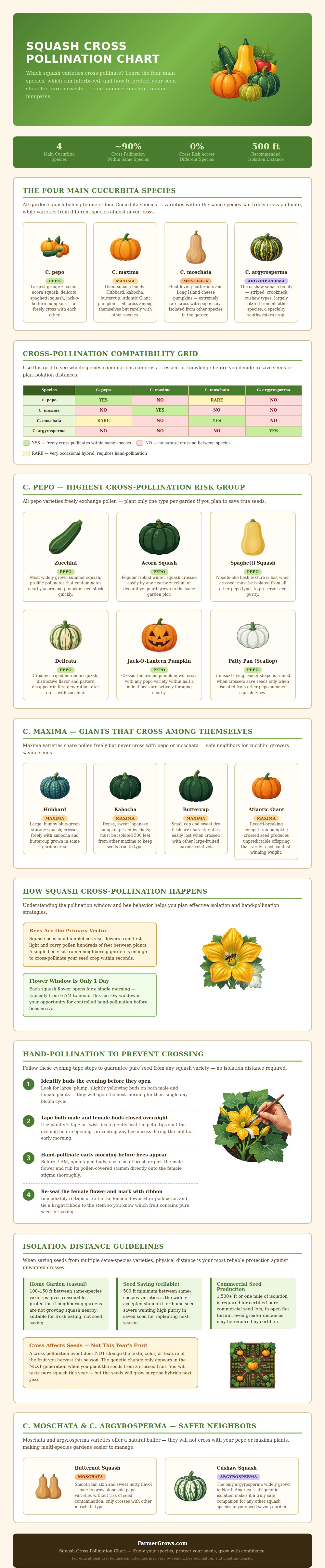
In the infographic, there are four general species of garden squash. Each will cross easy within its own varieties but stay true to its type across groups. Classic jack-o-lantern pumpkins, for example, are in the same group (the *Cucurbita pepo*) as zucchini, acorn squash, and delicata. This is the biggest and baddest of all groups, meaning it’s the most promiscuous. Plant your acorn squash bed next to a zucchini patch, and the bees will do the rest: They’ll ferry pollen back and forth. The seeds will be hybrids, potentially edible but not having desired traits you saved them for. That’s where most people mess up when they begin to save seed.
How to Save Squash Seeds Without Mixing Them Up
And so we move to the big guys, the *Cucurbita maxima* family. Think of Hubbards; think of Atlantic Giants or kabochas, these are all big producers (hence their name), and they cross readily among themselves (but not with the *pepo*s). In fact, that’s part of their allure, because if your garden isn’t large enough for them all, you can plant them alongside one another (not right next to one another, though, obviously); zucchini beside kabocha, say, won’t cross-pollinate even though both are cucurbits. And the chart makes that genetic barrier clear, too. It’s nature’s way of keeping things separate in your plot. Unless they are in the same species, no need to fear that the butternut will taint pumpkin genetics next door.
Most tend to be in their own company: C. Moschata is butternut, and it sticks close to home for most part. Even more so, *C. *C. Argyrosperma* (cushaw squash) stay genetically separate. So you’re free to mix things up a lot with some distance between each individual plant… No need for miles. It’s all risk within family units.
The first line of defense is physical distance. The classic advice is to have about five hundred feet of separation between two different varieties within one species. On a suburban plot, it’s hard to imagine having that much space to play with. Usually you don’t; most home gardens are too small to allow for such separation. If your garden is on the small side and you’re hellbent on saving clean seed, then you go manual, no other choice. When spreading can’t be done, hand pollination is the answer. It’s not hard, though it takes time, and it assures pure seed.
First: you have to identify your flower buds the night before they open. Next: Tape or twist-tie them shut (to keep out bees overnight). Early the next day, before dawn, the sun has barely risen and the pollinators is still asleep. Untape one male and one female. Rub their stamens around on her stigma, or use a tiny paintbrush (or even just my finger) to swipe the pollen onto the stigma. Re-tape the female, and tie a ribbon around her. That’s it, that’s the science part of this rather ceremonial-feeling ritual.
What is key: Cross-pollination won’t alter the fruit itself this year, so you’ll still be having zucchini-tasting zucchini tomorrow regardless of where the pollen came from. The change in genetics isn’t visible until seed time when those seeds within that fruit contain some of both parents. Save the seeds for use next year, and the hybrids shows their stuff. But if you’re just consuming the fruits of your labor, a mishmash of crosses throughout the garden won’t hurt anything.
Whether you want straight-line purity or simply something tasty to enjoy, knowledge is power. It makes sense out of the chaos and puts choice back in your hands so you know what’s going into the ground next season.