Iris Bulb Bloom Time Calculator
Estimate iris bloom timing for Dutch iris bulbs, bearded iris rhizomes, Siberian iris divisions, Japanese iris divisions, and established clumps using depth, chill, sun, division age, and establishment strength.
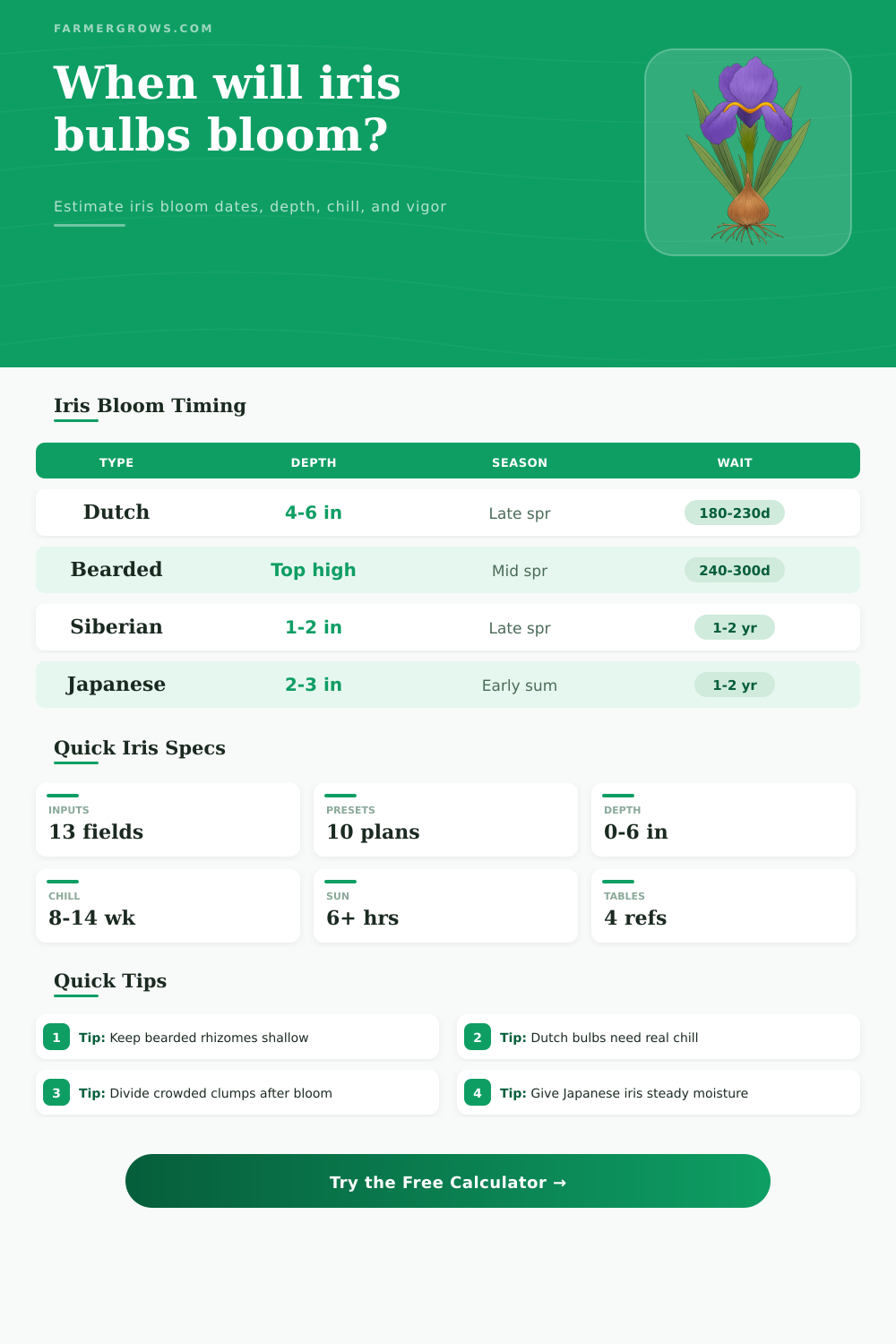
Irises do not all run on the same clock. Dutch iris behave like fall-planted bulbs, bearded iris bloom from exposed rhizomes, and Siberian or Japanese iris divisions often spend a season building roots before they flower heavily.
Iris Bloom Forecast
Adjust the inputs to estimate first bloom timing and establishment strength.
| Iris type | Planting organ | Best depth | Main bloom season | First-year expectation |
|---|---|---|---|---|
| Dutch iris | True bulb | 4 to 6 in deep | Late spring to early summer | Usually blooms after a chilled fall planting |
| Bearded iris | Rhizome | Rhizome top at or just above soil | Mid to late spring | May bloom next spring if planted by late summer |
| Reblooming bearded | Rhizome | Same shallow rhizome position | Spring, sometimes fall repeat | Fall rebloom is less likely in the first year |
| Siberian iris | Division | 1 to 2 in over crown | Late spring to early summer | Often light the first year, stronger year two |
| Japanese iris | Division | 2 to 3 in over crown | Early to midsummer | Often settles first, then flowers better |
| Dwarf reticulata iris | Small bulb | 3 to 4 in deep | Very early spring | Reliable after winter chill in drained soil |
| Louisiana iris | Division | 1 to 2 in over crown | Spring to early summer | Best in moist soil, mild climates |
| Condition | Dutch and reticulata bulbs | Bearded rhizomes | Siberian and Japanese divisions | Calculator effect |
|---|---|---|---|---|
| 8 to 14 weeks below 45°F | Supports normal bloom trigger | Usually enough winter rest | Good dormancy cycle | Little or no delay |
| Limited chill | Bud count and timing suffer | May bloom, but can be weak | Less severe than bulbs | Delays bloom and lowers strength |
| Cold, slow spring | Later stems, often sturdy | Later spring bloom | Later but steady | Adds calendar days |
| Mild early spring | Earlier flower stems if chilled | Earlier bloom season | Slightly earlier fans | Moves window earlier |
| Hot spring | Bloom period can shorten | Flowers may fade faster | Japanese iris may stress if dry | Earlier end and lower stem quality |
| Plant age | Bloom behavior | Division signal | Best action | Calculator factor |
|---|---|---|---|---|
| Newly planted | May bloom lightly or skip | Roots are still forming | Keep evenly moist without burying crowns | Lower bloom strength |
| One year established | More reliable first flush | Fans expanding | Feed lightly after bloom | Moderate strength |
| Two to four years | Prime flowering window | Clump is full but not congested | Maintain sun and weed control | Highest strength |
| Five-plus years crowded | Fewer flowers despite many leaves | Dead center or tight rhizomes | Divide after bloom or late summer | Reduced strength |
| Recently divided old clump | Reset year, then improves | Fresh cuts and fewer fans | Replant at correct depth quickly | Delayed but healthier later |
| Factor | Dutch iris bulbs | Bearded iris rhizomes | Siberian and Japanese divisions | Timing note |
|---|---|---|---|---|
| 6+ hours sun | Best stem strength | Best bud set | Best bloom count | Fastest reliable bloom |
| Under 5 hours sun | Weak stems possible | Bud set drops sharply | Fewer flowers, more leaves | Delay and strength penalty |
| Too deep | Delayed emergence | Common cause of no bloom | Crowns can sulk | Depth penalty in model |
| Too shallow | Bulbs dry or heave | Usually okay if roots anchored | Crowns dry out | Stress and establishment penalty |
| Wet heavy soil | Rot risk | Rhizome rot risk | Japanese tolerates moisture best | Type-specific adjustment |
Depth tip: Treat Dutch iris as bulbs but bearded iris as rhizomes. Burying a bearded rhizome like a bulb can grow leaves without giving you flowers.
Division tip: Siberian and Japanese iris often reward patience. A fresh division may bloom lightly in year one, then produce a stronger show after it has rebuilt roots and fans.
You plant A bulb in fall for springtime flowers; the garden remains green. No bloom materializes. Why? Something didn’t match up between what you expect from a bulb and what it actualy wants. This may have nothing to do with whether soil is okay or even if leaves appear healthy. Most commonly, it’s about how deep the bulb was planted, how long it’s had time to settle in, or about chill hours.
Not all irises is the same. They each has their own biology, including different root systems and a biological clock. There are also various types of iris, such as Dutch iris (true bulbs), bearded iris (rhizomatous plants), and Japanese and Siberian species (which propagate by division). The mistake we make? We treat them all alike.
Why Your Iris Bulbs Are Not Blooming
This is why I’m a fan. The tool does that math for you which eliminates guessing. It also accounts for factors like Dutch bulbs’ need for prechilling, which can prevents them from blooming at all in a mild winter. It factors in the fact that bearded rhizomes want to be planted just barely covered or else rot. And it takes into account how long it take a division to establish, because a division will probably spend its first year building roots rather than blooming. You enter your location’s sun hours and frost dates and the system plots out a reasonable bloom window.
Most people plant bearded irises at the wrong depth. The rhizome must be exposed to light and air. If it is buried too deeply, the plant may grow leaves but rarely produce flowers. They go into survival mode and think they’re in the ground. Bulbs such as Dutch ones want some soil on top of them to help insulate against temperature changes, but don’t want to be buried so deeply that they suffocate. Get it right, and youve changed everything.
Bulb types also requires chill hours. Your Dutch irises might not have recieve a cold enough winter (below forty-five degrees Fahrenheit) to signal that it’s time to bloom. They won’t bloom if you are in a warm climate. Use the calculator to check whether your winter is up to snuff; or should of spent chilling the bulbs yourself. It’ll save you months of wondering why nothing ever blooms.
Don’t expect a full show the first year following division of a Siberian or Japanese iris: That’s asking too much of the stressed-out creature, who will have to expend energy rebuilding her roots before she’s strong enough to bear flowers. A lesser show is expected for those first couple of years so be patient and give plant time to recuperate.
The last piece of the puzzle is sunlight. Full sun (meaning six or more hours of direct sun a day) suits all irises. Fewer hours lead to weaker stems and fewer buds per stem. This also increases the chance of disease because leaves stay wet for a longer period. And if it’s part-shade in your garden location; half-day shade… It won’t matter how well you time the soil preparation, or chill the seeds.
This process turns gardening from trial and error into a way to plan with knowledge. If I want more flowers, I know the conditions needed for them to appear. If my flowers didn’t grow, I know the conditions that led to there success or failure. Instead of being surprised when the flower didn’t arrive, you learn to expect the condition that caused it to arrive, or fail to do so. With time (depth), chill, and light aligned with right kind of iris, the bloom follows suit.
What’s most commonly misapplied is to force the timeline instead of accepting the plant’s rhythm. Give it what it wants, and the garden will pay you back.