Asparagus Crown Growth Time Calculator
Estimate spear emergence, trench backfilling, first-harvest restraint, fern establishment, crown count, bed spacing, and the year your asparagus bed should reach full harvest.
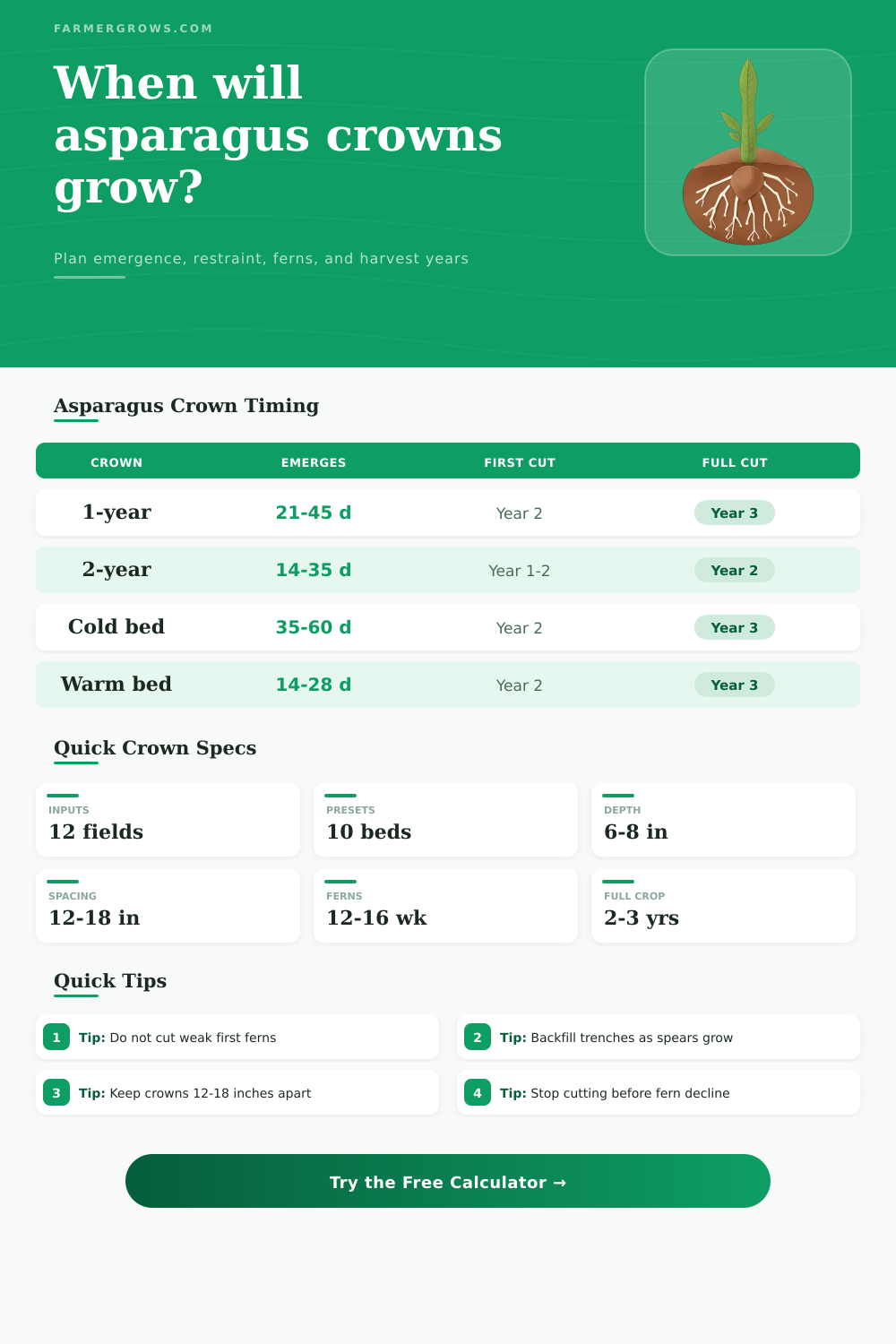
Asparagus crowns are perennial storage roots, not annual transplants. The calculator favors crown strength, fern growth, and harvest restraint so the bed can build reserves before regular spring cutting.
Asparagus Crown Timeline
Your crown schedule will appear here after calculation.
| Variety | Crown age | First harvest year | Full harvest year | Bed note |
|---|---|---|---|---|
| Jersey Knight | 1-year | Year 2, 7-14 days | Year 3 | Reliable male hybrid for many home beds. |
| Mary Washington | 1-year | Year 2, very light | Year 3 to 4 | Open-pollinated type; keep spacing generous. |
| Purple Passion | 2-year | Year 1 sample or Year 2 | Year 2 to 3 | Thicker spears; do not overcut young crowns. |
| Millennium | 1-year | Year 2 | Year 3 | Strong choice for colder regions and heavier soils. |
| UC 157 | 2-year | Year 1 sample in warm beds | Year 2 | Warm-climate standard where spring arrives early. |
| Final trench depth | Initial cover | Emergence effect | Backfill timing | Crown caution |
|---|---|---|---|---|
| 4 to 5 in | 1 to 2 in | Faster spears | Backfill lightly after shoots harden | Can leave crowns shallow in hot dry soil. |
| 6 to 8 in | 2 in | Standard | Fill trench over 4 to 6 weeks | Best balance for perennial bed stability. |
| 9 to 10 in | 2 to 3 in | Slower emergence | Backfill in smaller steps | Use only in loose soil with good drainage. |
| Heavy wet soil | 1 to 2 in | Delayed and risky | Keep crown shoulders from staying wet | Raised beds often beat deeper trenches. |
| In-row spacing | Crowns per 10 ft | Row spacing | Best use | Harvest effect |
|---|---|---|---|---|
| 12 in | 10 crowns | 48 to 60 in | Dense home beds | Earlier canopy, more competition later. |
| 15 in | 8 crowns | 48 to 60 in | Balanced home rows | Good spear size and crown room. |
| 18 in | 6 to 7 crowns | 60 in | Long-lived beds | Less crowding as crowns expand. |
| 24 in | 5 crowns | 60 in or more | Wide vigorous crowns | Lower first count, larger mature plants. |
| Bed year | 1-year crown rule | 2-year crown rule | Stop cutting when | Fern target |
|---|---|---|---|---|
| Planting year | No harvest | No harvest or tiny sample | Spears look thin or ferns are slow | Build tall fern canopy. |
| Second spring | 7 to 14 days | 2 to 4 weeks | Most spears are pencil-thin | Allow ferns to rebuild reserves. |
| Third spring | 4 to 6 weeks | 6 weeks if vigorous | Diameter drops sharply | Healthy summer fern mass. |
| Mature bed | 6 to 8 weeks | 6 to 8 weeks | New spears weaken or weather heats | Full-season fern after harvest. |
Protect the first ferns: Young asparagus crowns are charging a perennial root system. If spring spears are thin, skip cutting so every spear can fern out.
Backfill gradually: Set crowns on a ridge, cover lightly, then pull soil into the trench as spears grow. Deep instant burial can slow emergence.
Patience is one of things that trips up gardeners who attempt to grow asparagus. They approach it as if it were something quick like lettuce or carrots. They forget the plant must use energy to store reserves for the coming year. You might crave dinner today, but the plant does not. The crown should be planted with a longer view in mind; and that’s where this calculator comes in.
By calculating how soon your crowns will yield edible spears rather then mere thin shoots, the calculator takes guesswork out of whether or not to harvest. The number one question during the first few years in any bed.
Why Patience Is Key to Growing Asparagus
An asparagus patch’s crown is its foundation: It’s your storage root system, filled with energy. If you purchase one-year crowns, you recieve a small bundle that takes a whole season to set in ground before being harvested. A two-year-old crown has had a year to grow in nursery field, arriving with more substantial roots and bigger buds, which will give you some harvest early in the first or second year (not the third). Depending on what you’re planting, this additional time spent growing shifts prediction accordingly.
But what happens underground? When do the spears push through the soil? The speed of emergence depends on soil temperature. Asparagus spears is sensitive to weather. Like most plants, they want the soil to warm up before they begin grow. If your spring is cool and wet, emergence can take several weeks more longer than in a warm bed. The calculator use your planting date and your local climate patterns to provide an estimate of when to expect green tips to poke up out of ground.
Why care? Because when will you stop weeding around those vulnerable young shoots and when should you start looking for signs of pests on tender ferns?
Depth is another thing that confuse beginning gardeners. “Plant the crowns 6 to 8 inches deep,” most references say, but few mention why. Burying the roots help keep them cool in summer heat wave and protects crown from freeze-thaw cycles in winter. But going deeper than six to eight inches hinders emergence quite a bit; too shallow (where the crowns are above ground) expose them to wind and fluctuating temperatures, and dries them out. How much difference does it make? The page’s reference tables shows the effects of various trench depths on emergence rate and the long-term stability of crown.
The number of plants also depend on spacing: How far apart are they? Since the plants must grow thick spears and extensive root systems, leaving enough space for them to grow makes all the difference. You may have a nice-looking bed of plant right away if you crowd them. However, as the beds age, disease pressure will increase and spears will be less thicker. No one wins in this scenario. Use the calculator to determine exactly how many crowns fit into the row length you’ve selected based off the spacing you prefer. Fewer but adequately spaced-out crowns are preferable to crowded ones and wondering why your harvest hasn’t lived up to its full potential.
Harvest restraint is most important of all the calculator’s outputs, and it’s where you pay off (culinarily and financially) with patience. You don’t want to take away the plant’s energy reserves by cutting spears too early (or for too long). Why? Because those spears are meant to turn into ferns… Solar panels that produce sugars, which the plant store again in its roots as reserves for the coming year. So if you cut them down without giving the ferns time to photosynthesize fully, you deprive the crown of food. For one-year crowns, the calculator suggest severe restraint; for robust two-year plants, not quite so much. But the message is consistent either way: Save those ferns so you can have more spears.
Manage your asparagus expectations. While you might get a modest harvest in the first or second year if you use two-year crowns, it’s still more of a “manage expectations over time” crop than an “immediate yield” one. Plan carefully and give a good bed three to five years to achieve peak productivity, and then expect consistent harvests for decades after that. Understanding that timeline, visualizing it with the calculator, will help you resist the urge to over-harvest too soon.
The reason you are planting those crowns now isn’t because you crave a meal this week, but because you want many more like them to freeze each spring for next two decades, right? See? It’s the long view that turns a troubled patch into a staple of garden forever.