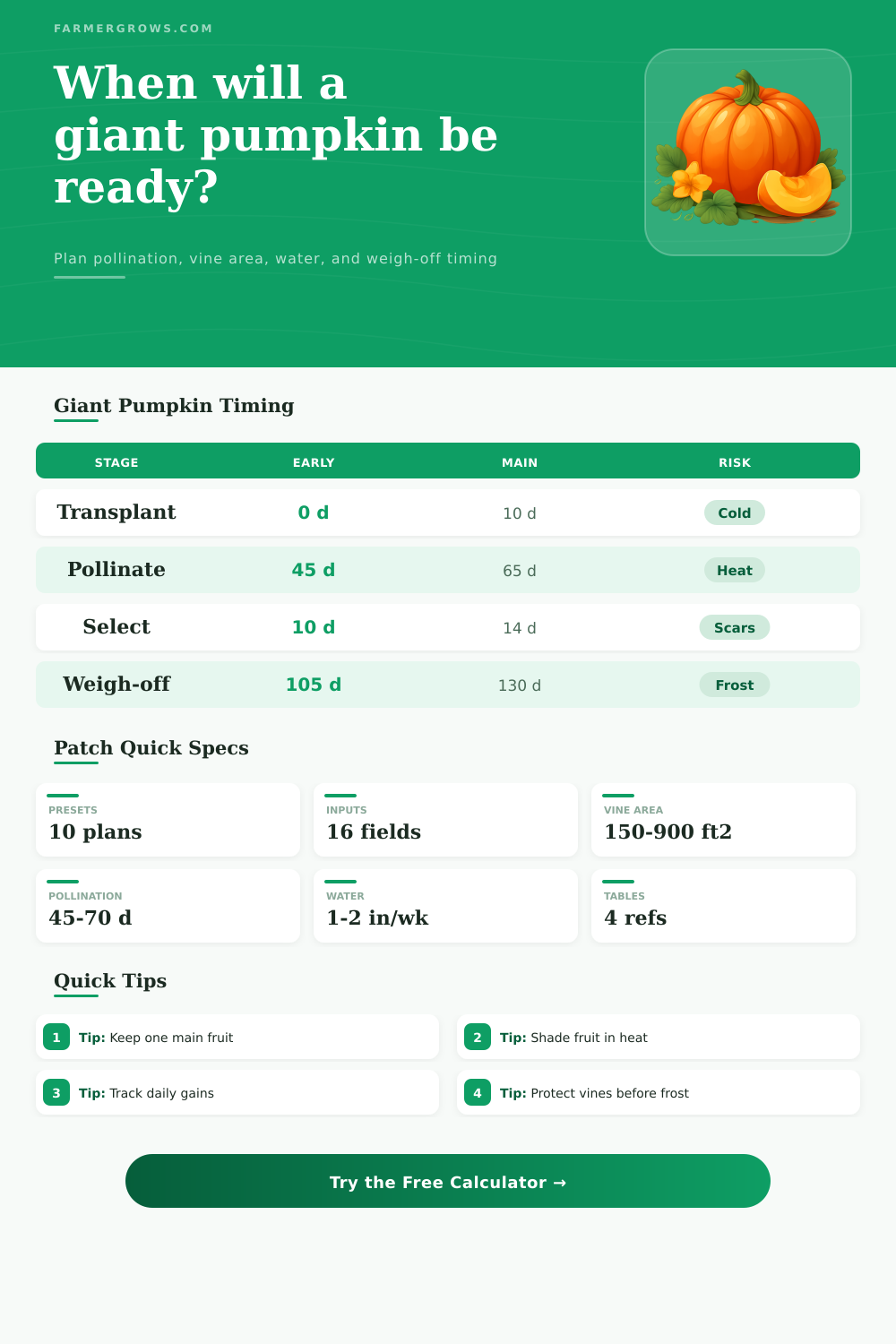
Giant Pumpkin Growth Time Calculator
Plan an Atlantic Giant style pumpkin from transplant to controlled pollination, fruit selection, vine fill, daily gain, frost margin, and weigh-off readiness.
Giant pumpkins are timed around one chosen fruit, a large trained vine system, steady irrigation, and a narrow period when female flowers can be pollinated early enough to mature before a weigh-off. This calculator estimates readiness using days after transplant, heat adjustment, fruit age, vine area, water demand, plant load, and frost risk.
Giant Pumpkin Growth Forecast
Your patch estimate will appear here after calculation.
Learning Patch
About 100 to 250 sq ft, one vine, one fruit, modest daily gains, and a realistic finish in the 100 to 400 lb range when timing is steady.
Serious Backyard Patch
About 350 to 650 sq ft, controlled pollination, buried nodes, stronger watering, and enough plant mass for a 500 to 1000 lb attempt.
Contest Patch
About 700 to 1000 sq ft or more, one selected fruit, mapped vines, protected crown, heavy soil work, and a long protected finish.
| Phase | Typical timing | Giant pumpkin target | Timing risk |
|---|---|---|---|
| Seedling establishment | 0 to 14 days after transplant | Warm root zone, no check in growth, first true leaves expanding | Cold soil below 60°F slows roots and delays later pollination |
| Main vine run | 15 to 40 days after transplant | Fast main vine extension with secondaries trained and buried | Dry wind or poor nitrogen limits leaf area before fruit fill |
| Female flower setup | 40 to 65 days after transplant | Target a female 10 to 16 ft from the crown on a strong vine | Very hot nights, weak vines, or poor pollinator timing can miss the best window |
| Controlled pollination | 45 to 70 days after transplant | Pollinate early morning, tag date, protect blossom, record cross | Temperatures above 90°F can reduce pollen quality and fruit set |
| Fruit selection | 7 to 14 days after pollination | Choose one fast, well-shaped fruit with a good stem angle | Keeping extras too long steals plant energy from the main fruit |
| Peak fruit fill | 20 to 55 days after pollination | Stable water, shaded fruit, healthy leaves, calcium and potassium support | Splits follow sudden water swings, blossom-end stress, or rapid pressure changes |
| Finish and weigh-off | 80 to 120 days after pollination | Maintain leaf health and frost protection until weigh-off or harvest | Early frost, vine decline, or stem cracks can end the season before target date |
| Class | Realistic weight | Patch area | Planning notes |
|---|---|---|---|
| First-year giant | 100 to 300 lb | 100 to 250 sq ft | One plant and one main fruit; focus on timing, water, and avoiding vine damage |
| Backyard Atlantic Giant | 200 to 500 lb | 200 to 450 sq ft | Works with compact training if the fruit is selected early and vines stay healthy |
| Fair or school show giant | 300 to 800 lb | 300 to 650 sq ft | Needs controlled pollination, fruit shade, and a reliable 100 day fruit age target |
| Competitive Atlantic Giant | 800 to 1500 lb | 600 to 900 sq ft | Requires wide training, buried nodes, strong soil, and very steady irrigation |
| Elite Atlantic Giant | 1500 lb plus | 800 to 1100 sq ft | Assumes top genetics, deep soil prep, intense monitoring, and season-long protection |
| Training style | Useful area per plant | Best fruit load | Where it fits |
|---|---|---|---|
| Compact backyard | 100 to 250 sq ft | 1 fruit | Small gardens, learning patches, school projects, and lower weight goals |
| Flag pattern | 250 to 500 sq ft | 1 fruit | Narrow plots where secondary vines mostly run to one side |
| Christmas-tree pattern | 400 to 800 sq ft | 1 fruit | Most serious backyard and show-pumpkin setups |
| Spider pattern | 450 to 750 sq ft | 1 fruit | Useful where the crown sits near the center of a large bed |
| Wide competition layout | 700 to 1100 sq ft | 1 fruit | Contest patches with long secondaries, node rooting, and mapped vine termination |
| Factor | Working range | Calculator effect | Grower note |
|---|---|---|---|
| Weekly water | 1.0 to 2.0 inches | Moves water score up when supply is close to 1.5 inches | Even moisture matters more than one heavy weekly soak |
| Soil temperature | 65 to 80°F | Warm soil shortens the pollination estimate and raises early vigor | Hoops, cables, or black mulch help early transplants |
| Day temperature | 75 to 88°F | Supports GDD accumulation and steady leaf production | Above 90°F, shade cloth and misting may protect leaves and pollen |
| Night temperature | 58 to 70°F | Cool nights slow the growth factor and late fruit fill | Cold late summer nights can reduce daily gains even before frost |
| Compost level | Moderate to very high | Raises weight potential when paired with watering and vine area | Over-rich, wet soil can still cause crown or root disease |
| Disease pressure | Low is ideal | High pressure reduces projected weight and increases finish risk | Leaf area after pollination is the engine that fills the pumpkin |
| Moment | Best practice | Why it matters | Calculator link |
|---|---|---|---|
| Evening before bloom | Tape or cover male and female blossoms expected to open | Prevents unplanned insect pollination and protects the cross | Improves controlled-pollination confidence |
| Pollination morning | Hand pollinate early, label the fruit, and shade the blossom | Fresh pollen is strongest before heat builds | Sets the fruit age clock for weigh-off readiness |
| Day 7 after set | Measure circumference and check stem angle | Fast starts often become the best keeper fruit | Feeds the projection through fruit load and vigor |
| Day 10 to 14 after set | Remove competing fruit if the chosen pumpkin is sound | One main fruit receives more leaf energy and water flow | Improves the vine area per fruit score |
| Day 20 to 45 after set | Watch daily gain, shade fruit, and avoid water swings | This is the highest pressure period for splits and growth stalls | Water, heat stress, and disease risk matter most here |
Pollination tip: If the target weigh-off is fixed, count backward about 100 days for the ideal pollination date, then ask whether the vine will be large enough by then. A late, tiny vine with an early fruit usually loses to a slightly later fruit on a healthier plant.
Weight tip: A giant pumpkin projection is not a promise; it is a stress-adjusted planning range. Use it to spot weak links such as too many fruit, short vine area, low water, or a frost date that arrives before the fruit has a proper finish.
Giant pumpkins: They can take up to six months to grow from seedling to squash, and you’ll do all this preparation and spend good money on fancy seed packets just to have your pumpkin sit in the sun and bake itself silly in August if you didn’t get around to fertilizing or pollinating three days earlier. Giant pumpkins is as much about timing as they are strength, and with the time calculator above, you can see their time schedule long before lifting a shovel to turn over first clod. The device will calculate when those big seeds will be ready to go into ground, when to hand-pollinate them. And ultimately, when to dig up what could be biggest gourd ever.
Feeding determines weight. Right? Most people believe they just need to feed more until those vines gets thick with gloss, then ask why their fruit isn’t increasing in size. There’s often a lag issue (physiology). How can a pumpkin rapidly expand without sufficient leaf surface area to fuel such expansion? Demand for horsepower require a huge engine. First create the engine (tons of leaf), then demand horsepower (fruit). Use the calculator to plan out this situation, and take into account your trained vine surface area.
How to Grow Giant Pumpkins
With only two hundred square feet of viable growing space, the model will tell you that you’d better have minimal fruit load and really watch your water consistency. Every root tip matter on a small patch. Adding all the compost you want won’t help if vines lack space to stretch their energy around.
And then there’s this: The season hinges on getting it right at the moment of pollination. When is that? It must be early enough to reach maturity before frost, but strong enough for vine to support weight of fruit production. That’s where the reference table on the page helps, it spells it all out, telling you what’s biologically ready when (measured in days after transplant). Transplanting may be in May in your cool climate, but you’ll have viable female flowers by late June. Too soon, and the vine will collapse from the energy demand of fruit development. Too late, and the fruit can’t fill itself out fast enough. It’s a fine line between calendar and biology.
Most plans go wrong because of water management. The calculator wants to know how much water you put into the thing each week, but it’s not so much the quantity as it is consistency. Wet-dry cycles makes giant pumpkins unhappy. If they dry off suddenly, their skin will get tough while the interior keeps expanding (thanks to residual moisture). This creates splits. Often fatal to crop. And if you’re growing on a saturated root zone and soak things again…whammo, rot sets in and kills the plant overnight.
It assumes you’ll follow its guidance for how much water is required (based off heat units/soil temperature), but guess what? You’ve gotta monitor this yourself. Aim for about an inch and a half a week, but keep it consistent to avoid wet-dry swings; sandy soil might need twice that amount in short bursts. In quick doses.
Everything else is relative; the hard deadline is frost risk. Even with 90 perfect days, your fruit may not have time to mature if frost comes early in your area (say, September fifteenth). That’s why the calculator adjusts its stress-adjusted timeline to let you know whether your target weigh-off date would of been realistic, based on when it expects first frost in your location. It factors in the fact that a slight drop in air temperature won’t shut down root activity thanks to warm soil. That margin of safety distinguishes the hobbyist from the competitive grower.
It’s all a matter of project management, as far as the top growers is concerned: the day that the vine runs; the day the fruit sets; and the days when gains accumulate at their most rapid pace. It’s a pattern you can spot without being a science expert, and once you grasp that there is nothing random about any of it, then you’ll find yourself thinking less in terms of crossing your fingers for good fortune different than in terms of managing variables.
Let one main fruit grow. Give it shade from the midday sun. Shield the crown from beetle attacks. Weight equals time times stability. Get the math of the season, and the rest doesn’t feel so much like a shot in the dark as a matter of making adjustments.
Yes, it’s a question of the size of the pumpkin. More importantly, it is about whether you stayed on top of things long enough to let nature take its course.