Savoy Cabbage Growth Time Calculator
Estimate savoy cabbage harvest timing from transplant or direct sow date, crinkled leaf health, head formation, cool-season weather, spacing, frost sweetness, and expected head weight.
This calculator is for round, blistered-leaf savoy cabbage. It is not a napa or Chinese cabbage estimator; napa forms elongated, softer heads and usually follows a different fall calendar.
🌱Savoy Cabbage Presets
🥬Savoy-Specific Timing Focus
Savoy heads need healthy puckered outer leaves before the center tightens. Leaf loss delays head fill more than it does for loose greens.
Light frost can sweeten savoy leaves, but repeated hard freezes can split or collapse mature heads.
Savoy cabbage forms round crinkled heads. Do not use napa timing or tight Chinese cabbage spacing for large savoy heads.
⚙Savoy Growth Inputs
Savoy Cabbage Growth Results
Estimate updates after calculation.
📌Variety, Season, and Head Grid
📚Savoy Variety Timing Table
| Savoy variety | Typical days from transplant | Best season | Head and leaf note |
|---|---|---|---|
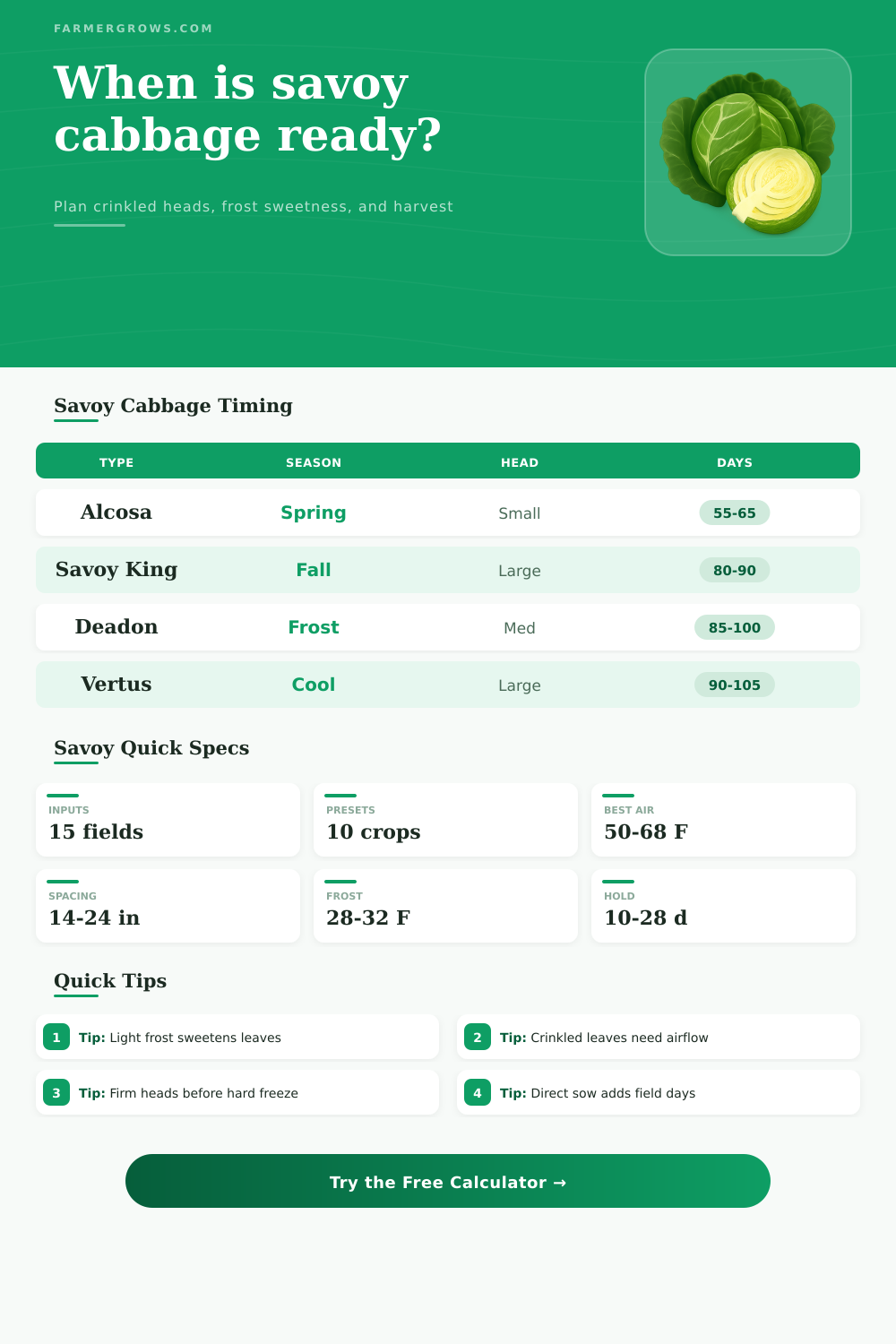
| Alcosa | 55-65 days | Spring, tunnel, quick fall | Small round heads with tender crinkled leaves and short holding time. |
| Melissa | 65-78 days | Spring or fall | Uniform medium heads with strong savoy texture and good field quality. |
| Savoy King | 80-90 days | Fall finish | Large deeply blistered leaves and heavy round heads when spacing is generous. |
| Deadon | 85-100 days | Fall frost finish | Red-tinged outer leaves, sweet flavor after light frost, and good field holding. |
| Vertus or drumhead savoy | 90-105 days | Late fall or mild winter | Large heads need cool weather, steady moisture, and room for wrapper leaves. |
🌡Cool-Season Timing Table
| Weather pattern | Timing effect | Head quality signal | Field action |
|---|---|---|---|
| 50-68°F days, cool nights | Normal to slightly fast | Firm crinkled heads with sweet mild flavor | Keep moisture even while heads tighten. |
| Warm days over 78°F | Add 5-14 days | Loose heads, stronger flavor, more pest pressure | Shade young plants and avoid spring heads finishing in heat. |
| Light frost after cupping | Little delay | Sweeter leaves and longer harvest window | Harvest mature heads before repeated hard freezes. |
| Short late-fall days | Add 4-12 days | Heads fill slowly but quality can be high | Transplant early enough for size before deep winter. |
| Wet, still canopy | Add 3-8 days | Disease risk in crinkled leaves | Use wider spacing and avoid overhead water near harvest. |
📏Spacing and Head Weight Table
| Head goal | Plant spacing | Row spacing | Expected head weight |
|---|---|---|---|
| Mini savoy heads | 12-14 inches | 16-20 inches | 1-2 lb heads, quicker but shorter holding. |
| Medium fresh heads | 16-18 inches | 24-30 inches | 2-4 lb heads with good crinkled wrapper leaves. |
| Large savoy heads | 20-22 inches | 30-36 inches | 4-6 lb heads when moisture stays steady. |
| Storage or winter heads | 22-24 inches | 32-36 inches | 5-8 lb heads, slower to size but better hold. |
| Too close for savoy | Under 14 inches | Under 20 inches | Small, loose, damp heads; napa spacing is too tight for large savoy. |
🔍Head Formation and Harvest Cue Table
| Stage | What to look for | Calendar signal | Harvest decision |
|---|---|---|---|
| Wrapper leaf build | Wide puckered leaves cover the soil | First 30-45 adjusted days | Protect from caterpillars and flea beetles. |
| Cupping begins | Center leaves fold inward | About 25-35 days before harvest | Maintain even water for head initiation. |
| Head fill | Round crinkled head gains weight | Final 18-28 days | Check firmness and remove damaged outer leaves only if needed. |
| Frost-sweet stage | Firm head after one or more light frosts | Near harvest in fall | Cut fresh heads or hold briefly with protection. |
| Late hold | Head is firm, outer leaves weathered | After peak maturity | Harvest before splitting, deep freeze, or disease enters crinkled leaves. |
💡Savoy Growing Tips
Use frost as a finish, not a rescue. Savoy cabbage can taste sweeter after light frost, but the head should already be firm before repeated freezes arrive.
Give crinkled leaves airflow. Savoy texture traps moisture more than smooth cabbage. Wider spacing and morning watering help keep heads clean near harvest.
Savoy cabbage follows a different schedule than other varieties. Expect it to take longer to mature, much like smooth green or red varieties do when compared to Savoy’s crinkly leaves, which hold in moisture and slow the formation of head. When you select your variety and your local frost date(s), the calculator factors this variable for you, removing guesswork about when the plants will size up enough to avoid being overtaken by winter. It simplifies plant biology and weather conditions into one obvious window for a crop to come to harvest, on your particular piece of ground.
The most important question to ask yourself is: Do I direct sow, or will I use transplants? That decision affects timing of everything because direct sowing takes more days than transplanting, so the tool adjusts the calendar to match. If you go with transplants, there’s a potential downside (weather fluctuations can cause shock to set them back), but an upside (they have a running start). The calculator wants to know how you’ll start things so it knows how many extra days to remove from the final tally. It matters if dinner is due Labor Day or if a market date is coming up.
How to Grow Savoy Cabbage Successfully
“Days are not what matters as much as temperature,” it says. Daytime temperatures in the 50- to 68-degree F range promote strongest heading (meaning slow steady heading without boltiness). Heat slows heading and will add days to heading. A chart on the page explains that even a week-long spell of warmer weather can push back harvest another week or so, just like a rainy period might; you count those days too. The real trick is to know your climate, not the seed packet’s ideal conditions.
For example: When planting Savoy cabbage (which must have a little space so its outer leaves can blister to catch light as they grow, protecting the inner cabbage head), beginners tend to space them like they do their looser-leaved lettuces, too close together. Moisture collects in those crinkles and the heads is small and vulnerable to disease. You enter both your plant spacing and row width into the tool, and it calculates what weight heads you can expect from that number, and how many there will be. It’s not just “more plants, more,” but “each head has some chance of getting firmed up before the weather goes bad.
The head must be forming; frost is a friend, but only if the head is already formed. When light freezes hit, it can convert starches to sugars, sweetening the leaves, so fall-harvested Savoy tend to taste sweeter than spring-harvested ones. But it won’t help an unfrozen head that hasn’t started tightening up. So the calculator takes your estimated first frost date (and how many light frosts you anticipate before picking) into account. It will tell you whether you’re cutting it too close. If the tool says frost will come three weeks before maturity, you know you should of get on it, and choose a faster variety than a slow one such as giant Vertus or Alcosa.
What’s also important about Savoy: Those puckered leaves are actualy the engine behind head development. Those puckered leaves is the driver behind head development; they are what provide surface area for photosynthesis and get the heads filling out. Chewing by flea beetles (or even caterpillars) on the outer wrapper leaves diminishes that surface area, slowing head fill. The calculator has a field to enter how healthy your leaves are, and adjust your expectations accordingly. Realistic is good.
What happens in the garden? Pests seldom leave well enough alone. There’s no such thing as growing a Savoy cabbage perfectly on schedule. But there is such a thing as making perfect sense out of it. You have some say over how fast you grow your crop (the spacing), and when you start it (the date). Weather’s another matter; you can’t control it. But the tool will take the guesswork out of those two choices by showing you where you are in your timeline.
Want to push for early baby heads, or big long-lasting cabbages for winter storage? Knowing when to do so is half the fight. Get the timing correct and you’ll get tight sweet heads, not loose bitter ones. They have beautiful crumpled leaves, but they are demanding. Do your homework up front, and let Mother Nature do hers.