Bunching Onion Growth Time Calculator
Plan Japanese bunching onions, Welsh onions, and scallion clumps from seed, plugs, divisions, or perennial stands with first harvest dates, regrowth intervals, and bunch yield.
This calculator is for true bunching onions grown for stems and dividing clumps. It is not a bulb onion sizing calculator, a simple onion seed germination checker, or a generic green onion kitchen-regrow timer.
Bunching Onion Growth Estimate
Results combine starting method, annual or perennial habit, spacing, bunch diameter, temperature, light, and regrowth style.
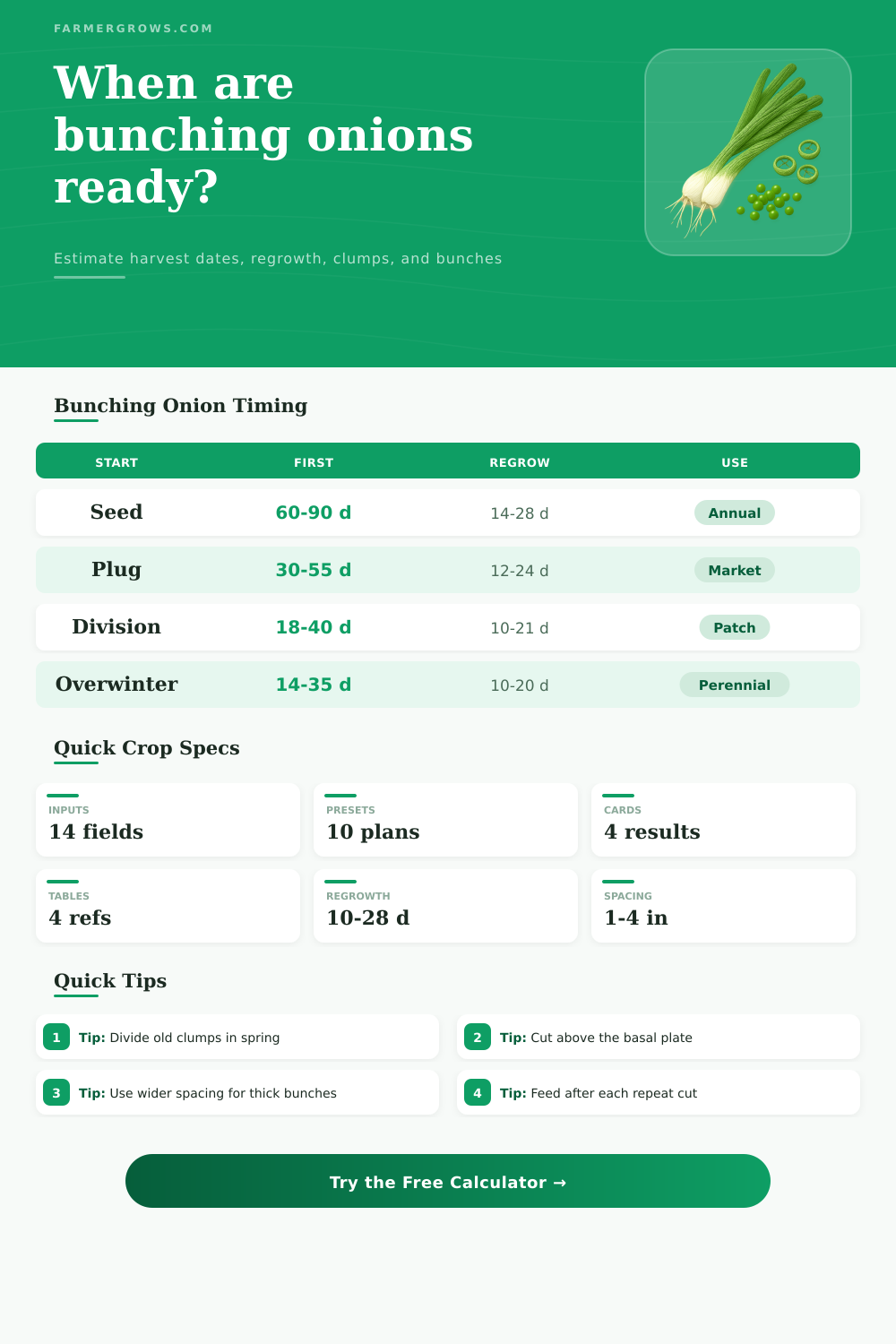
| Start method | Typical first harvest | Best use | Watch point |
|---|---|---|---|
| Direct seed | 65 to 90 days | Annual bunching rows and dense market beds | Slow emergence in cold soil; thin early for straight stems. |
| Plug transplant | 30 to 55 days after transplant | Predictable bed turns and uniform bunch diameter | Keep plugs moist for the first week to avoid stall. |
| Clump division | 18 to 40 days after replanting | Perennial bunching onion patches and quick renewal | Divide tired clumps before centers get woody or crowded. |
| Overwintered stand | 14 to 35 days after spring growth resumes | Early scallion flush from hardy perennial types | Remove winter-damaged leaves before bundling. |
| Base regrow | 10 to 24 days | Small home harvests from rooted bases | Yield drops after a few cuts without soil and feeding. |
| Cultivar or type | Habit | Timing tendency | Best harvest style |
|---|---|---|---|
| Evergreen Hardy White | Strong perennial bunching | Moderate first crop, fast regrowth | Cut-and-come-again or clump division. |
| Tokyo Long White | Annual long-shank bunching | Slower, straighter stems | Whole-pull bunches or one clean cut. |
| Ishikura | Thick white shank | Needs extra time for diameter | Wider-spaced bunches with blanching or hilling. |
| Parade | Uniform market bunching | Reliable mid-speed crop | Dense annual rows and market bunches. |
| Welsh onion | Persistent perennial clumps | Quick spring flush from established roots | Divide older clumps and cut greens repeatedly. |
| Red Beard | Colored bunching stem | Moderate, sensitive to crowding | Small bunches where color is part of the bundle. |
| Spacing | Likely stem style | Bunch diameter fit | Planning note |
|---|---|---|---|
| 1 inch / 2.5 cm | Very slender scallion stems | Small bunches, many stems | Best for annual direct-seeded rows. |
| 1.5 to 2 inches / 4 to 5 cm | Pencil to medium stems | Standard 1 to 1.5 inch bunches | Good balance of count and diameter. |
| 3 inches / 7.5 cm | Thicker shanks and small clumps | Fuller bunches with fewer stems | Useful for plugs and perennial divisions. |
| 4 inches / 10 cm | Dividing clumps | Large hand bunches | Leave space for perennial expansion. |
| 6 inches / 15 cm | Mother clump stock | Division material, not dense bunching | Use when saving clumps to split later. |
| Harvest cycle | Expected interval | Yield pattern | Crop care |
|---|---|---|---|
| Whole-pull annual | One main harvest | Highest clean bunch count at once | Resow or transplant the next block after harvest. |
| First cut | First maturity date | Largest and cleanest leaves | Cut above the basal plate and avoid tearing roots. |
| Second cut | 10 to 28 days later | Usually 75 to 95 percent of first cut | Feed lightly and keep moisture steady. |
| Third cut | Another 14 to 32 days | Often smaller unless clumps are strong | Retire weak annual rows or divide perennial clumps. |
| Division reset | 18 to 40 days after split | Fewer bunches at first, stronger future stand | Replant 3 to 6 shoots per clump for quick recovery. |
Perennial patch tip: When clumps crowd and the center weakens, lift them, trim tired roots, and replant small divisions with 3 to 6 healthy shoots.
Bunch sizing tip: A thicker target bunch diameter usually needs either more stems per bunch, wider plant spacing, or a longer interval after each cut.
Onions is the worst because growing a row of bunching onions are tricky since they won’t act like other vegetables. You sow some seeds; eventualy they grow. Then you wait some more, and chop them down and eat them. But instead, the foliage persists; dividing beneath the soil without asking, sending up more shoots as if to say: What? Not done yet?
This persistence can be there great reward, but it’s also why the art of onion growing involve more than simply timing your cut right. The vast majority of us just guess, leading to clumps that rot in the middle (or to wispy stalks so thin we might as well not have bothered). If you want a dependable crop, plan your work around life of an onion, not in reaction to it.
Simple Tips for Growing Bunching Onions
With all this in mind, plug it into the calculator up top and let it do the math for you, no guesswork required as to how quickly your set-up will recover. This isn’t simply calculating the number of days between sowing and harvest. You must also considers which crops are annuals, meaning they’ll be dead at year’s end, versus perennials, such as Evergreen Hardy Whites and Welsh onions, which divides over time.
Why does it matter? It changes how plant regrows. A single annual bunching crop offer just one strong harvest, often in two months or less if you direct-sow. Meanwhile, a well-managed perennial clump may yield indefinitely, year after year.
Everyone mess up spacing from the start. Too-tight spacing result in lots of stems per foot… But they’ll be skinny, not thick. Sounds good…except no. Thin stems lack the crisp texture and strong flavor that make growing bunching onions worthwhile in the first place. To produce really respectable thick stems (the kind of big white shank typical of Japanese varieties such as Tokyo Long White or Ishikura), each plant need room to develop fully. How wide? The page’s table of references explain how your row width determines the desired diameter, depending on whether you plan for many skinny scallion or fewer, fatter bundles.
Light and temperature also matter, not as loudly, yet just as much. Everything move slower in cool soil, so that first wait period stretches out weeks longer than in warmer soil. Don’t plan on getting any fast action with early-spring seeds started while the ground’s still cool. The tool takes that into account, lengthening its time estimate if your mean growing temperature drop.
Sunlight matters. It makes things leggy, slows the regrowth cycle, and thins out the flavor. Steady fertility and moisture are needed, particularly post-cut. Letting some stumps remain as stubble will protect the basal plate, the under-soil growth point that pushes up another round of leaves.
If your perennials is already planted in a patch, the best way to add more may be to divide rather than wait for self-sowing or shoots. The central part of old clumps will become woody and fail to produce any tender greens. By lifting and dividing them, you can reset the clock by repotting each as a group of roots that’s smaller again, and at least until they grow back up through the soil, this will improve the soil structure all around them. A little up-front work produces several new plants (and revives the ones that came out). Fresh divisions will re-sprout faster then an overworked old rootball would of.
How do you handle the bed? Think not in single events, but in cycles. Don’t just have one harvest and nothing until then; rotate your cut through various parts so that there’s always something growing. One section trimmed; one resting, providing a stream of food all season long. A little more up-front planning required, but worth it for consistency. You will no longer ask what is next and when, but you will know exactly when the next bundle are coming.
Basically, respecting the rhythm of how bunching onions grow will get you there. Don’t fight for the plants to thicken up by cramming them into a row; let them divide on your own schedule and feed the ones you do cut back regularly. Start with proper spacing, harvest carefully, keeping the base intact, and keep the area around the plants fed. That’s it, and pretty soon you’ll have a supply of freshly harvested greens long after most spring crops is spent.