Little Gem Lettuce Growth Time Calculator
Estimate Little Gem mini romaine harvest timing from seeding date, transplant age, tight mini-head spacing, temperature, hot days, and succession interval.
Little Gem is a compact mini romaine grown for small, tight baby heads, not long full-size romaine hearts, loose butterhead cups, or cut-and-come-again leaf lettuce. Use this tool for soil-grown mini heads, baby head bunches, dense bed blocks, and short succession plantings.
Little Gem Harvest Estimate
Adjust inputs to estimate harvest timing, spacing density, and bolting risk.
| Harvest target | Typical days from seed | Best use | What changes timing |
|---|---|---|---|
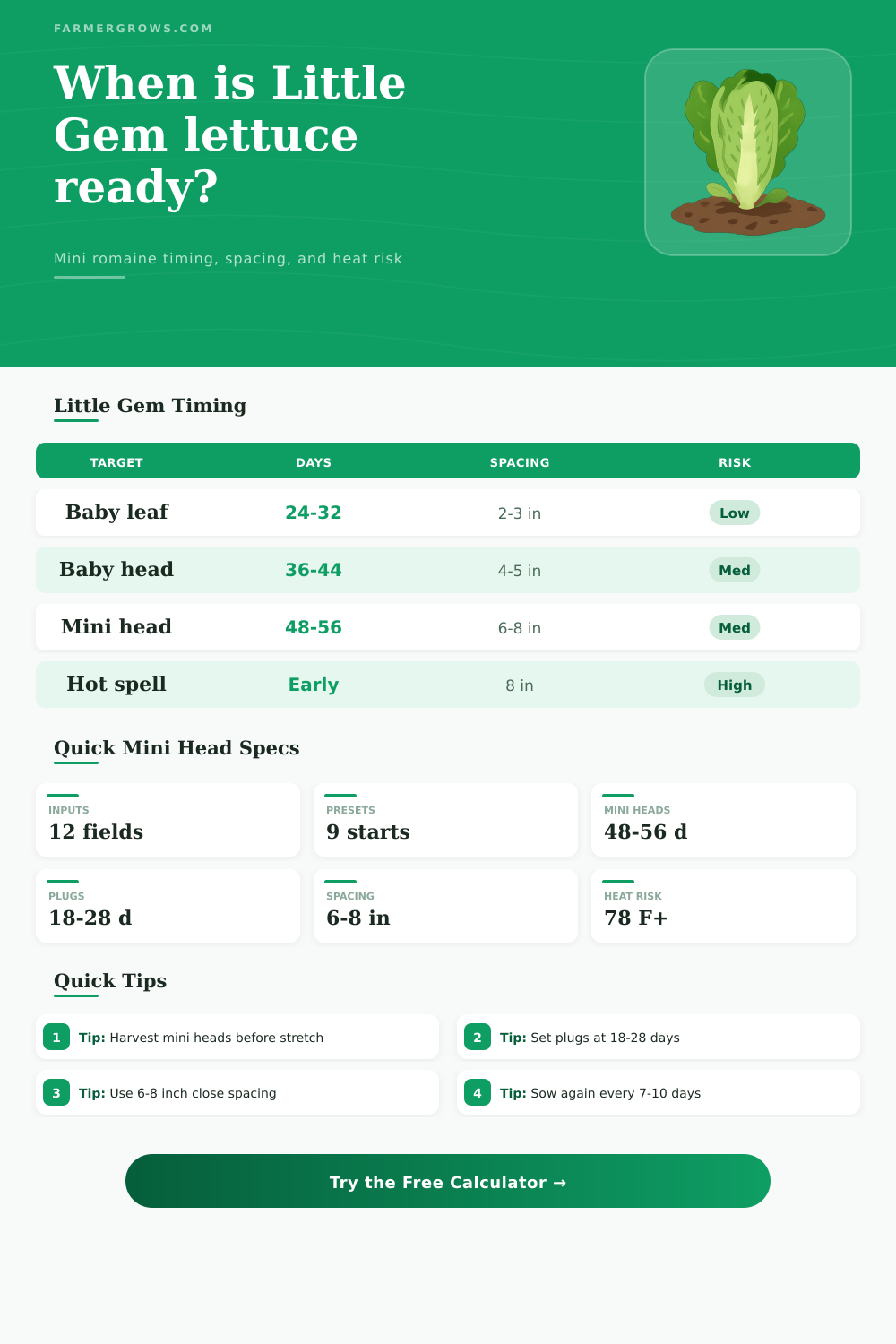
| Baby Little Gem leaves | 24 to 32 days | Loose young leaves before head fill | Fastest in mild, bright weather |
| Baby heads | 36 to 44 days | Small whole heads for tight beds | Close spacing is acceptable but not crowded |
| Finished mini heads | 48 to 56 days | Classic tight Little Gem mini romaine | Needs steady moisture through heart fill |
| Dense mini hearts | 54 to 62 days | Maximum firmness before stretch | Riskier if hot days arrive near maturity |
| Spacing plan | Approx heads per sq ft | Best target | Notes |
|---|---|---|---|
| 3 x 3 inches | 16.0 | Baby leaf only | Too tight for true mini heads |
| 4 x 5 inches | 7.2 | Baby heads | Fast small whole-head harvest |
| 6 x 8 inches | 3.0 | Little Gem mini heads | Common dense bed spacing |
| 8 x 10 inches | 1.8 | Dense mini hearts | More airflow and bigger cores |
| Growing condition | Timing effect | Bolting risk | Little Gem response |
|---|---|---|---|
| Cool spring, 55-68°F days | Normal to slightly quick | Low | Tight heads with good sweetness |
| Cold nights below 45°F | Adds several days | Low | Slow roots and slower heart fill |
| Warm shoulder season, 72-78°F | May shorten calendar days | Medium | Harvest at baby head or early mini stage |
| Hot spell above 78°F | Shorter quality window | High | Heads may stretch, turn bitter, or bolt |
| Goal | Interval | Block size cue | Why it works |
|---|---|---|---|
| Home salad heads | 10 to 14 days | 12 to 24 plants | Avoids too many mature heads at once |
| Market baby heads | 7 to 10 days | 48 to 144 plants | Keeps small head harvest steady |
| Warm-season escape | 5 to 7 days | Short blocks | Lets you cut before bolting pressure builds |
| Cool tunnel crop | 14 to 21 days | Dense bed sections | Slower growth needs wider harvest spacing |
Transplant tip: Count plug age separately from field days. A 21-day plug does not remove 21 full field days, but it usually moves harvest earlier than direct seeding.
Spacing tip: Use 6 to 8 inches for finished Little Gem mini heads. If heat is near, cut baby heads instead of waiting for a denser heart.
While this isn’t an “easy” crop (it shouldn’t be grown carelessly like a loose butterhead), Little Gem does respond well to good attention. You’ll get nice little round-headed versions if you don’t space them too far apart and tend to them carefuly. Miss the mark? Bitter bolting greens rather then those wanted sweet hearts are your reward.
By factoring in both heat pressure and age at time of transplant, the calculator will help you plot out when things will likely work out and what won’t. No more guesswork. Typically you’re going to either seed direct, or plug. With plugs you control for transplant shock because a young plug roots quickly and without stress. Eighteen- to twenty-two-day-old plugs will get established out in the field. But those getting close to thirty days may bolt before establishing on the ground. That’s what the tool takes into account when it calculates timing… That the age of the plug doesn’t just take time away from the calendar, but also resets its body clock in some way.
How to Grow Little Gem Lettuce
“Nobody spaces this crop correctly.” Because of its small size (a Little Gem head fits in your fist), you can get away with planting close together, unlike with a full romaine. For mini heads, six or eight inches apart is about right. For mini heads, six or eight inches apart is about right. If planted too tightly, the plants competes for light and produce a stringy heart; they also don’t dry off well after rain. Aim for fewer perfect heads… Rather than more stretched-out failures. The reference table show the impact of density on quality, so read it.
Little Gem lettuce grows based off the temperature. It prefers daytime highs below sixty-eight degrees Fahrenheit; when temperatures hit seventy-eight and stay there, it knows spring is ending. The plant bolts; and messes up the flavor and head shape. Check upcoming hot days in the prediction, because if a heat wave hits while the head is filling, the calculator will flag the risk and you’ll want to harvest earlier rather than later. Better to harvest small, firm heads early then wait for perfection and get bitterness instead.
With successions, there’s always another crop of lettuce coming along, without cluttering up the place. Little Gem reaches maturity in about forty-eight to fifty-six days, so it doesn’t take long to grow one head or even several. Sow every seven to ten days to make sure there is something for immediate use. Do this so you never have too much all at once but also never have nothing when you are ready for more. Small patches is also simpler to care for than whole rows of lettuce that will eventually bolt together.
Besides time of year, successful crops depend on good water management. Dry periods result in looser heads inside with tougher outer leaves; consistent moisture helps maintain tight, sweet hearts. Watering through drip irrigation (shown) delivers water directly to the roots. It also dries the leaves which reduces disease pressure. Watch for humidity issues if growing in a low tunnel or greenhouse. Wet leaves and stagnant air invite botrytis. This can destroy a crop overnight if conditions is right for it to spread.
Little Gem lettuce wants moderately fertile rather than heavy soil. With a shallow root system, it doesn’t require lots of nitrogen. A well-balanced routine will help it form a tight head with less leafiness; too much fertilizer encourage all leaves at the cost of head size. Expect to harvest less often and see slower growth in poor beds. This is already included in the calculator’s standard conditions.
To keep your greens fresh when harvesting, you need to be careful: Cut off just above the ground, leaving some foliage (which might help re-sprout another head). The second crop are usually smaller. To get your Little Gem lettuce into tip-top shape for picking, go early in the morning (when they are still cool and firm from the night’s moisture). Wash them gently in cold water to remove soil without bruising the delicate leaves. Proper storage in high-humidity conditions extend shelf life significantly.
With Little Gem, it’s about knowing how much headspace they need, when they’ll be ready, and what temperatures is ideal. To calculate that, there is a tool (the calculator); to monitor it, you must pay attention (your eyes, not theirs). How do you know? What does stressed look like? When should you thin? What to do with early heat? Master these steps, and you will have sweet, crisp heads ready to eat from start to finish.