Sugar Beet Growth Time Calculator
Estimate field sugar beet growth from planting date, beet GDD, row spacing, final stand, canopy health, root tonnage, sugar accumulation, frost timing, and harvest readiness.
This is for field sugar beets grown for sucrose and root tonnage, not garden beet roots. It uses a cool-season GDD model, final stand math, canopy and frost adjustments, and harvest-window logic.
Sugar Beet Growth Estimate
Enter field conditions to estimate beet GDD stage, harvest window, final stand, root tonnage, and sugar accumulation.
Good factory-delivery profile when root tons and sucrose both matter.
Often rewards a later window if canopy remains clean and frost risk stays low.
Useful where wet soils, tare, or delivery slots push harvest earlier.
Steady moisture and low compaction support root expansion and uniform lifting.
Water stress lowers canopy duration and can shorten late-season sugar gain.
Frost-injured roots lose storability and should not sit in a long pile.
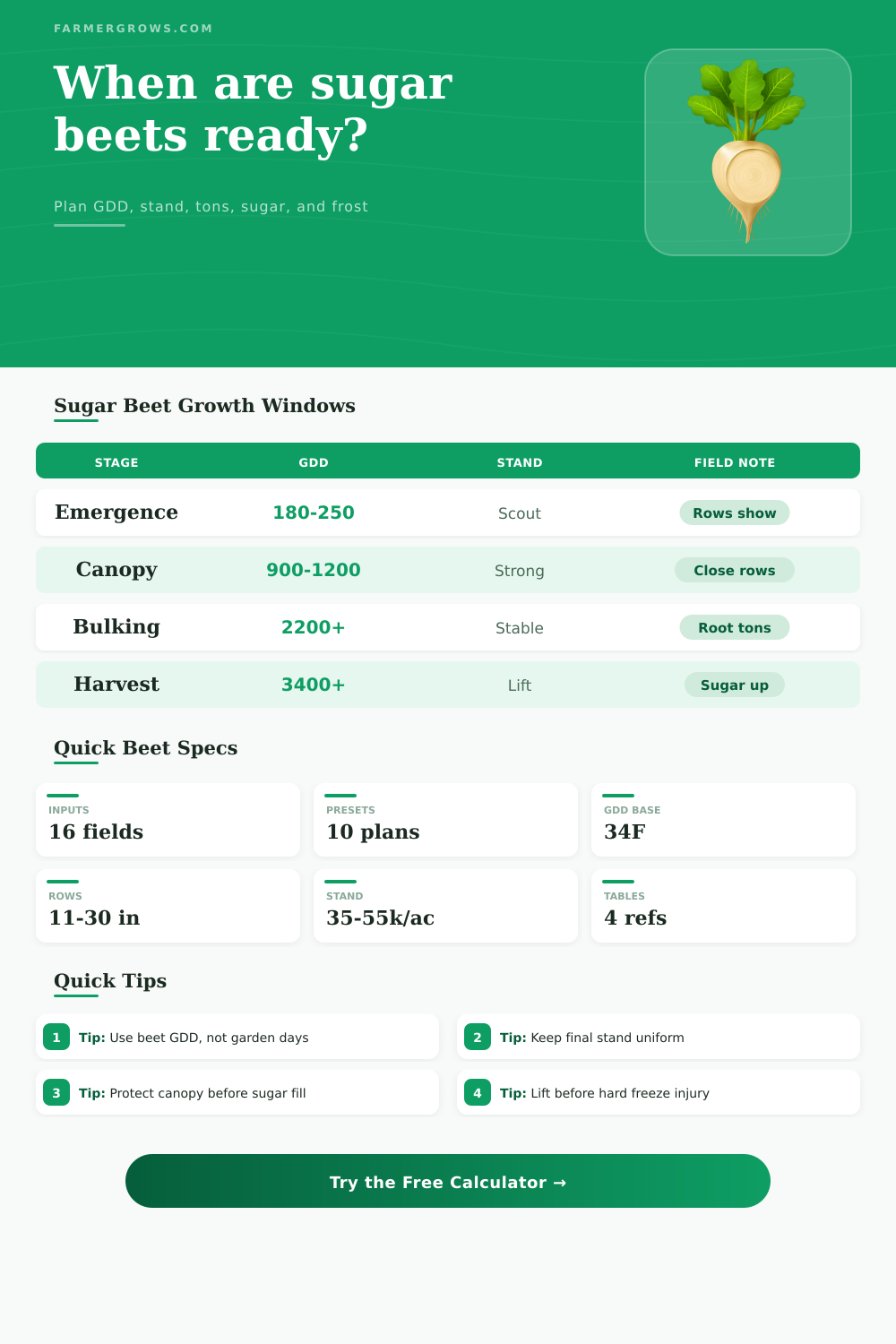
| Growth stage | Approximate beet GDD | What to scout | Field decision |
|---|---|---|---|
| Emergence and row visibility | 180 to 250 GDD | Skips, crusting, seedling disease, early weeds | Confirm stand before replant or herbicide timing. |
| Rapid leaf growth | 500 to 900 GDD | Leaf count, flea beetle or wind injury, early vigor | Protect stand uniformity and avoid unnecessary stress. |
| Canopy closure | 900 to 1,200 GDD | Row closure, weeds, leaf spot start, irrigation status | Full canopy drives root bulk and later sucrose. |
| Root bulking | 1,800 to 2,800 GDD | Canopy color, water stress, compaction, disease | Keep leaf area healthy while roots add tonnage. |
| Sugar accumulation and harvest | 3,200 to 3,800+ GDD | Sucrose trend, tare, frost, pile suitability | Balance tons, sugar percent, delivery, and freeze risk. |
| Row spacing | In-row spacing | Typical final stand | Use note |
|---|---|---|---|
| 30 in single rows | 4.5 to 6 in | 35,000 to 46,000 plants/ac | Older wide-row systems, easier cultivation, lower plant count. |
| 22 in rows | 4.5 to 5.5 in | 43,000 to 55,000 plants/ac | Common sugar beet target range in many northern areas. |
| 18 in rows | 5 to 7 in | 50,000 to 70,000 plants/ac | Higher canopy speed but watch root size and harvest losses. |
| 11 to 12 in narrow rows | 8 to 14 in | 45,000 to 70,000 plants/ac | Can close canopy fast; population and root size need testing. |
| Variety or soil profile | GDD effect | Sugar effect | Harvest guidance |
|---|---|---|---|
| High sugar variety | Needs a little longer | Higher sucrose ceiling | Best with clean canopy and low freeze pressure. |
| Early tonnage variety | Ready sooner | Moderate sucrose | Useful for early factory openings or wet fields. |
| Disease tolerant canopy | Protects late GDD value | Maintains sugar fill | Keep leaf spot from shortening the factory window. |
| Wet or compacted soil | Slower root fill | More tare risk | Watch harvest traffic and lifting losses. |
| High residual nitrogen | More leaf growth | Can dilute sucrose | Delay only if sugar trend and frost risk justify it. |
| Harvest condition | Canopy or frost cue | Expected effect | Action |
|---|---|---|---|
| Clean green canopy | 80%+ healthy leaf area | Continued sugar gain and root fill | Allow crop to use safe fall GDD if delivery allows. |
| Leaf spot or hail loss | Below 60% healthy canopy | Lower late sugar accumulation | Move field earlier in harvest priority. |
| Light frost | Brief leaf burn, roots firm | Usually manageable for prompt harvest | Recheck crowns and pile suitability. |
| Hard freeze risk | Root freezing or thaw injury possible | Storage quality drops quickly | Lift or deliver before long exposure. |
Stand count: Convert your row spacing and in-row spacing to plants per acre, then compare with real emerged stand. Uniform spacing often beats a high but uneven count.
Harvest window: Sugar percent can rise late, but only while the canopy is feeding the root and freeze injury is still unlikely. Move weak-canopy or frost-risk fields up the list.
Growers: When did you plant your sugar beets? If most do, that’s just a date written on a piece of paper sitting in the truck cab gathering dust. Does the plant care what calendar date it is? Nope. It only responds to light quality and heat accumulation. Guessing when a crop will be ready for harvest based off days after planting means you’re just guessing. You need to measure Growing Degree Days.
You don’t need to do math yourself. This calculator above do it for you by using your own stand count and local temperature average. You won’t have to guess how to convert numbers or use coefficients.
Why Growing Degree Days Are Better Than Calendar Dates
It begins with emergence. Beets push through the ground at about two hundred GDD. This is fairly constant whether you sowed in late May or early April. That’s why scouts need to be in field then, not fretting over tonnage but keeping an eye out for crusting and other skips. Seedlings have no chance in the wind if they aren’t protected in growing row, and otherwise can’t compete with their weed companions. Close those gaps now before any loss in yield shows up as uneven root sizes months from now.
The canopy becomes the main driver of growth through the season. To that end we shoot for closed rows by the time the plant reach nine hundred to twelve hundred GDD. Soil conditions affects both stand density and variety selection at this point in the game. Often a uniform stand at forty-five thousand plants per acre will out produce a patchy stand at fifty-five thousand. Remember, it’s not just about raw density but uniformity. Every square inch of leaf area must contribute to root expansion without competing for nutrients or water.
Eighteen-hundred to two-thousand eight-hundred GDD is where the bulking happens, and that’s where all the leverage occur. That’s when those roots are adding physical weight to field. How many tons of it do you get? That depends on inputs such as soil profile and moisture level. Sustained expansion happen in deep loam soils under steady moisture. Compaction stress or dryland conditions will cap it off sooner then anticipated. With the tool, you can adjust to match what is actualy happening out there instead of using an ideal lab condition for your yield estimate.
By late season, all the management changes to frost risk and sugar accumulation. When nights get a little cooler and canopy stays healthy, the root begins accumulating sucrose. The higher the percentage of clean green canopy (eighty percent or better), the greater the capacity for the crop to pump that sugar into storage organ. Leaf disease, especially leaf spot, can rob this engine prior to harvest. Once leaves are gone prematurely so is the sugar potential. So protecting the leaves in both August and September is just as important than weed control in June.
It’s a bit of a dance around when to pick: When do you get maximum tons vs. When do you maintain good sugar? If you wait too long, then root frost damages the crop, reducing how long it can be stored (and the recoverable sucrose). Lift it too soon and there’s cash in the ground from not-yet-accumulated weight. The tool will help you determine a harvest window based off your frost cutoff date and how many more GDD’s you think you’ll get. It will then help you time your field by priority, getting the ones at greater risk for frost or with weakest canopies into first lift.
The trick of growing beets successfully, indeed, of growing any crops successfully, is not reaching fixed targets. Instead, it is moving well through each stage: from standing to a closed canopy, then building bulk, and finally filling with sugar until frost arrive. Each step presents both opportunity and vulnerability. If you use GDD as your time-keeping device, the biological clock instead of the calendar days; you have a tool that mirrors the plant’s true requirements. Your choices become more acute and adaptive when you stop looking at the date on the wall, and start looking at the heat units.
Harvest isn’t an event; it’s a process. You should of guide this process.