Seed Potato Growth Time Calculator
Plan certified seed potato timing from chitting and cut-piece curing through emergence, hilling, new potato lifting, storage harvest, and post-dig curing.
This calculator estimates calendar windows for healthy certified seed lots. It assumes normal moisture, workable soil, and disease-free seed; local frost, heat, irrigation, and cultivar behavior can still move real dates.
Seed Potato Timing Results
Dates are based on adjusted maturity days, soil temperature response, seed piece condition, chitting credit, curing time, and the selected harvest goal.
| Certified seed piece type | Typical piece size | Pre-plant handling | Timing effect | Field note |
|---|---|---|---|---|
| Whole B-size seed | 1 to 2 oz | No cutting; plant when soil is workable | Often even emergence | Useful where rot pressure is high or labor is limited |
| Cut certified seed | 1.5 to 2.5 oz | Cure 2 to 4 days in a ventilated space | Standard timing when healed | Each piece should have at least one strong eye |
| Small cut piece | Under 1.5 oz | Use only from vigorous seed lots | Can emerge slower | Lower reserve energy increases stand risk |
| Large cut piece | 3 oz or more | Allow clean cuts and enough cure time | May make more stems | Can support larger plants but uses more seed weight |
| Pre-sprouted seed | Any sound piece | Chit 2 to 5 weeks in light, cool conditions | Can shorten emergence | Handle gently so sprouts stay short and firm |
| Soil temperature at seed depth | Expected emergence | Timing adjustment | Main risk | Planting action |
|---|---|---|---|---|
| Below 45°F / 7°C | Very slow or stalled | Add 12+ days | Rot before sprouting | Wait unless using protected beds |
| 45 to 49°F / 7 to 9°C | About 22 to 30 days | Add 7 days | Uneven stands | Use cured, vigorous seed only |
| 50 to 54°F / 10 to 12°C | About 16 to 24 days | Add 3 days | Slow early growth | Good early planting range |
| 55 to 65°F / 13 to 18°C | About 12 to 18 days | No penalty | Manage moisture | Best general emergence range |
| 66 to 70°F / 19 to 21°C | About 10 to 16 days | Subtract 1 day | Fast top growth | Watch hilling interval |
| Above 75°F / 24°C | Variable | Add 4 days | Heat stress and poor tuber set | Plant cooler soil or mulch ridges |
| Maturity class | New potato window | Full crop window | Storage fit | Timing note |
|---|---|---|---|---|
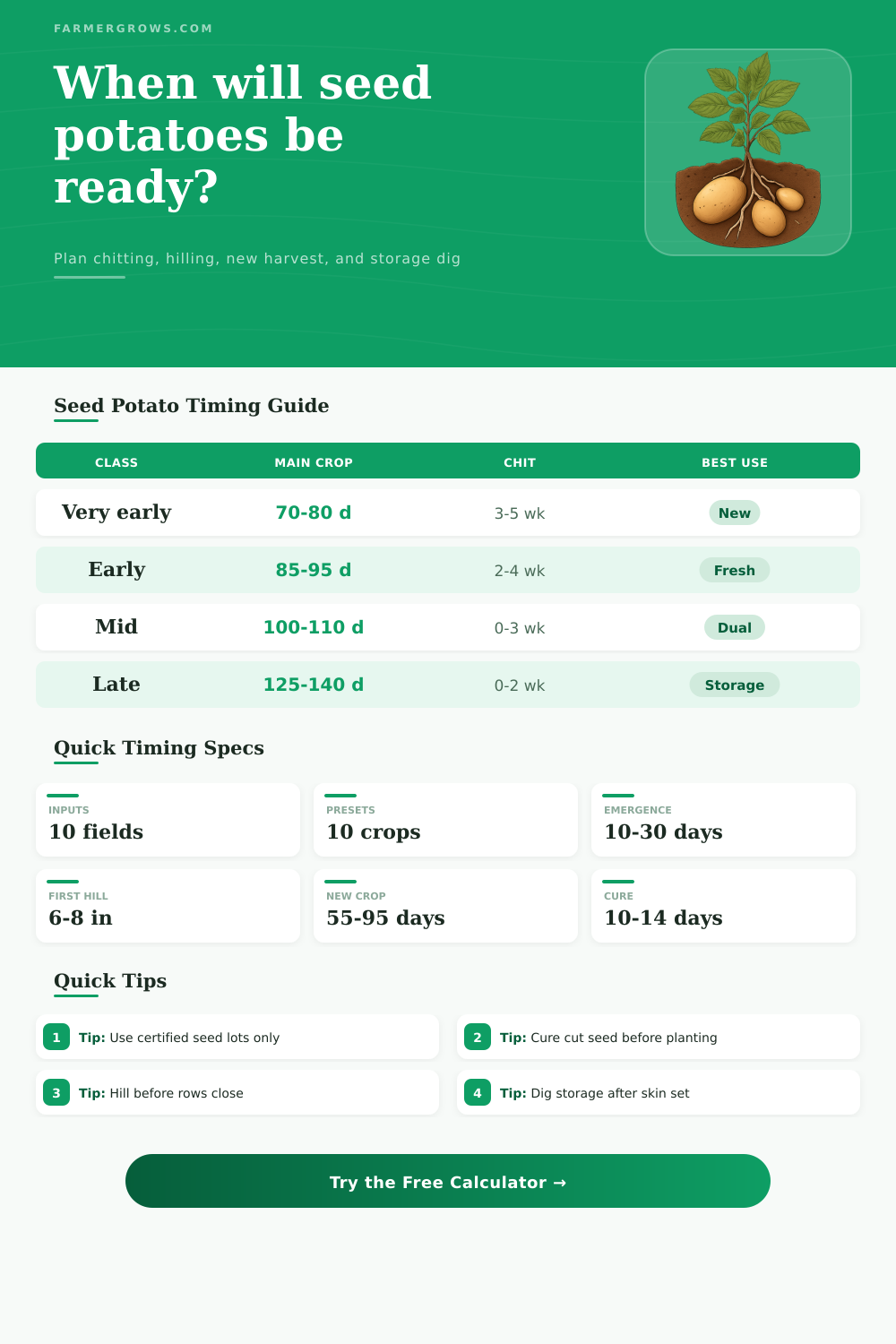
| Very early | 50 to 60 days | 70 to 80 days | Short holding | Best for first fresh lifting, not long cellar storage |
| Early | 58 to 70 days | 85 to 95 days | Limited storage | Good balance for fresh stands and quick turnover |
| Midseason | 70 to 82 days | 100 to 110 days | Moderate storage | Often works for both fresh sales and short storage |
| Maincrop | 80 to 92 days | 115 to 125 days | Good storage | Wait for vines and skins before cellar harvest |
| Late | 90 to 100 days | 125 to 140 days | Best storage | Needs a long enough frost-free season |
| Crop stage | When to schedule | What to check | Calculator use | Field caution |
|---|---|---|---|---|
| Cut seed curing | 2 to 4 days before planting | Dry, corky cut surfaces | Back-dates the seed cutting task | Do not seal wet pieces in bags |
| First hilling | Shoots about 6 to 8 in tall | Stems still flexible | Emergence date plus growth interval | Avoid burying weak, yellow plants too deeply |
| Second hilling | About 14 to 21 days later | Ridged soil covers forming tubers | First hill plus selected interval | Finish before rows close if possible |
| New potato harvest | After flowering or early tuber sizing | Thin skins and small tender tubers | Maturity class minus storage wait | Lift only what can be used quickly |
| Storage harvest | After vine death and skin set | Skins resist thumb pressure | Full maturity plus vine-kill wait | Cure before long-term cool storage |
Seed handling: Cut certified seed with clean tools, cure pieces in a ventilated spot, and plant into warming soil. Wet, cold seed beds can erase the advantage of chitting.
Harvest choice: New potatoes are lifted while skins are tender. Storage potatoes need mature vines, firm skins, gentle digging, and a 10 to 14 day cure before cellar temperatures.
One kind of potato failure is planting them prematurely. The calendar says it’s time. The air warm and the ground thaws. You’re all excited and tuck your certified seed in the ground. A couple of weeks later, what? There are no green shoots, just brown mush that rots when you try to dig it up.
Almost everybody makes this mistake at first, though they was following the calendar, which isn’t really as precise as feeling around inside yourself for those fuzzy spring inklings of readiness, and then translating them into real-life dates to abide by. That’s where the calculator comes in: It’ll help you stop making that error, transforming those fuzzy inclinations into dates you’ll live with.
How a Potato Calculator Helps You Grow Better
Potato growing boils down to work, but behind the scenes, there’s a lot of waiting. You’re coaxing a tuber set and root system to form inside soil that doesn’t really want to be anything but cool. Enter the calculator: Plug in the variety class and the date you planted, and it do all the arithmetic for you. No more guesswork about whether to add or deduct days from the given estimate based off what the weatherman says (though of course it will compensate for what he tells you, since every early variety acts different than a late storage variety, which acts different still from a midseason one).
An early variety sprints out of the gate but burns out relatively soon; a late variety is a marathon runner that run a long race to fill out its dry matter and thicken its skin so it can store well in the cellar. PICKUP A TROWEL, but first: What do you want to get? Do you want to chase new potatoes, those thin-skinned, tender red-skinned beauties? You’ll lift them long before they’re fully grown; the calculator calculates the window for you, depending on which class of potato you choose.
Dig them too soon and you lose some yield potential; dig them too late and you end up with fibrous, tough-tasting tubers that taste like dirt. To store them, you have to wait even longer for the skins to set and for the vines to die. That’s the potato’s natural system of preservation. The skin. Lift without it, and you’ve got harvest that will shrivel in storage in weeks.
Another way to get some handle on the unruly spring of nature is by chitting (also called pre-sprouting) seed potatoes a couple weeks ahead of time, making them jumpstart their growth with short but strong green shoots. The thinking is that when they reach the ground, the tuber isn’t starting over by creating energy from scratch. That’s why the calculator allows for this headstart… And it shaves time off your emergence window. Most important when the soil temperature hovers right around that magic forty-five-degree level, below and the potato just stalls, above and all systems go…nicely.
For tubers of greater size, some cutting up of seed pieces is a necessary evil, but it also invites risk. Those fresh cuts are an open wound, which invite disease. To prevent that, you have to cure those cuts to allow a corky layer to form over them, which takes several days. Enter that curing time, and the timeline will reflect that (rather than ideal conditions).
Planting fresh wet seed pieces directly into damp spring soil without any cure is like setting out an invitation for bacterial soft rot to move in. This little step offer big payoffs by preventing massive losses.
The other big moment in time is hilling. As their stems elongate, you must add soil over them to shield emerging tubers from the sun, making the tuber green and bitter. The calculator figures out roughly when that’s supposed to occur (after emergence). Too soon, you smother struggling plants; too late, and you expose tubers. Until then, it feels like busywork until you realize you are building a sunroof for your crops.
Bottom line: Potatoes will forgive you for crowding, but they won’t forgive you for temperature. For that, consult the tables above; as the reference notes state, a warm snap may speed up top growth without speeding tubers, and a late start from a cool spring can throw things off by two weeks or more. That’s why it matters that you know one isn’t the other. So don’t panic at giant vines with no tubers below. Let the weather and the skin on each potato be the guide.
The dates tell you what to do, and the season tells you when. If only we could of all stop fighting the season, everything would work out perfectely every single time.