Spring Onion Growth Time Calculator
Plan spring onion bunches from seed, transplants, divided clumps, or kitchen-base regrowth with harvest dates, bunch count, and cut-and-come-again timing.
This planner is for spring onions harvested as tender bunching stems. It is separate from bulb-onion seed calendars, red onion bulb sizing, germination-only checks, and generic green onion regrowth estimates.
Spring Onion Bunching Plan
Dates use the start option, cultivar, bed conditions, bunch size, stand percentage, and repeat-cut plan.
| Starting option | Root or stand phase | First spring onion bunch | Best use |
|---|---|---|---|
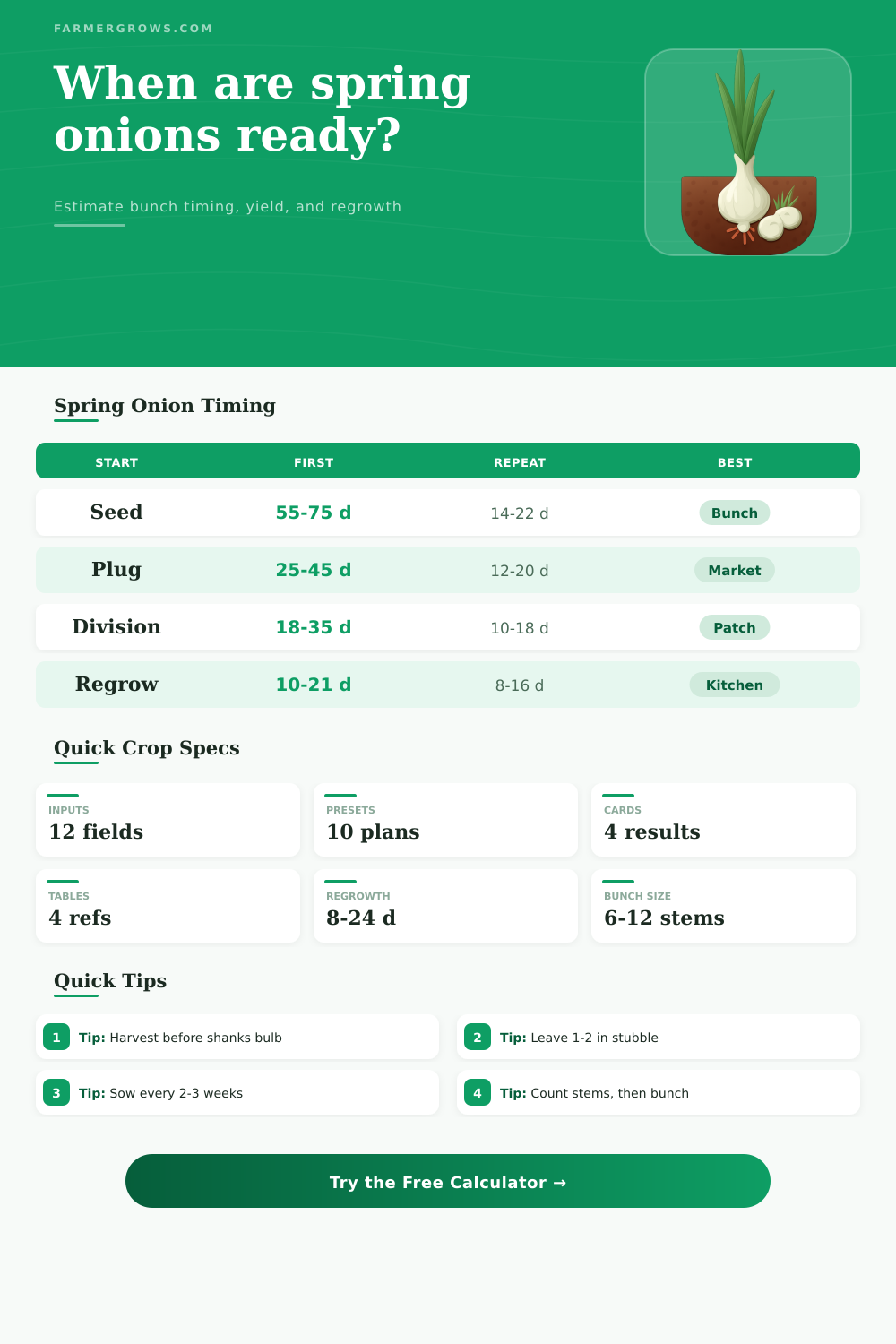
| Direct seed or seed tray | 7 to 14 days for emergence | 55 to 75 days in workable spring weather | Succession rows, trays, and dense bunching stands |
| Transplanted plugs | 4 to 8 days to resume growth | 25 to 45 days after transplanting | Uniform market bunches and faster bed turns |
| Divided bunching clumps | 3 to 7 days for feeder roots | 18 to 35 days after division | Established bunching-onion patches and perennial clumps |
| Kitchen-base regrow | 2 to 5 days if bases are alive | 10 to 21 days in light and moisture | Small trays, windowsills, and quick home harvests |
| Overwintered stand | 7 to 12 days after spring wake-up | 30 to 55 days from active spring growth | Early bunches before fresh seed rows mature |
| Cultivar group | Typical first bunch | Season strength | Regrowth habit |
|---|---|---|---|
| White Lisbon and Guardsman | Quick to standard bunch size | Cool spring and protected beds | Reliable, moderate repeat cuts |
| Tokyo Long White and Ishikura | Slower when grown for long shanks | Mild spring with steady moisture | Good if cut above the base |
| Evergreen Hardy White | Medium seed crop, strong overwinter crop | Cold-tolerant spring and fall rows | Strong repeat growth from clumps |
| Parade and Ramrod | Uniform market bunch timing | Main spring succession rows | Balanced repeat interval |
| Nabechan and Purplette | Medium to slower for thicker stems | Patio troughs, specialty bunches | Best with fewer, cleaner cuts |
| In-row spacing | Plants per 10 ft row | Likely stem style | Bunching note |
|---|---|---|---|
| 0.75 in / 1.9 cm | 160 spaces | Very slim pencil stems | Use larger bunch counts and harvest young |
| 1.0 in / 2.5 cm | 120 spaces | Thin spring onion bunches | High yield for frequent succession cuts |
| 1.5 in / 3.8 cm | 80 spaces | Standard bunching stems | Good default for home and market bunches |
| 2.0 in / 5.1 cm | 60 spaces | Thicker table stems | Lower bunch count but easier cleaning |
| 3.0 in / 7.6 cm | 40 spaces | Large or long-shank stems | Use for blanching types and specialty bunches |
| Cut or harvest style | Regrowth estimate | Best stubble | Planning note |
|---|---|---|---|
| Whole-pull bunches | No repeat cut from pulled plants | Not applicable | Best for clean market bunches with roots attached |
| Low cut under 1 in | Slow and uneven | Avoid if repeat harvests matter | Raises loss risk and stretches the next cut |
| Standard cut at 1 to 2 in | 10 to 22 days | Living white base plus some green | Default cut-and-come-again setting |
| Tall cut over 2 in | 8 to 18 days | Fast leaf rebound | Faster return but less stem harvested each cut |
| Kitchen-base regrow | 8 to 16 days | Roots alive and base moist | Good for small repeat trims, not full field yield |
For steady bunches: base the schedule on usable stems after thinning, then sow or transplant a smaller follow-up strip every 2 to 3 weeks.
For repeat cuts: water after harvest, keep the base alive, and stop cutting tired plants once regrowth becomes thin or uneven.
There’s something quietly frustrating about sowing seed in cold soil and waiting (nothing happening). Water the dirt. Wait. Stare at the dirt: Did I plant garlic instead? You don’t get spring onions on your own timetable, no matter what app you have. Instead, they follows the biological clock of a seed. That response is based off the duration of light, soil temperature, and the extent to which you thinned that row.
Once you input your conditions and start date, the calculator does the rest of the math for you, and spares you guesswork over conversions and coefficients. It’s largely about knowing what’s actualy being measured, the trick of it. For most folks, planting means one thing: Done deal. Spring onion? Not so fast.
How to Grow Spring Onions Successfully
Do you prefer to grow your crop by direct seeding for very thin plants, or do you want market-sized bunches quickly by using plugs and transplanting? Those two approaches differ more wildly in time frame. Direct seeding is slower from the start because roots take time to grow, and the plant must create them itself from scratch. With transplants, there’s no vulnerable early period, which save weeks on the calendar. And there lies the mistake we all make, planting at the same time but assuming it’ll all be ready at once, forgetting to account for headstart a transplant enjoys over direct-sown seedling.
Timing isn’t all that counts; your cultivar choice is also critical. Some onions are speedy, like ‘White Lisbon‘, and others takes longer to bulk up (for example, Tokyo Long White types) into those plump white shanks desired for blanching purposes. The calculator takes such traits into account, varying the growing windows to match. Then there’s the matter of protection: If you grow under a tunnel or fleece, the roots will be more active and warmer sooner in the season, which realy speeds up set-up time. Every timeline gets stretched by cold spring weather, which can make the difference between dinner next month and dinner tonight…literally.
Most home gardeners go wrong with onion production by letting spacing get away from them. Plants that are crowded together will fight for sunlight and nutrients, growing weak stems that bend and break easily. On the page, the reference table breaks down stem thickness by spacing. Close spacing produces many pencil-thin stems that is good for pickles and garnishes, but they do not work well as a side dish on their own. Spacing farther apart lets each plant grow into itself more, developing a thicker shank than the others and holding its shape better when cooked. Is it more important to you to have quantity or quality? It depends on what you need in your own kitchen.
There’s another wrinkle: How much can it regrow? Some people treat spring onions like a cut-and-come-again crop, but again, there must be enough living tissue remaining after each cut to sustain itself. If you’re not careful, you’ll damage the basal plate, which halt all further growth. Leave perhaps an inch or two of white stem remaining, so that it has plenty of energy reserves to push up more leaves. Based off your soil moisture and your stubble height, the calculator tells you the time required between repeat cuttings, that’s good to know if you want to plan for continuous harvesting instead of constant replanting.
But ultimately: Spring onion cultivation is more about reading the season than precision farming. Even the best-laid plans (and spacings) wouldn’t of help them grow fast in dry, lean soils. Moderate fertility and consistent moisture will help them focus on growing green leaves instead of using all their energy to grow roots. Yes, do the math and figure out the ideal date…but sometimes that’s theoretical, because of some other element of the environment, maybe a fence blocks the light, or the soil was compacted. Set your expectations using the tool, but make adjustments to reflect what the actual bed is like.
If a tender spring bite is your goal, harvest before the shanks begin to bulb up. It’s a small thing, but a matter of both texture and flavor. When the seed goes into the ground, the clock begins ticking (not when the calendar says it should).