Zoysia Grass Seed Germination Time Calculator
Estimate zoysia seed germination timing, warm-soil delays, seed quantity, watering cycles, first mow timing, and early coverage for a slow-establishing warm-season lawn.
Zoysia seed needs steady warmth and patience. This calculator is built for seeded zoysia establishment, where germination can be slow, seed must stay shallow and damp, and lateral coverage takes longer than Bermuda even after seedlings appear.
Zoysia Establishment Estimate
Results combine zoysia seed type, warm soil, seedbed moisture, light, cover depth, and the slower coverage pace typical of zoysia lawns.
| Soil temperature | Zoysia response | Estimated sprout window | Watering focus | Planning note |
|---|---|---|---|---|
| Below 60°F | Too cool for reliable zoysia | Often stalled or 45+ days | Avoid keeping soil soggy | Wait for warmer soil instead of forcing seed |
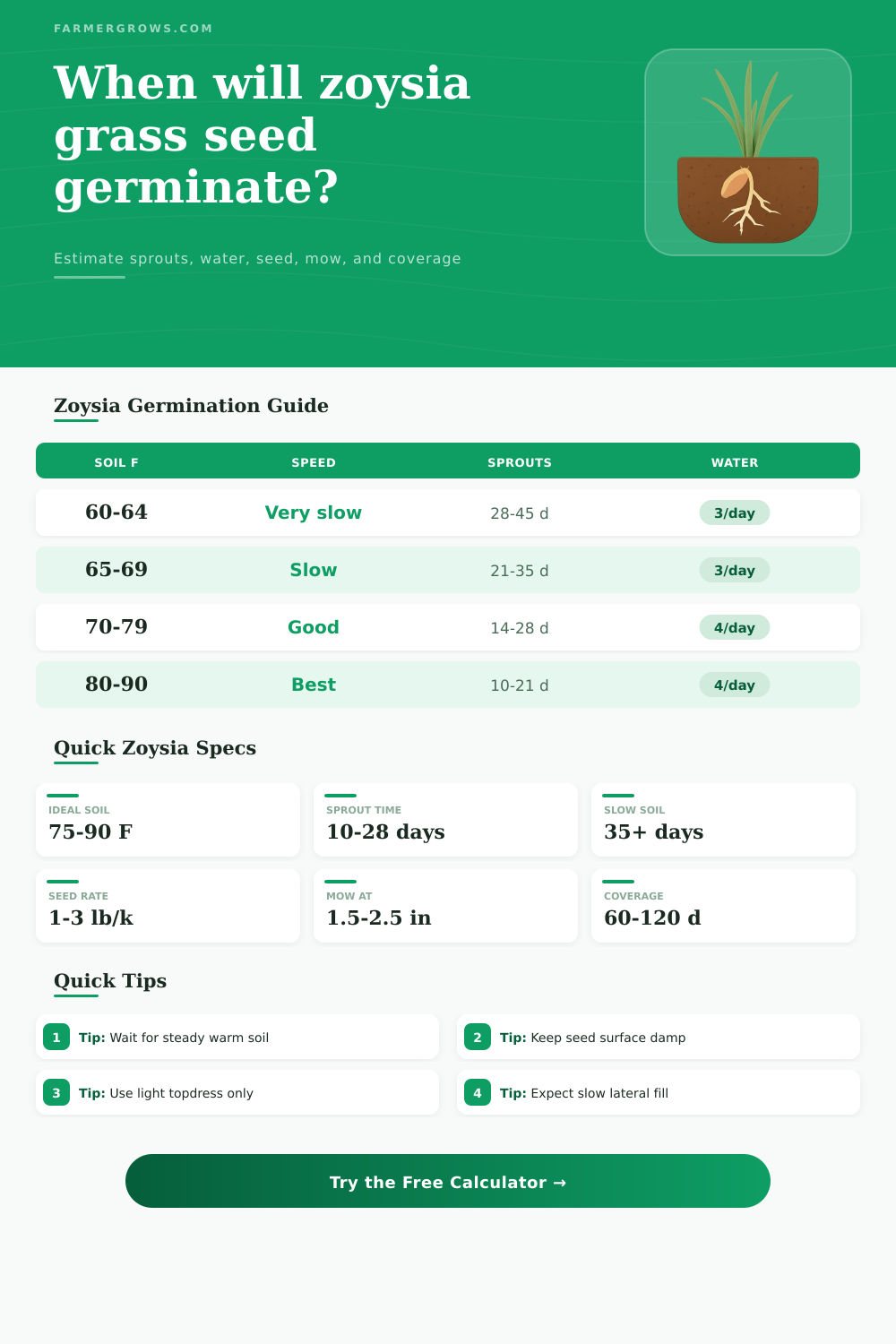
| 60 to 64°F | Very slow start | 28 to 45 days | Light, steady moisture | Expect uneven patches and delayed green haze |
| 65 to 69°F | Slow but possible | 21 to 35 days | Keep seed from crusting | Better for small repairs than full lawns |
| 70 to 79°F | Good zoysia seeding range | 14 to 28 days | Three to four short cycles | Best balance of moisture and heat |
| 80 to 90°F | Fastest practical range | 10 to 21 days | Frequent short cycles | Watch hot afternoons on sandy soil |
| Above 92°F | Fast drying risk | 12 to 28 days | Protect seed surface | Heat helps only if moisture is steady |
| Cultivar or seed type | Warm-soil timing | Seed rate guide | Soil preference | Establishment note |
|---|---|---|---|---|
| Zenith seeded zoysia | 10 to 21 days at 80°F soil | 1 to 2 lb/k | Firm loam or topdress | Good general lawn choice with slow lateral fill |
| Compadre zoysia | 9 to 20 days when warm | 1 to 2 lb/k | Warm, well-drained seedbed | Best when seeded after nights stay warm |
| Coated Zenith-style seed | 14 to 30 days | 2 to 3 lb/k | Moist loam, not buried deep | Coating changes bulk weight, not patience needed |
| Zoysia japonica blend | 14 to 28 days | 1.5 to 3 lb/k | Loam or sandy loam | Use tag germination to adjust spread amount |
| Generic zoysia seed | 14 to 35 days | 2 to 3 lb/k | Clean, firm seedbed | Quality depends heavily on seed tag and storage |
| Stage | Typical timing | Watering cycle | Mowing or traffic | What to watch |
|---|---|---|---|---|
| Seed contact | Day 0 to 3 | Several light cycles | No traffic | Seed should be pressed into soil, not buried |
| Germination | Day 10 to 35+ | Keep top 1/4 in damp | Stay off loose seed | Slow zoysia sprouts may appear uneven at first |
| Seedling rooting | After green haze | Begin deeper watering gradually | Limit walking | Roots should resist a gentle tug before mowing |
| First mowing | About 35 to 70 days | Water day before mowing | Mow at 1.5 to 2.5 in | Use a sharp blade and remove little leaf |
| Early coverage | 60 to 120 days | Deep watering as needed | Light use only | Zoysia spreads slowly by runners after sprouting |
| Seedbed condition | Germination effect | Calculator adjustment | Best water plan | Field check |
|---|---|---|---|---|
| Firm prepared loam | Best contact and air | Neutral timing | 3 to 4 short cycles | Footprint should be shallow, not fluffy |
| Sandy fast-drying soil | Warms fast, dries fast | More cycles, slight delay | 4 to 5 short cycles | Surface should not bleach dry by afternoon |
| Clay or crusting soil | Can trap small sprouts | Longer window | Fewer, gentle cycles | Break crust carefully if seedlings are pinned |
| Compacted builder soil | Poor root expansion | Longer coverage timing | Keep damp without puddles | Improve grade and contact before seed goes down |
| Thin topdress | Protects moisture | Slightly faster | Even mist cycles | Cover should be light enough to see some seed |
Warm-soil tip: Zoysia is not a cool-season rescue seed. If the soil is still near the low 60s, waiting for a stable warm pattern usually gives a cleaner stand than watering cold seed for weeks.
Coverage tip: Germination is only the first checkpoint. Zoysia seedlings can sprout while the lawn still looks thin, because lateral fill depends on warm growing days after emergence.
MAY: There’s a bag of zoysia seed in your hand, and half-baked plans for where it will go. The day looks promising; the sun is shining. But then you spread the seed and water it, and…nothing happens, right? Well, maybe something happens…but what happens isn’t the rich carpet you had hoped for. Physics doesn’t bend to power of patience; that’s why there are all these zoysia seed germination time calculators.
Unlike cool season grasses, warm season types need both moisture and heat (but not drowned), and they’re behaving accordingly. So enter your seedbed conditions into this calculator, along with your soil temperature, and it will do the rest. You will not have to wonder if a spot is dead or just dormant, and you won’t have to second-guess when to mow again. The math tell you that.
How to Grow Zoysia Grass Successfully
You can’t make a deal with nature: Soil temperature is everything, and there’s no getting around biology here. At sixty degrees Fahrenheit, zoysiagrass will take awhile; in fact, you might be lucky to get sprouting in six weeks. Go lower then that and the seed just waits patiently for spring to catch up. As the chart on the page illustrates, when temperatures climb toward that magic number of 75 degrees, that’s the sweet spot where things get moving quickly, eighty degrees, and you’re cooking with gas. If it doesn’t reach sixty, you’re essentially just soaking seeds while waiting for the heat to come, and that little bit matters a lot in terms of your timing.
This part gets confusing… People mistake “germination” for “establishment.” They get green shoots and figure the work is complete. Not yet! Those emerging sprouts only mark the beginning, since zoysia spreads outward via both rhizomes and stolons. Thus the calculator estimates the coverage gap. That’s why zoysia lawns appear sparse well past seed emergence: the first mow may come as late as 40 days post-seed date. But even then, lawn won’t feel like a lawn for at least another three months. Making that distinction saves heartache because you won’t overseed next year if you’ve fooled yourself into thinking the grass didn’t take.
Another typical mistake is the seed rate, which explains why zoysiagrass seed isn’t cheap. It’s delicate stuff, and not as viable as Kentucky bluegrass or fescue. If you spread too little, there will be gaps that fails to close. If you spread too much, which is also a waste, you will end up with crowding and small seedling. Depending on the type, most people recommend anywhere from a pound to three pounds per thousand square feet spread. Zoysias like Compadre need more heat, while a popular seeded variety called Zenith is a bit more tolerant. Because the tool takes into account germination percentages on each seed company’s tags, it can calculate those rates for you according to where you live and what kind of seed you’re using. That bag of leftover seed from last year may be only half-viable today, and the calculator prevents you buying more in hope, rather than knowledge.
Zoysia presents another art form: watering, which must be constant (down to the top quarter inch) until germination occurs. If the top dries out, deep soaking won’t help. Shorter cycles are preferable initially. Clay soils hold water but can crust over and trap seedlings; sandy soils dry quicky. Because that varies by soil type and sun exposure, the calculator figures out how often to water (more frequently for sandy soil in full sun, less so for shady areas in clay). Sounds like a pain, yes? But it’s the difference between a lawn and a wasted piece of money.
Another key is knowing when is best for your first mow. You don’t want to be early. If you are, you expose the soil and invite weed seeds in. You also pull up more than just the grass itself. It takes time for those roots to get firmly set. This tool ties its growth-rate information to the temperature you inputted. It figures out roughly when that window of safety arrives. To be sure, if a seedling slides right out when you try to gently tug it, wait some more.
Zoysia seed needs light, so don’t bury it. Cover depth can be tricky. A quarter-inch of press-in coverage is fine. Lighter topdressing that holds soil in place but doesn’t block light will help retain moisture. If buried more deeply than a quarter inch, germination takes far longer: adding days or weeks to your waiting time. The calculator allows for this deeper-cover choice and adjusts the sprouting window to match.
Establishing Zoysia requires patience. You want it to get growing NOW, but mow too soon, or push too hard with watering, and you’ll hurt more than help. Let the heat come; let the soil do its work. Adjust accordingly if your numbers don’t match up with what’s happening out there in the real world. If you let it happen, it will, and that green haze comes…and it always does if the conditions are right.