Red Onion Growth Time Calculator
Estimate red onion crop timing from seeds, sets, or transplants through daylength-triggered bulbing, target bulb size, top fall, curing, and storage readiness.
This calculator is for red bulb onions harvested as dry or fresh bulbs. It is not a green onion regrowth planner, a germination-only tool, or a generic onion-from-seed calendar.
Red Onion Crop Timeline
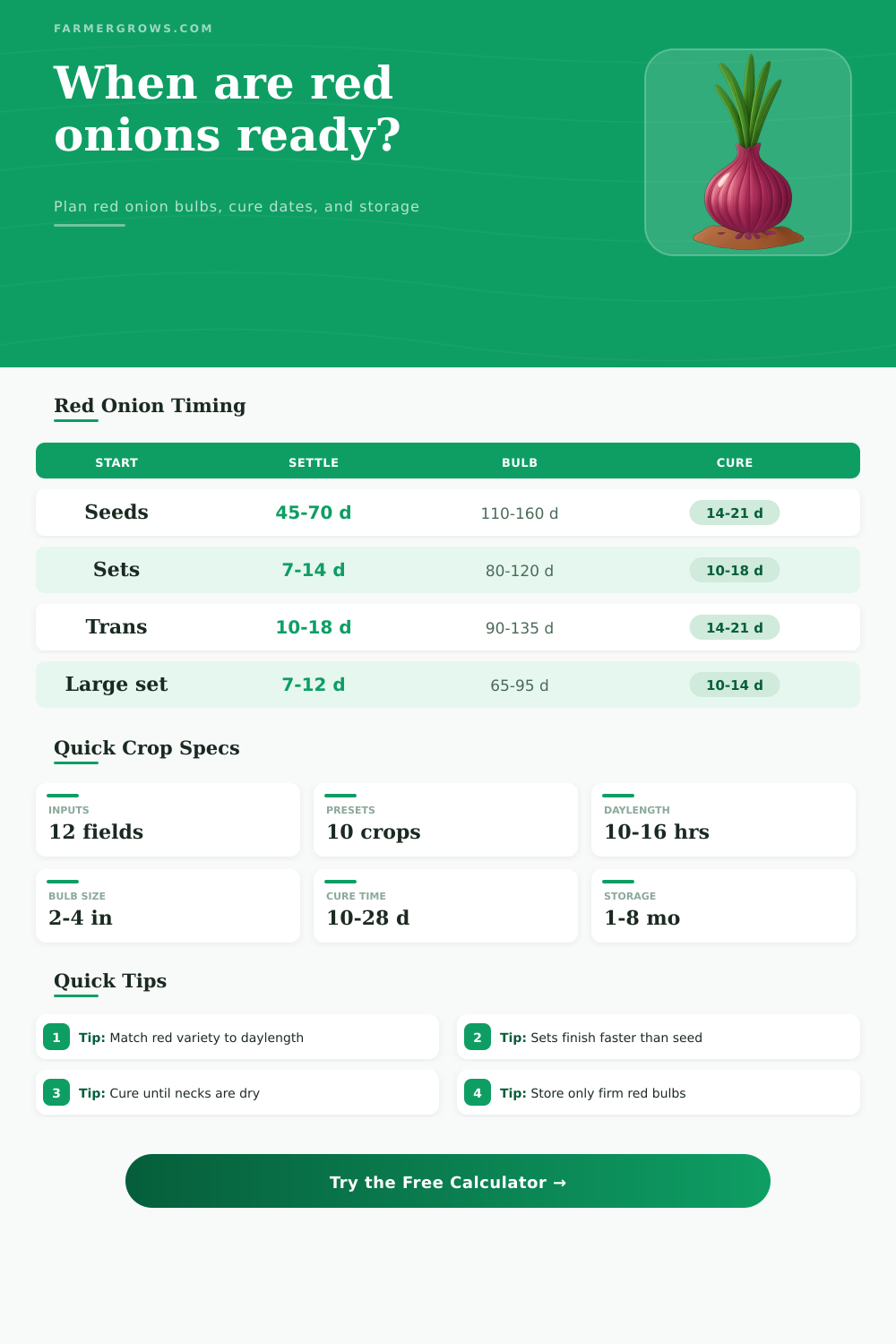
Dates include establishment, bulb sizing, top fall harvest, curing, and storage readiness.
| Red onion start | Establishment | Typical harvest | Best use |
|---|---|---|---|
| Direct seed | 45 to 70 days to strong plants | 120 to 165 days | Full-season beds, best variety choice |
| Transplants | 10 to 18 days after setting | 90 to 135 days | Predictable medium and large red bulbs |
| Small sets | 7 to 14 days after planting | 80 to 120 days | Fast kitchen bulbs and home gardens |
| Large sets | 7 to 12 days after planting | 65 to 95 days | Early harvest, higher bolting risk |
| Class | Bulbing trigger | Named red examples | Timing note |
|---|---|---|---|
| Short-day red | About 10 to 12 hours | Red Burgundy, Red Creole | Works for fall or winter planting in mild southern regions |
| Intermediate-day red | About 12 to 14 hours | Red Candy, Cabernet | Useful across many middle-latitude spring crops |
| Long-day red | About 14 to 16 hours | Redwing, Red Baron, Milano | Needs long northern summer days for storage bulbs |
| Day-neutral red | Less strict trigger | Regional hybrids | Use when seed catalog lists broad adaptation |
| Target bulb | Typical spacing | Time effect | Harvest cue |
|---|---|---|---|
| Small red bulbs | 2 to 3 inches | 5 to 12 days faster | Pull earlier for firm fresh bulbs |
| Medium red bulbs | 3 to 4 inches | Baseline timing | Harvest after most tops soften |
| Large red bulbs | 4 to 5 inches | 7 to 14 days longer | Keep moisture even through bulbing |
| Jumbo red bulbs | 5 to 6 inches | 14 to 24 days longer | Needs strong leaf growth before bulbing |
| Storage goal | Cure focus | Expected keeping | Red onion note |
|---|---|---|---|
| Fresh sweet red | 10 to 14 days, gentle dry-down | 1 to 3 months | Use juicy bulbs first |
| Kitchen red onion | 14 to 21 days, dry necks | 3 to 5 months | Sort out thick-necked bulbs |
| Storage red onion | 18 to 28 days, firm skins | 5 to 8 months | Best from pungent long-day reds |
| Warm or humid storage | Extra sorting and airflow | 1 to 3 months | Check often for sprouting or soft spots |
Daylength first: A red onion can grow lush leaves and still make small bulbs if its daylength class does not match your latitude and planting season.
Cure before storage: Move red bulbs into storage only after the neck is dry, the skins are papery, and soft or sunburned bulbs are used first.
Plant red onions, and hope for bulb. Unlike yellow ones, red ones will be dark (purple) and will have a punchy flavor that sweetens at serving time. How do you grow things like this: It’s not as simple as sowing seeds; it involves timing, too.
Small thing go into the ground, and then you wait…and wait…and don’t see anything happen for months, but then out come the bulb. The trick is: When? Start too soon, and if it’s still warm out, forget bulb-making; those plants will bolt and try to grow flowers instead. Start too late, and you’ll never achieve the size needed to make bulbs because by then the days will be long…you’ll end up with scallion, not storage onions. Enter your variety and your planting date on the calculator above, and let it do the math for you. No more guesswork about whether your area adds X number of days; or subtracts, from seed packet’s instructions.
How to Grow Red Onions
What’s the best beginning: seeds or sets (pre-grown baby bulbs)? There’s no one-size-fits-all answer here; each has its pros and cons. Starting from seed offers widest variety, but it also means waiting four to seven weeks for plants to grow before they start producing bulb. Skip that step and jump straight to harvest by ordering some sets to get a uniform size for the kitchen. This method skips first stage and you’ll have a quicker result, but only after waiting longer than with transplant (see below).
If you choose this route, you need to watch out for any bolting of the sets before setting them out; keep them cold till it’s time to plant, and don’t wait long once soil gets warm. This is an easy precaution.
Transplants falls somewhere in between. You’ll get your bulbs earlier than seedlings would be ready, though not as fast as from sets. You’ll also have access to a slightly wider range of genetics since you’re choosing your own variety rather than buying set. The timing changes depending on which route you select, the slider tool lets you switch back and forth and readjusts the schedule accordingly.
The trickiest variable for gardeners is daylength. Temperature isn’t enough to get an onion to bulb; it has to be exposed to just the right number of daylight hours to signal the switch from leaves to bulb. Short-day varieties fits southern regions where summer days peak at about twelve hours, and long-day types require the sixteen-hour summers of northern latitudes. A long-day onion planted in the South will produce scrawny bulbs and lush tops, because it doesn’t ever get the signal. To succeed, you have to match variety to latitude.
Once the bulbs starts swelling, your role changes from waiting to managing moisture. Keep them consistently moist so the layers can expand and smooth out together without splitting. Stop watering completely once their tops go limp and turn brown. At that point, the plant has fed the bulb all it needs. Now you’re ready to harvest on a dry day which lets the skins cure well in the sun or under cover. Let them cure for a couple of weeks until they’re papery and tight around the necks. Only then should they go into storage. Keep them firm and well ventilated so they last months different than rotting in days.
These details is shown in the tool’s reference tables, broken down by bulb size and desired storage life: Pungent storage types keep longer than sweet red ones, which cure more quickly. For onions destined for next spring’s salads, focus on getting bigger bulbs of a sturdier variety, and get them realy dried off first so you know exactly when to store them. These timelines take the guesswork out of your garden calendar if planned ahead.
The key to growing really good red onion is to respect the clock. Whether you start from seed (for variety) or buy onion “sets” (for speed), the time at which you plant makes all the difference. Get it right by matching the daylength requirements of whatever variety or type you’ve selected, and the rest follows. Just keep up the steady attention over the summer months. And then one fall day, when the tops bend down and say, “Uncle,” there are the bulbs beneath, those richly colored ones we want.