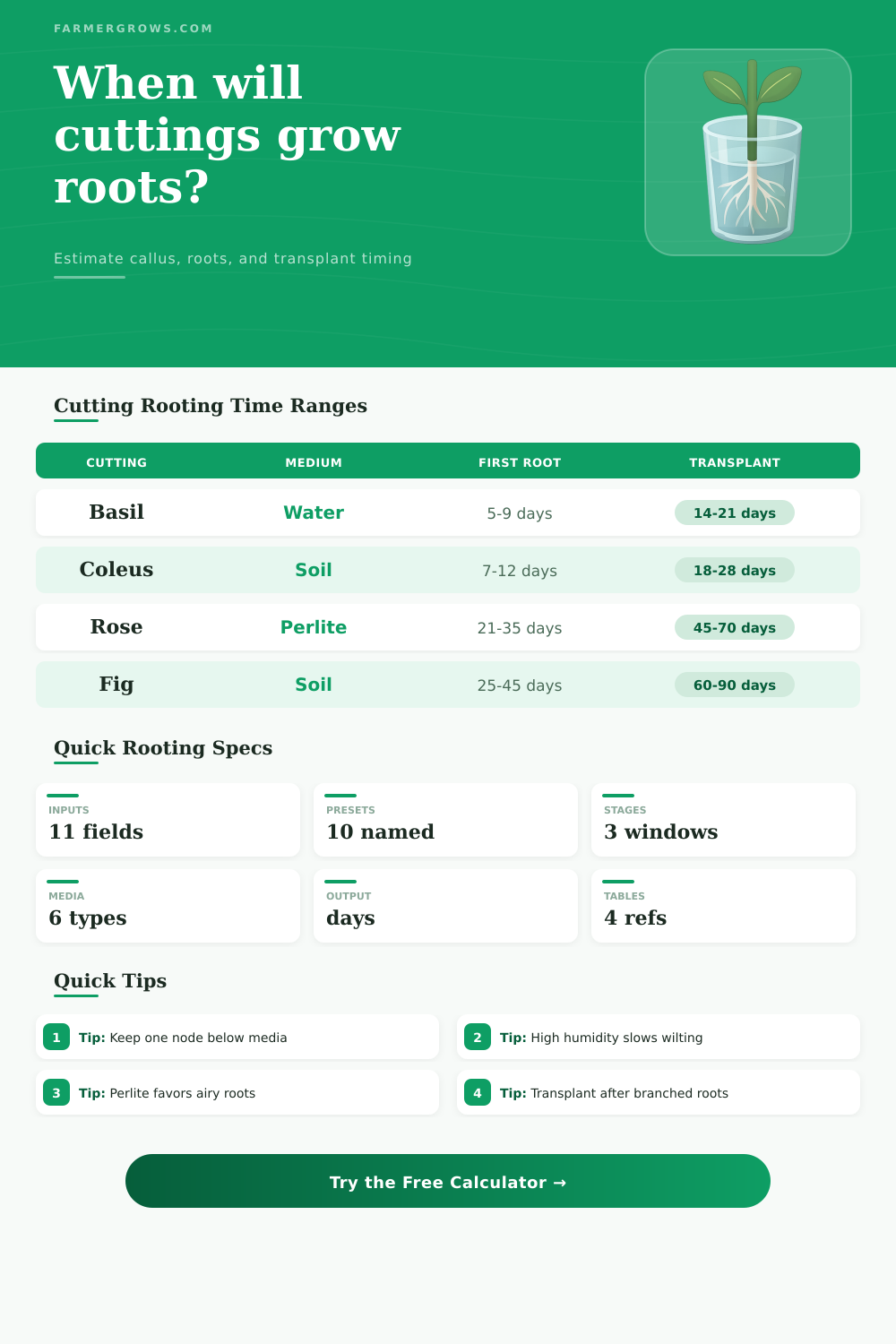
Root Growth From Cuttings Time Calculator
Estimate callus, first-root, and transplant-ready timing for stem or leaf cuttings in water, soil mix, perlite, sand, vermiculite, or plugs.
Use this for propagation planning when cuttings are healthy and taken from clean stock plants. It estimates root timing from cutting maturity, media, hormone, nodes, humidity, temperature, and leaf load.
Cutting Root Growth Estimate
Timeline estimate based on cutting type, medium, node count, humidity, temperature, hormone, and transplant root target.
| Cutting type | Callus or seal | First-root range | Transplant-ready range | Best rooting style |
|---|---|---|---|---|
| Herbaceous soft stem | 1 to 4 days | 5 to 14 days | 14 to 30 days | Water, plug, or light soil mix |
| Softwood shrub cutting | 4 to 9 days | 14 to 28 days | 28 to 50 days | Perlite, vermiculite, or plug tray |
| Semi-hardwood cutting | 7 to 14 days | 21 to 45 days | 45 to 80 days | Perlite, sand, or airy mix with humidity |
| Dormant hardwood cutting | 10 to 25 days | 25 to 60 days | 60 to 110 days | Soil mix, sand bed, or callus box |
| Succulent leaf or stem | 3 to 14 days dry | 14 to 45 days | 35 to 90 days | Dry callus first, then barely moist grit |
| Medium | Root speed | Strength | Main caution | Best-fit cutting |
|---|---|---|---|---|
| Water jar | Fast visibility | Easy root checks | Water roots can snap or stall after potting | Basil, mint, coleus, many soft stems |
| Potting or seed mix | Moderate | Roots adapt directly to soil | Wet mix can rot woody bases | Tomato, fig, herbaceous nursery starts |
| Perlite | Moderate-fast | High oxygen around the base | Can dry at edges under low humidity | Rose, hydrangea, mint, softwood shrubs |
| Vermiculite | Moderate | High moisture retention | Needs air breaks to avoid stale dampness | Tender leafy cuttings under a dome |
| Coarse sand | Slower | Firm, low-nutrient support | Dry pockets delay fine feeder roots | Lavender, rosemary, semi-hardwood herbs |
| Coco, peat, or foam plug | Moderate | Easy transplant with root ball intact | Small cells dry quickly after roots form | Tray propagation and farm-scale starts |
| Factor | Low range | Best range | High range | Rooting effect |
|---|---|---|---|---|
| Node count | 1 node | 2 to 4 nodes | 5 or more nodes | More node tissue improves odds, but oversized cuttings wilt faster |
| Humidity | Below 55% | 70% to 90% | Above 95% | Low humidity wilts leaves; saturated domes invite rot |
| Root-zone temperature | Below 62°F | 68 to 78°F | Above 84°F | Cool media slows cells; excess heat raises rot risk |
| Rooting hormone | None | Light IBA dip | Heavy coating | Helps woody bases most; too much powder can burn tissue |
| Leaf area kept | 0% to 20% | 30% to 60% | Over 75% | Some leaf helps energy; too much leaf drains water |
| Stage | What to look for | Action | Risk if rushed | Best handling |
|---|---|---|---|---|
| Callus only | White bump or sealed tan base | Keep stable; do not tug | Base tears before roots form | Hold moisture steady and ventilate briefly |
| First root tips | One or more short white roots | Wait for branching unless water-rooting | Single root breaks at potting | Lift with a spoon or plug, not the stem |
| Potting window | Roots 1 to 2 in and beginning to branch | Move to a light starter mix | Water roots tangle if delayed | Firm mix gently and water once |
| Established liner | New leaf growth and light root hold | Begin normal light and feeding slowly | Soft roots burn from fertilizer | Increase airflow and remove dome in steps |
Match moisture to the stem. Soft herbaceous cuttings can handle wetter media, while woody and succulent cuttings usually need more air around the cut base.
Transplant before roots get too long. Water roots and perlite roots are easiest to pot when they are short, white, and lightly branched.
You know that moment, when you remove a cutting from its parent plant, and cradle it carefuly as if it were made of glass. You snip off the leaves, inserted the stem into hormone, buried it with all the care of a surgeon, and then waited. Waited some more. A week goes by. Two weeks. Nothing different to see at the base. Is it dead? Sleeping? Doing something under there that you can’t even see yet, but exactly what it should be doing.
That’s the part when most amateur gardener lose heart, and yank out their cutting before they even start the real job. That is what the calculator above does: It translates your own setup into a number of days instead of guessing, and it factors in variables that sound like common sense (but are precise mechanisms).
Why Your Cutting Needs Time to Grow Roots
One example is humidity. If the leaves has enough moisture that they don’t wilt, even though the stem is struggling to pull up water, you’re doing something right. But excess dampness under a plastic dome invite rot more quickly then anything else. The calculator factors in ventilation and leaf load; it finds you a window of time when the tissue heals but doesn’t suffocate. Not everything is just about keeping things wet. It’s about managing water and gas exchange where there are no roots to pull from below.
But how long should I wait? It depends mostly on the kind of wood (or herbaceous stem) you’re using. Soft-tissue things… Coleus or basil stems, for instance; heal fast; within a couple of weeks, you’ll begin seeing white root tips. Because these plants has limited stored energy, they’re in a hurry. Dormant hardwood cuttings and woody shrubs takes their time, or even more: A fig cutting will take several weeks (perhaps three) to form its callus over the cut, staying as still as a mouse.
That’s the callus stage. And important: the biological bandage that seals out infection till some roots develops. When you tug gently on the stem to see if there’s been progress at this stage, guess what happens? You rip off that callus and then start again from scratch. That calculated waiting period is the interval that tells you when it’s really just time to be patient, rather than thinking something’s wrong.
The kind of media you choose can also affect the amount of available oxygen at the cutting’s cut site. Roots will form faster in water, as you can witness with your own eyes. But those roots will be delicate and hairless (without hairs, they won’t absorb in the soil). If you want to grow them in soil, first consider using coarser material (like sand or perlite) that offers both air pockets and some structure. This encourages good rooting from Day One (better root structure).
Whether you dip your cuttings in hormone and what sort of medium you are growing them in (sterile perlite, for instance, vs. Or richer soil. Using just plain old H2O also alters the window. The device knows: A somewhat slower-emerging but tougher set of roots tend to result when there’s plenty of air in the medium. Hormones, meanwhile, mainly hasten the rate of cell division near the base of the stem. That’s why IBA dips is generally more beneficial to woody cuttings than to soft herbs.
It provides three key milestones for you… Callus formation, first root emergence, and transplant readiness. And this is where most people goes wrong with their transplants. Moving one as soon as there’s a single white thread of a root showing. Nope. Wrong. Too early. You want branching. One snap of the root, if disturbed, and your plant is dead. Let the root system get going enough that it begins to fork; let it grow long enough to anchor in its new home. There is a big difference in the survival rate but only a small difference in the number of days.
Propagation has nothing to do with any magic formula. It is nothing but biology and environment. In particular temperature. Metabolic rates are higher in warmer roots, but not the leaves. Warmer root zones speeds up metabolic activity without overheating the foliage. Keep them too cool, and the whole thing goes to sleep (conservation mode) until things improve in the root zone. The tool factors that thermal reality into the equation.
Understanding what happens at each phase puts an end to guesswork and replaces it with observation: When should I be expecting the seal? When am I looking for the first tips? When can I safely relax my grip and pot it up? You’re not forcing anything; you’re simply letting the plant tell you when it’s ready for the next step itself. That sense of quiet confidence comes from understanding the timeline. It converts anxiety into anticipation, waiting and watching those unseen processes unfold beneath the surface. You should of waited longer.