Root Growth Time Calculator
Estimate when roots should become visible, how deep the active root zone may reach, how often to water, and when a plant is ready for less babying after transplanting or direct sowing in soil.
This calculator is for normal root establishment in soil after transplanting nursery starts or after direct sowing seed. It is not a cutting propagation calculator, and it is not meant for pothos or other water-rooting jars.
Root Establishment Estimate
Calculated from plant type, soil temperature, soil texture, root disturbance, water status, and surface cover.
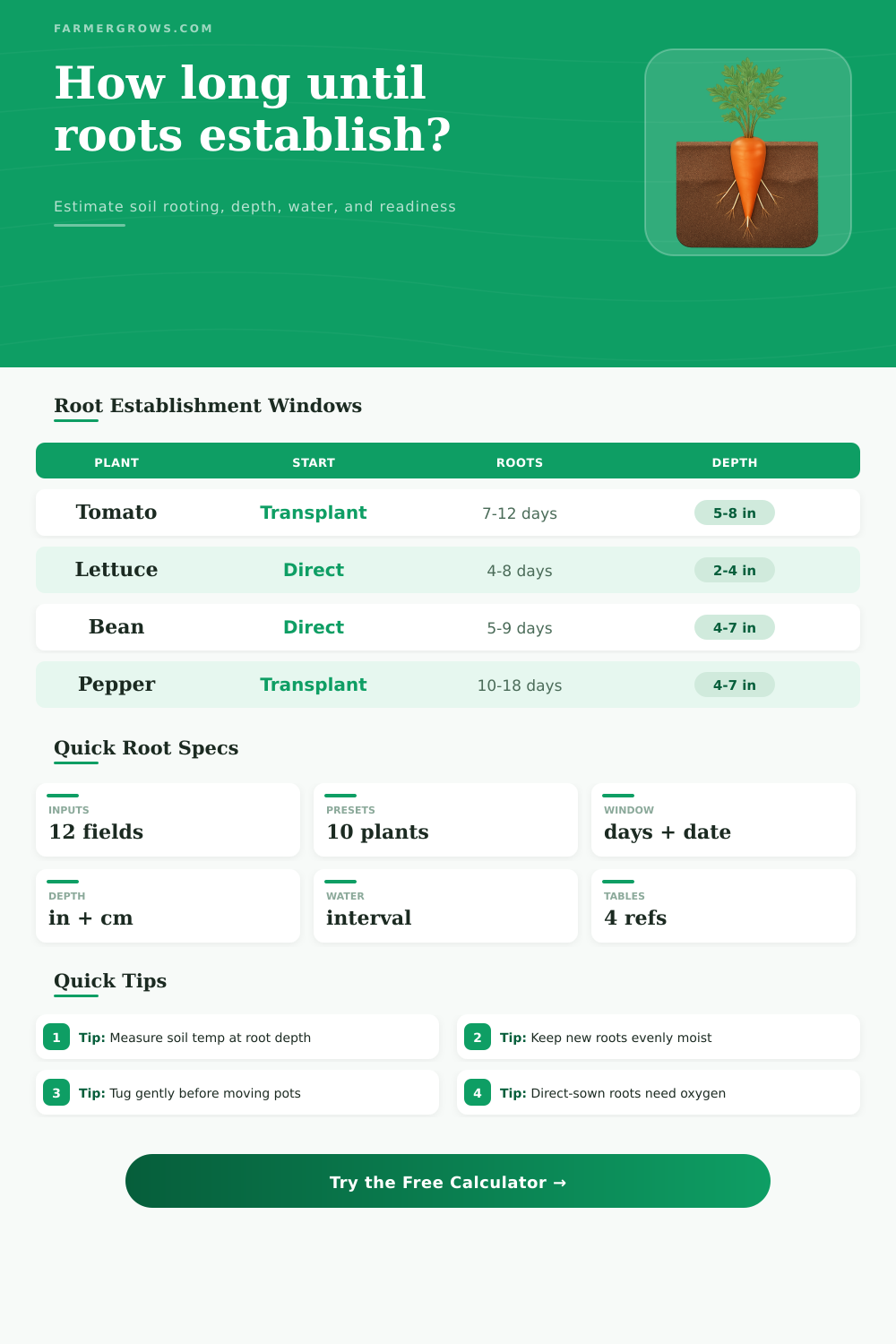
| Plant type | Typical first new roots | Useful establishment depth | Notes for soil planting |
|---|---|---|---|
| Leafy greens | 3 to 7 days | 2 to 4 in | Shallow, fast roots if soil stays cool and moist |
| Tomato and fruiting veg | 6 to 12 days | 5 to 8 in | Warm soil drives the shift from survival to growth |
| Beans and peas | 4 to 9 days | 4 to 7 in | Direct-sown seed benefits from loose, oxygenated soil |
| Cucurbits | 5 to 11 days | 4 to 8 in | Root disturbance delays early anchoring |
| Root crops | 6 to 14 days | 4 to 10 in | Early taproot depth matters more than visible top growth |
| Berry plugs or crowns | 10 to 21 days | 4 to 8 in | Keep crown level and avoid saturated soil |
| Soil texture | Root speed factor | Watering pattern | Best adjustment |
|---|---|---|---|
| Loam or raised bed mix | 1.00 baseline | Steady checks every 1 to 3 days | Maintain even moisture without sealing the surface |
| Sandy soil | 0.92 if dry | Shorter, lighter intervals | Use mulch and smaller but more frequent watering |
| Clay or heavy soil | 0.82 when cool | Longer interval but higher oxygen risk | Wait before rewatering if the root zone is glossy wet |
| Container potting mix | 1.05 when airy | Can dry from edges first | Water thoroughly, then check by weight or finger test |
| Compacted or crusted surface | 0.68 slow | Often wet above and dry below | Loosen surface carefully and avoid pounding irrigation |
| Soil temperature | Cool-season response | Warm-season response | Field note |
|---|---|---|---|
| Below 45°F | Very slow but possible for hardy crops | Stalled | Water sparingly because roots use moisture slowly |
| 45 to 55°F | Good for brassicas, lettuce, peas | Slow for tomatoes, peppers, basil | Raised beds and row cover can help |
| 56 to 65°F | Fast for cool crops | Workable for many warm crops | Good transplant window for mixed gardens |
| 66 to 75°F | Watch heat stress on greens | Fast root extension | Mulch after soil warms enough |
| Above 85°F | Heat stress likely | Moisture demand rises | Shade and morning watering matter more |
| Readiness sign | Transplants | Direct-sown plants | What to do next |
|---|---|---|---|
| Morning leaf posture | Leaves stand without overnight droop | Seedlings remain upright after first dry-down | Begin lengthening watering intervals |
| Gentle tug resistance | Root ball feels anchored, not loose | Seedling resists a very light touch | Stop tugging and allow roots to extend |
| New growth | New leaf or stem extension appears | First true leaves expand steadily | Shift from rescue watering to normal irrigation |
| Water use | Soil dries evenly below the surface | Root zone can use a full watering pulse | Water deeper and less often where appropriate |
Check the root zone, not just the surface. The top half inch can look dry while the new root band is still wet, especially in clay or mulched beds.
Ease off water gradually. Once roots anchor, switch from frequent shallow rescue watering to deeper pulses that invite roots downward.
The real action occurs underground, where most gardeners’ eyes never wander. Roots obtains nutrients, oxygen, and water from the soil before they’re able to support foliage above. So when you’re watching for signs of new stems or leaves, expecting that the “vigor” you see is a sign of a healthy plant, it isn’t, it usually isn’t. The root system’s doing the work, anchoring fast or else leaving the plant prone to drought or heat stress despite your constant watering. Learning about this hidden phase will change how you handle each and every seedling or transplanted plant.
Moving any young plant from nursery pot to garden bed is traumatic, and it’s no wonder: For the whole of its life so far, its roots has lived in a tight web with plenty of moisture always nearby. Out in the open, that root network suddenly stops dead at perimeter of the root ball. Now it has to extend into strange territory; soil whose texture varies, perhaps contains gaps, and so forth. How fast will it do that? It depends; this page calculates the time required (including details such as type of soil). Knowing that helps you plan ahead.
How to Help Plant Roots Grow
It isn’t about guessing or estimating when you think things will get better; it is about understanding the biological realties that limit growth. When can you cease babying it and assume it’ll behave normally? The single most important factor in this equation is soil temperature. Roots function as metabolic engines; they go faster when they’re warm and slower when they’re cold. If you transplant a tomato into cold soil, it’s going to wilt (even though it might look as if the soil were moist) because its leaves is trying to release water. Peas or lettuce, cool-season crops, do well in cooler soil where their own roots can grows without overheating. This calculator takes that into account, with different planting windows depending on whether you are growing hardy greens or warm-loving fruiting vegetables. You don’t want to make your roots work outside of their thermal comfort zone; checking the actual soil temperature at planting depth is more meaningful than gazing at air thermometer.
The second part of the equation is soil composition; how fast those new roots will punch into place. They’ll slip right along in loose, aerated loam, but hit a brick wall in tightly packed clay or excessively sandy ground. Clay retains moisture nicely, but it tends to be low on oxygen pockets, which young root tips requires to breathe. On the other hand, sand runs out of juice too fast; and the plant has to spend precious time finding water instead of rooting down. To make up for different compositions, the calculator factors in texture (a regular watering regimen won’t work with soil that behaves different below the surface). How do you know whether it’s better to water deeply and less frequently or shallowly and more often at this vulnerable stage?
Many people make the error of measuring success by lack of wilt, not by signs of fresh growth. A plant may stand upright for weeks while its roots remain confined to original root ball, slowly depleting their reserves until they collapse all at once. Real success comes when the first new leaves appear, indicating that roots has spread sufficiently to carry more biomass. The timing tables below represent averages for each plant family, giving you a frame of reference to see if your carrots are on schedule or stuck in a tough spot. They’ll give you a sense of what’s biologically possible where you live.
And then everything changes: when those roots start to spread out, your watering plan becomes very different. While the roots are young, keep them happy by providing even moisture so they don’t get shocked. Keep their growing tips moving, too, by making sure the soil stays moist early on. After that, you’ll want to allow the surface to begin to dry somewhat before watering again, so they has reason to explore deeper. Tenderness of fresh leaves is no match for excess water; nor does it fare well against a lack of it. That’s where the calculator comes in. It tells you when to check on moisture so you don’t overwater or let things dry out, while avoiding a soggy mess that suffocates the plants. It’s a happy medium between panicked watering and relaxed neglect.
All this means, of course: there’s no substitute for patience when you’re growing roots. You should of didn’t pull gently on those seedlings to test whether they have anchors, and don’t coddle or coax them with extra food before they are strong enough to handle it. These numbers take the guesswork out of waiting, the math of waiting, and replace it with a roadmap: one grounded in the science of how soil works, not just the hope that something will. It’s what turns interference into encouragement, what helps a wobbly section become a bountiful bed. And that mental change is sometimes everything.