Lawn Watering After Fertilizing Calculator
Estimate how much water to apply after lawn fertilizer, how long to run sprinklers, whether expected rain is enough, and how much burn risk comes from nitrogen rate, weather, soil, slope, and turf condition.
This calculator is built for the first watering after fertilizing, not weekly irrigation scheduling. Always follow the product label, especially for weed-and-feed products, because some broadleaf herbicide granules need leaf contact before watering.
Watering After Fertilizer Results
Use the cards for the immediate sprinkler plan, then check the breakdown for rain credit, cycle-soak timing, fertilizer label conflicts, and burn-risk drivers.
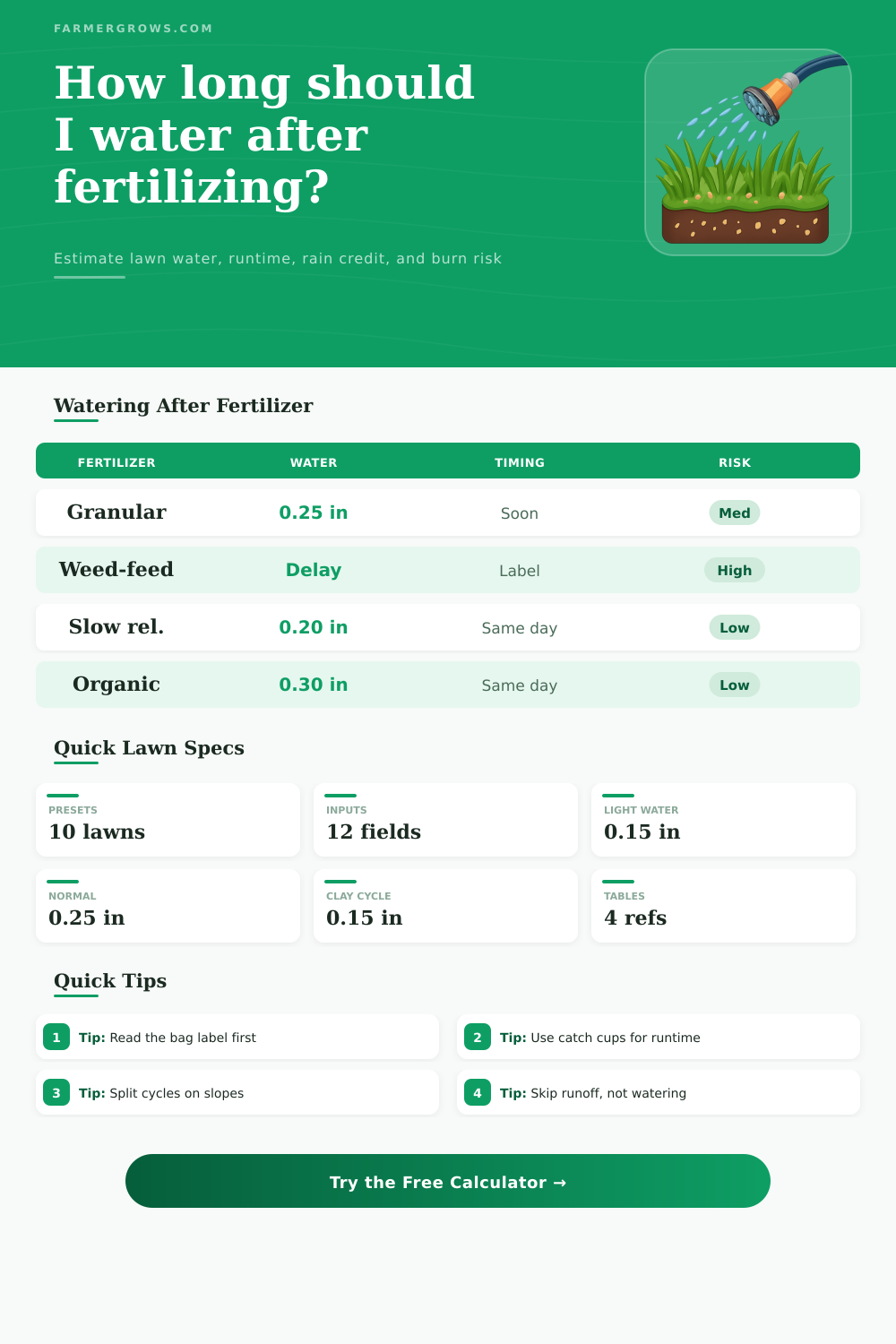
| Fertilizer type | Typical first water | Timing clue | Special caution |
|---|---|---|---|
| Quick-release granular nitrogen | 0.20 to 0.30 in | Water soon after spreading | High salt contact can mark leaf blades in heat. |
| Weed-feed granular | 0.10 to 0.20 in later | Often wait 24 to 48 hours | Follow herbicide label; watering too early can reduce weed control. |
| Slow-release coated fertilizer | 0.15 to 0.25 in | Same day is usually fine | Gentle watering moves prills off leaves without flushing. |
| Organic meal or biosolid | 0.25 to 0.40 in | Water same day | Enough moisture starts breakdown and reduces odor or dust. |
| Starter fertilizer with seed or sod | 0.20 to 0.35 in | Keep surface evenly moist | New roots need more frequent light cycles, not one heavy soak. |
| Soil or surface | Safe water per cycle | Runoff habit | Best watering move |
|---|---|---|---|
| Sandy soil | 0.35 to 0.50 in | Low runoff, fast leaching | Water enough to dissolve fertilizer, then avoid over-flushing. |
| Loam soil | 0.25 to 0.35 in | Moderate intake | One normal cycle works for many fertilizer applications. |
| Clay soil | 0.12 to 0.22 in | Puddles and seals quickly | Split into cycle-soak irrigation with a pause. |
| Compacted or thatchy turf | 0.10 to 0.18 in | Runs off before soaking | Use short cycles and consider aeration later. |
| Moderate to steep slope | Reduce cycle 20 to 45% | Moves fertilizer downhill | Cycle until wet, pause, then finish the remaining depth. |
| Sprinkler output | 0.15 in rinse | 0.25 in water-in | 0.35 in deeper water |
|---|---|---|---|
| 0.25 in/hr slow rotary | 36 min | 60 min | 84 min |
| 0.40 in/hr mixed heads | 23 min | 38 min | 53 min |
| 0.60 in/hr spray heads | 15 min | 25 min | 35 min |
| 0.80 in/hr high-output spray | 11 min | 19 min | 26 min |
| 1.00 in/hr hose-end sprinkler | 9 min | 15 min | 21 min |
| Condition | Lower risk | Higher risk | Watering response |
|---|---|---|---|
| Nitrogen rate | 0.25 to 0.75 lb N / 1,000 sq ft | Above 1.0 lb N / 1,000 sq ft | Use prompt label-safe watering and avoid dry leaf contact. |
| Weather | Cloudy, cool, evening | Hot sun, wind, dry air | Water sooner unless the herbicide label says to delay. |
| Turf condition | Actively growing lawn | Drought-stressed, dormant, new sod | Use lighter repeated cycles and check moisture by touch. |
| Delay after spreading | 0 to 6 hours for standard granular | Over 24 hours in hot dry weather | Water in before prills sit through heat, unless weed-feed needs delay. |
| Runoff | Water soaking into soil | Water moving to gutter or sidewalk | Stop, wait 20 to 45 minutes, then resume. |
Measure one zone: Place several straight-sided cups in the lawn and run the sprinkler for 15 minutes. Average the cup depth to get a real in/hr value for this calculator.
Respect the label: If a weed-feed product says to wait before watering, use the burn-risk result as a caution flag but follow the label timing for herbicide performance.
When the final application of fertilizer is spread, you look up at sky hoping for rain. Now the granules of potassium, phosphorus and nitrogen lies atop your lawn. They are waiting to enter soil. Rainfall will help the process along. As particles settle into the soil, water will carry them off the foliage and deeper in the ground.
If it’s dry out? That’s a problem. Not only can sun scald the tops of grass blades, but heat will also bake granules into a salty solution that harms thatch layer. By then, it’s too late: The roots hasn’t had time to tap the nutrients.
How Much to Water After Fertilizing
Now what? How can you get those fertilizers down where they belong (into the soil)… Without washing them away? Clay soil vs. Sandy loam; quick-release formulations vs. Slow-coated pellets all requires their own timetable. After fertilizing, how much should I water? That’s what this calculator figures out.
How deep does that initial watering has to be? How long will it take my sprinklers to apply that? What is my rain credit? Do I need a cycle-soak regimen? Will the nitrogen rate, plus weather conditions, plus sloped ground, plus soil type plus the kind of fertilizer used causes burning? The tool helps you calculate exactly how much you must water, so no more brown spots in the yard. And it help you avoid a flooded yard.
Most important: What kind of fertilizer? Fast-dissolving fertilizers, such as quick-release granules, need to be wetted down immediately upon use; otherwise they’ll burn the leaves. Caustic if left sitting in sun for even a few hours. An instant-water window is what the tool recommends with such conventional granulars.
With weed-and-feed formulas, the herbicides works only when granules are dry and touching the weeds’ surfaces; therefore, they must stay that way for at least twenty-four hours (some say forty-eight). That’s when the chemical control come into contact with the plant. If you water too soon, you wash away herbicide and waste money on surviving dandelions. The calculator alerts you to this variation, but never overrides the label directions from the manufacturer. Always read bag first.
Confused about soil type? Does an hour of watering realy mean deep soaking? Clay soaks up on top. Water runs off and won’t reach root zone. The timing is cycle-and-soak. You turn the sprinklers on briefly, then stop. Repeat. There are no runoff channels to carry the fertilizer away to gutter.
The tool will adjust its recommended run time according to how much time things take in your soil, whether it’s heavy clay, loamy (a mix of sand/silt/clay), or sandy (the fast-draining variety). Since it holds more water without running off, you don’t need to water for as long than you would with sandy soil, which drains quickly. Soaking a little deeper than necessary on sandy soil mean overwatering, and leaching nutrients too deeply for the shallow roots to access them. With clay, be patient. Infiltration is the goal; no flooding.
Weather matters for burn risk. Is a mild, cloudy evening good for applying fert? There is low stress on the turf. What’s happening with the plants? They’re less active. What about transpiration? Slow. Up the ante with high temps. Eighty-five degrees raise the stakes. Add dry air and you raise the burn risk. Heat causes fast evaporation. Water might not reach root zone before it vanishes. This leaves behind concentrated salts. The calculator accounts for weather conditions. It adjusts the burn risk score. Gentle water may be needed if high risk. Wait till cooler hours, if label allows.
Runoff control is effected by slope. Flat equals even water spread. Hill equals a river. When more comes out of a sprinkler than soaks in, it move. And so does the fertilizer. If your sprinkler output exceeds how fast the soil can soak it up, you’re watering your neighbor’s lawn instead of your own. You are starving your own lawn because the nutrients moves with the water. The solution doesn’t have enough nutrients because you were watering someone else’s yard. With the tool you could of figured out whether to use split cycles or not. There is no unwanted movement.
The tradeoffs of gardening: Lush grass? Yes. There is chemical waste. No. Damaged lawn? Uh-oh. So what’s the right amount of water? That’s a question with a structured answer. It links guesswork to science and anxiety to action. Rain or no rain, you’re no longer worried. You’re in control of the things within your power.
Down go the granules. Up come the roots. Greening out happens the way it should.