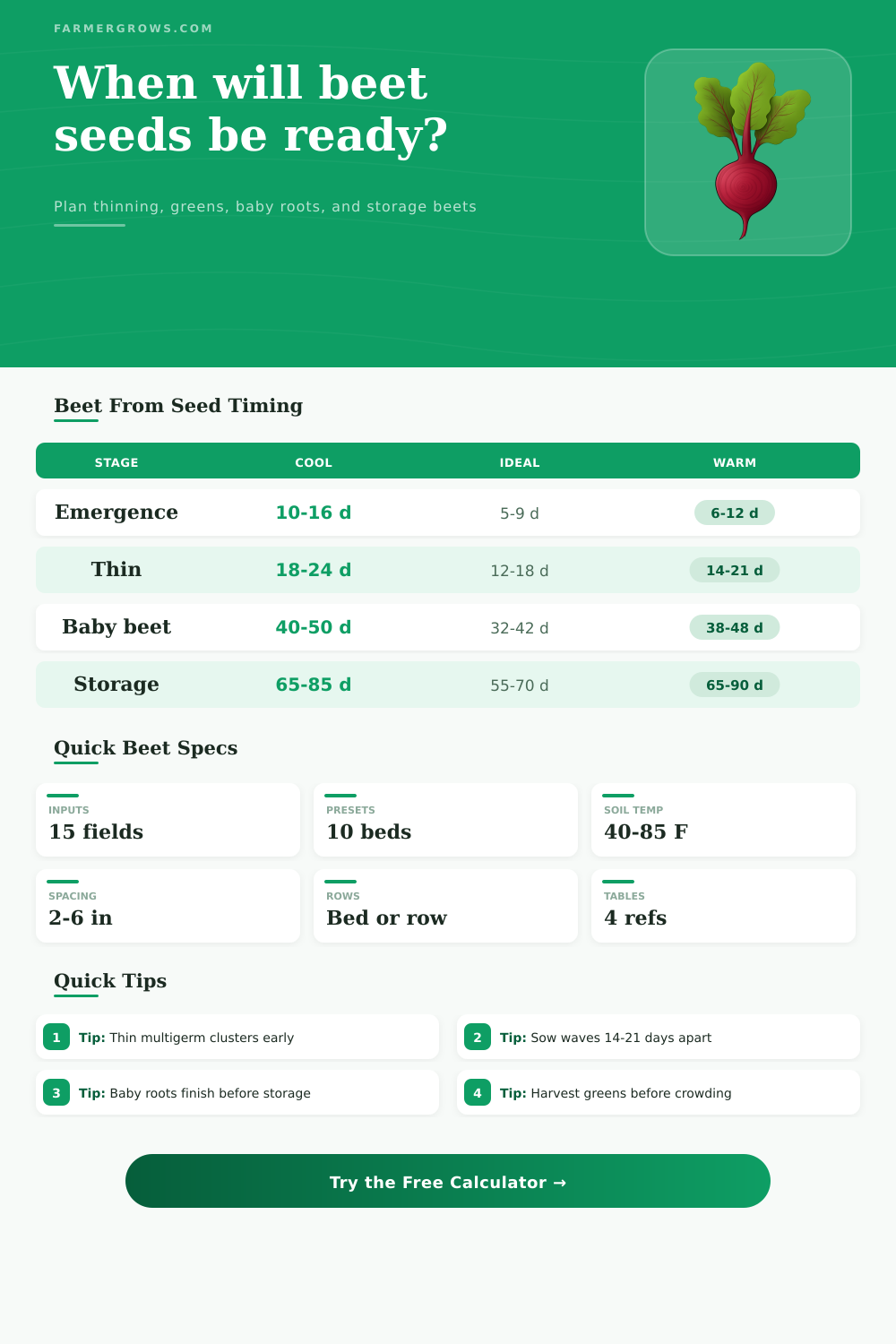
Beet From Seed Growth Time Calculator
Estimate beet seed emergence, seed-cluster thinning, greens harvest, baby beet roots, storage harvest timing, and succession sowing windows from real bed conditions.
This tool starts at direct seeding. It is different from a general beet growth-time estimate because it includes multigerm beet seed clusters, final spacing, row layout, thinning removals, greens harvest timing, and repeated sowings.
Beet From Seed Timeline Results
Dates update from sowing, soil warmth, variety maturity, final spacing, thinning pressure, and succession schedule.
| Soil temperature | Expected emergence | Growth adjustment | Seed-bed note |
|---|---|---|---|
| 40 to 44°F | 12 to 18 days | Add 10 to 14 days | Possible but slow; protect moisture and avoid crusting. |
| 45 to 54°F | 8 to 14 days | Add 3 to 8 days | Normal early-spring beet sowing window. |
| 55 to 75°F | 5 to 9 days | Baseline | Best mix of fast emergence and steady root sizing. |
| 76 to 85°F | 6 to 12 days | Add 2 to 7 days | Keep seed line moist; heat can slow root quality. |
| Cluster sowing pattern | Likely seedlings | Thinning target | Best use |
|---|---|---|---|
| 3 clusters per foot | 5 to 7 seedlings/ft | 2 to 4 plants/ft | Storage roots with low thinning labor. |
| 4 to 5 clusters per foot | 7 to 11 seedlings/ft | 3 to 5 plants/ft | Balanced table beet stand. |
| 6 to 8 clusters per foot | 10 to 16 seedlings/ft | 4 to 6 plants/ft | Baby beets, bunching, and greens. |
| Dense band seeding | 16+ seedlings/ft | Harvest thinnings early | Greens-first plantings only. |
| Harvest stage | Typical days from seed | Root size | Spacing and greens note |
|---|---|---|---|
| Micro thinning greens | 14 to 24 days | No root crop yet | Clip or pull extras before clusters crowd. |
| Baby leaf or small tops | 25 to 35 days | Tiny roots | Remove outer leaves lightly from well-spaced plants. |
| Baby beets | 35 to 50 days | 1 to 1.5 in | Close 2 to 3 inch spacing works well. |
| Table or storage roots | 55 to 85 days | 2 to 4+ in | Use wider spacing for larger roots and storage. |
| Layout | Row spacing | Final plant spacing | Practical result |
|---|---|---|---|
| Intensive raised bed | 6 to 8 in | 2.5 to 4 in | High stand count; thin promptly for smooth roots. |
| Market-garden bed | 8 to 12 in | 2 to 3 in baby, 3 to 4 in table | Good balance of bunches, roots, and hand harvest. |
| Single garden row | 12 to 18 in | 3 to 5 in | Easy weeding and larger roots. |
| Storage beet row | 15 to 24 in | 4 to 6 in | Lower plant count with larger harvest roots. |
Thinning clusters: Beet seed clusters often make two or more seedlings. Thin when leaves are easy to handle, then water the row so remaining roots settle.
Succession timing: Use closer intervals for baby beets and greens, but give storage beets enough calendar time to size before the hard-frost cutoff.
Tillers: Pulling up some tangles of green shoots reminds me that my beet seeds are actualy a little packet of dirt. And when I untangle them, I understand: I have a thinning crisis. Each one isn’t a seed at all, but rather a cluster of embryos, which explains why growing beets feels more like managing a population boom.
Unless you take those clusters into account, your rows gets overcrowded, and the plants starve each other out long before they has time to grow a worthwhile root. After you plug in your estimate of clusters per row and row length, the calculator does the math for you. You don’t have to guess what percent of the germinated plant will make it through till harvest time.
How to Grow Big Beets
Seeds aren’t guaranteed; that’s why we call those germination rates probabilities, and each day delayed reduces them further. The calculator also adds an emergence window adjustment based off your soil temperature. My screen says fifty-eight degrees Fahrenheit now. Remember, the seed is slowed down by colder soil because its metabolism work more slowly. Even in prime moisture conditions, early spring sowings can be slow…until warmth gets into the picture. Then they go.
Most gardeners get squeamish during the thinning part. How can I rip out those nice-looking greens, when they’re all growing? Answer: They never will if left alone. Letting some survive won’t result in any good-sized roots. If beets is crowded, they compete and don’t grow; they just take nutrients. This means that the closer you plant, the more you’ll harvest small ones (as shown in the chart below).
For bigger beets to store overwinter, meaning “storage” types… You’ll need to leave more room. Again: Choose at planting time if you hope for an ingredient for eating now (salad) or something to last all winter in the pantry. Those are two very different plans right from the start, requiring different ways of spacing them.
This biological limitation becomes a feature with succession planting. Rather than sowing it all in place, the production line keeps rolling through staggered sowings. Sow another batch every couple of weeks for a rolling harvest. That’s how fast you can eat what you grow. Plus, it protects against pest pressure: Not all things is vulnerable to pests all at once. There’s a little more up-front scheduling involved. The payoff is fresh beets for several months, instead of an overwhelming weekend of beet digging.
Seed varieties matter much more then many seed catalogs will admit. For everyday cooking, count on Detroit Dark Red to be sweet. For display and to fetch higher prices at the market table, use Chioggia. The Lutz Green Leaf stores well for the winter, which also means you can plant it later. Why? Because each variety has its own pace of maturing, so there’s hardly ever a single date to plan for when you start seeds. Sow those that come up early-ish first and sow ones that need extra time to mature slightly later in the season. And since these latter can withstand some frosty nights, they’re ideal to try a little bit later and have them to eat around fall.
The part that’s not so quiet (and very decisive), is soil prep. Twisted and forking roots shows that beets hate any compacted pockets of rocks. Thick layers of clay are no good either. Sandy loam with good tilth lets the roots spread out freely. As a bonus, compost makes it even better by improving structure, but not too much nitrogen, which can mean lots of leafy growth and small, bitter beets.
Fertilizer goes wrong, too… No one wants to chew on inferior veg, do we? The thing that messes up nice beets is inconsistent watering; it make them bitter. The plants need a consistent watering routine so they don’t crack on the inside (that will also concentrate their sugars in odd ways). Stress-free plants are those that get a slow, steady drip from you, or are carefully handled by hand. Too-fast heat waves can pushes things along too quickly and make them all woody-textured. Keep an eye out and learn to monitor your soil temperature. Use those clues to know when to do things different with your care routine.
Growing seed-grown beets is ultimately a lesson in precision, and patience. You get to decide when it’s time. You get to decide how much space to leave between each plant. And you account for the fact that those seeds grows in a cluster. When it all pays off, you get a lot of sweet, earthy roots that reward your thoughtful care: far superior in flavor to anything purchased at the market.
All you have to do is wait. And to thin early (but never mindlessly), to water regularly, and to let the soil temperature tell you what day it is on your calendar.