Jalapeno Seed Germination Time Calculator
Estimate jalapeno sprout dates, seedling stand, transplant-ready date, and green or red harvest windows from heat mat temperature, seed age, soak, cell depth, humidity, and cultivar timing.
Jalapeno seed usually responds fastest when the cell mix stays warm and steady, not just when room air feels warm. This calculator treats jalapenos separately from bell, generic chili, and superhot peppers by using jalapeno cultivar maturity, Scoville range, transplant age, and green-to-red harvest timing.
Your Jalapeno Seed Timeline
Results combine jalapeno cultivar timing, seed-zone heat, seed age, soak method, humidity, sowing depth, transplant age, and green-to-red maturity.
| Jalapeno cultivar | Green maturity from transplant | Red color add-on | Typical heat range | Germination note |
|---|---|---|---|---|
| Early Jalapeno | 60 to 65 days | 14 to 20 days | 2,500 to 5,000 SHU | Good short-season choice when starts must move quickly. |
| Jalapeno M | 70 to 75 days | 18 to 24 days | 2,500 to 8,000 SHU | Classic green pod timing and reliable seed behavior. |
| TAM Mild | 65 to 70 days | 17 to 23 days | 1,000 to 3,500 SHU | Mild heat, similar sprout needs to classic jalapenos. |
| Mucho Nacho | 70 to 76 days | 20 to 26 days | 4,000 to 8,000 SHU | Large pods benefit from sturdy transplant age. |
| Jedi Jalapeno | 70 to 75 days | 18 to 24 days | 2,500 to 6,000 SHU | Uniform market trays reward even heat and moisture. |
| Goliath Jalapeno | 72 to 78 days | 20 to 28 days | 4,000 to 6,000 SHU | Deep cells help hold larger seedlings before transplant. |
| Purple Jalapeno | 70 to 75 days | Red after purple stage | 2,500 to 8,000 SHU | Specialty color harvest still starts like jalapeno seed. |
| Lemon Spice Jalapeno | 70 to 75 days | Yellow stage, then later red | 2,500 to 8,000 SHU | Warm starts help keep specialty lots uniform. |
| Cell-mix temperature | Likely jalapeno sprout window | Stand effect | Heat mat action |
|---|---|---|---|
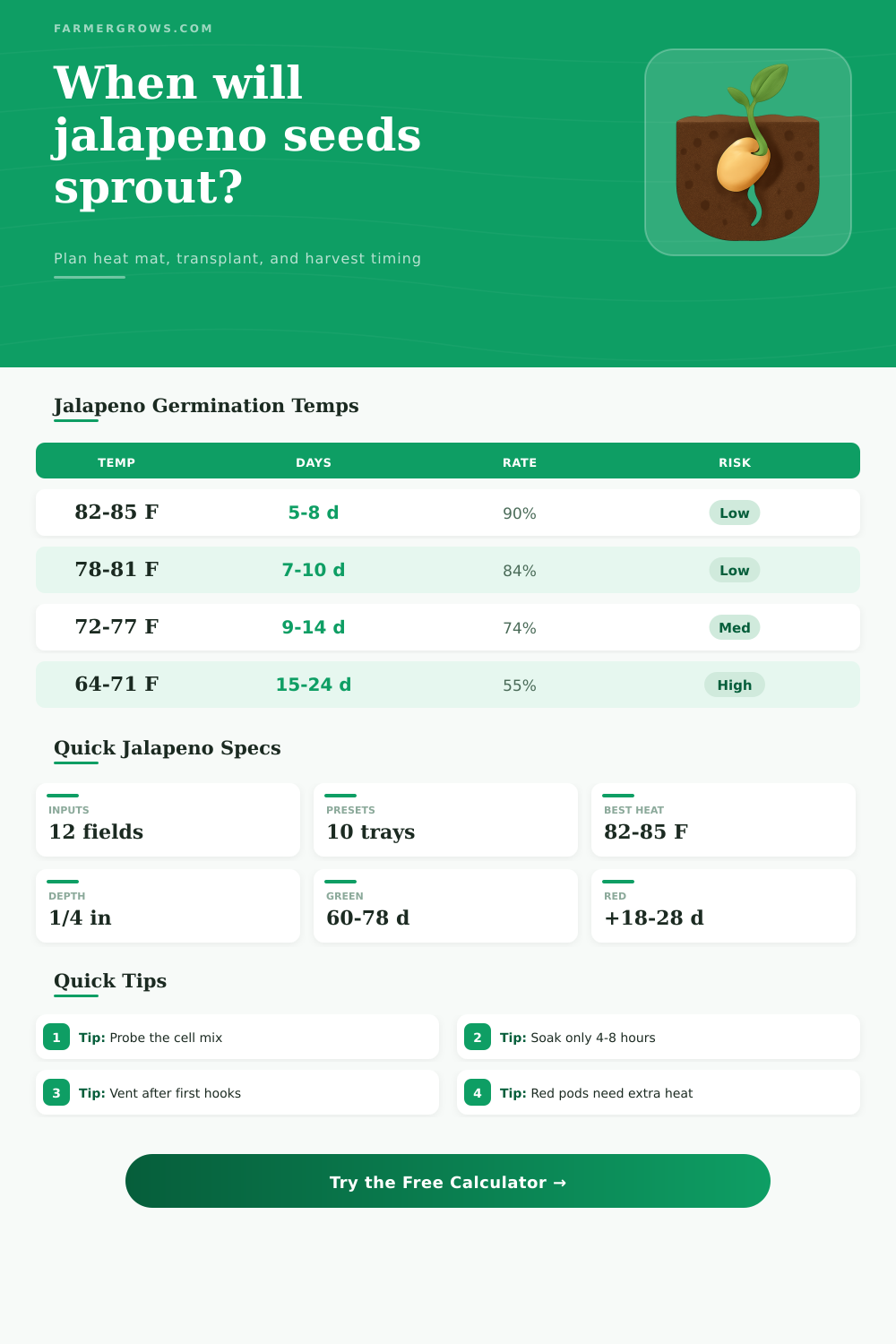
| 82 to 85°F | 5 to 8 days | Strong and even | Use a thermostat probe in a representative cell. |
| 78 to 81°F | 7 to 10 days | Good but slightly slower | Keep dome vented and avoid cold irrigation water. |
| 72 to 77°F | 9 to 14 days | Moderate spread | Raise mat setting only if the cell probe confirms cool mix. |
| 64 to 71°F | 15 to 24 days | Patchy, old seed suffers | Add bottom heat before reseeding the tray. |
| Above 90°F | Unreliable | Heat stress risk | Lower the thermostat and vent covers. |
| Seed age or treatment | Timing adjustment | Stand adjustment | Best jalapeno use |
|---|---|---|---|
| Fresh dry seed | No delay | Baseline stand | Use for full trays and production starts. |
| 1 year stored dry | Add 0 to 1 day | Small loss | Still dependable if packet stayed cool and dry. |
| 2 year seed | Add about 2 days | Noticeable loss | Sow extra cells for target plant count. |
| 3+ year seed | Add 4 to 7 days | Large loss | Run a small pre-test or over-sow. |
| 4 to 8 hour soak | Subtract about 1 day | Small gain | Helpful for dry seed coats, but drain promptly. |
| Over-soaked seed | Add 1 to 2 days | Loss from low oxygen | Rescue lots only; do not soak overnight by habit. |
| Cell and humidity setup | Preferred setting | Calculator effect | Warning sign |
|---|---|---|---|
| Cover depth | About 1/4 in or 6 mm | No delay when moisture is even | Deep seed takes extra days to push up. |
| 128-cell plugs | Check moisture twice daily | Can dry faster at edges | Dry corners before center cells sprout. |
| 72-cell plugs | Balanced jalapeno starting size | Neutral timing | Wet centers if air movement is absent. |
| Deep cells | Best for later transplanting | Small transplant buffer | Cold dense mix if watered heavily. |
| Humidity dome | Vent after first hooks | Improves early moisture | Condensation dripping onto cells. |
| No cover | Only with careful moisture checks | Adds delay and stand risk | Helmet heads and dry seed coats. |
Heat mat tip: Set the mat by the cell-mix probe, not the dial alone. Jalapeno seed wants warm media, while a tight dome can make the top of the tray hotter than the root zone.
Harvest timing tip: Green jalapenos are the early harvest. Red jalapenos need extra warm days after green maturity, so a late start can still produce pickling pods but may miss full red color.
The thing with jalapeno seeds: They’re delicate (unlike, say, bush beans or radishes). The seed coat must softens up, and then the soil beneath them need to hit a certain temperature and maintain it. With that date, the math work out how long your little beauties will wait on the mat before moving upstairs, above ground.
How do I know? There’s a calculator on the page for that, where you enter your heat mat settings, and it tell you when. It takes out all the guesswork about whether or not a chilly corner of your garage might work. Waiting makes me crazy, so this converts the waiting time into actionable tasks; when to move seedling outside and eventually harvest them.
Key Tips for Growing Jalapenos
Air temperature is only one variable, with soil-mix temperature being more critical. Why? Seeds is planted beneath the soil’s surface! A heat mat let you have comfortabley low eighties inside seedling cells, even though the ambient temperature in your basement may be just sixty-eight. Don’t make the mistake of equating air temperature with medium temperature; that’s why so many beginners’ trays succumb to dampness and damping off.
With the tool, you enter two temperatures: the room temperature, and the temperature you measure in your medium. Germination slow down when the soil is cool, sometimes by as much as three weeks, if under about seventy degrees. Cold stress also greatly decrease seed viability.
Genetics matter: If you’re gardening with a particular kind of jalapeno (for instance, TAM Mild instead of Mucho Nacho or a classic Jalapeno M), garden calendar has to take that into account, too. Those jalapenos are all genetically different; some require less time indoors then others do before they can be hardened off, for example. Their green maturity may come sooner or later; see the reference chart.
Some have been bred for smallness and even early heat; others requires more days to get thickness of wall to qualify as a drying type (the jalapenos that become chipotles). For those red ripe pods, plan on adding almost a month to the traditional “harvest” day, which means a big logistical challenge if you’re in an area where summer season is short.
Success depend on seed age as well. You’ll have fast and even sprouting with fresh seed from this year’s packet. With older seed, you should of been patient. Rehydrating the seed coat by soaking for only a few hours in warm water can hastens metabolic activity and get things going again. Don’t leave them sitting in water; they might rot and then you won’t recieve any sprouts at all.
But if you discover a packet of seed aged three or four years, don’t give up hope entirely, but prepare to wait longer for it to start. A small adjustment in technique make a big difference with stubborn seed.
Many gardeners makes mistakes with seedling care. Either waiting too long to set out their transplants or tugging them out too early. With most jalapenos, it’s about six weeks after emergence to get things going outdoors. Ideally, plants will be strong but not rootbound. When you upend a tight spiral of roots circling at the bottom of the seedling cell, that thing is shocked silly in the open ground.
Give them a week or two to harden off gradually so they can stand up to the sun and wind without wilting. According to the calculator, there is an exact day for moving them outside, days from sprouting to transplant-readiness. And then it create a reverse-engineered calendar backward from your intended harvest date.
Jalapeños are no different: It’s less a matter of waving your magic wand, and more one of creating conditions good for growth. Heat. Water. Time. That’s why they can be a challenge for beginners. And that’s also why it makes sense to keep track of those variables in an organized way…so that what was once an exercise in fretting turns into an experiment that tracks results. From then on, it’ll be just a matter of time.