Apple Seed Germination Time Calculator
Estimate cold stratification, warm germination days, first sprout timing, and viable apple seedlings from fruit seed, cider seed, crabapple seed, or stored seed lots.
Apple seeds usually need moist chilling before warm germination. This calculator estimates planning dates and seedling counts; seed-grown apple trees will not come true to the parent cultivar.
Apple Seed Germination Estimate
Timing assumes moist chilling first, then warm germination after seeds move to a tray, bag, or seed pot.
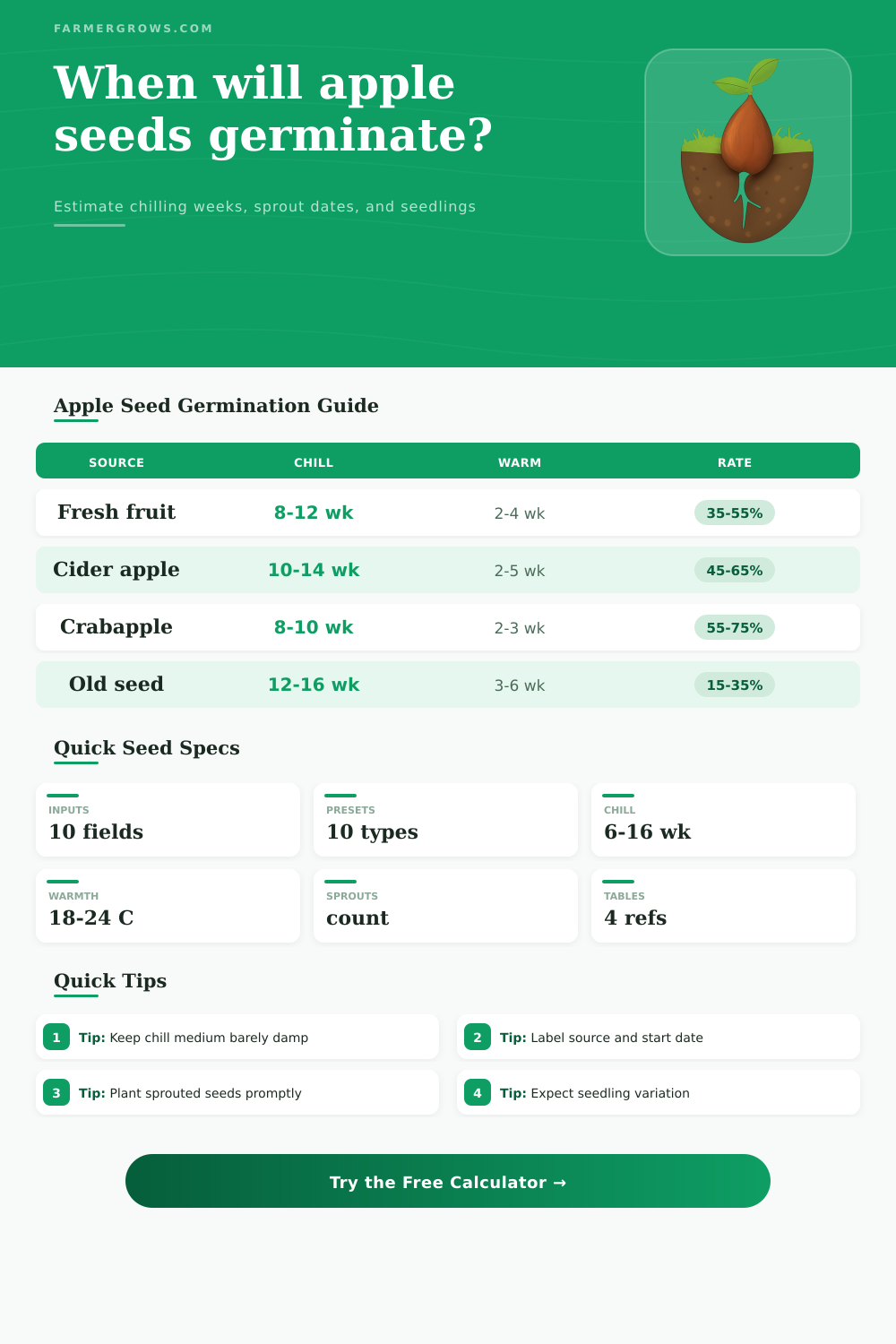
| Apple seed source | Typical moist chill | Warm germination | Expected germination | Use note |
|---|---|---|---|---|
| Fresh table apple, mature brown seed | 8 to 12 weeks at 33 to 41°F | 14 to 30 days at 65 to 75°F | 35% to 55% | Good learning seed, but offspring will vary from the fruit parent |
| Cider press pomace, mixed cultivars | 10 to 14 weeks at 33 to 41°F | 14 to 35 days at 65 to 75°F | 45% to 65% | Often mature seed from diverse pollen sources |
| Crabapple or wild apple seed | 8 to 10 weeks at 33 to 41°F | 10 to 24 days at 65 to 72°F | 55% to 75% | Useful for hardy seedling trials and wildlife plantings |
| Seedling rootstock seed | 10 to 14 weeks at 33 to 40°F | 14 to 28 days at 68 to 75°F | 60% to 85% | Used to raise graftable seedling rootstocks when seed is fresh |
| Old dry seed, more than one year | 12 to 16 weeks at 33 to 41°F | 21 to 45 days at 65 to 75°F | 15% to 35% | Viability drops quickly if seed was warm, dry, or immature |
| Chilling condition | Best range | Too low or too high | Effect on timing |
|---|---|---|---|
| Refrigerator stratification | 33 to 41°F, moist but not wet | Freezing solid or sitting above 45°F | Steady dormancy release and even sprouting |
| Outdoor winter flat | Natural cold with drainage | Warm spells, flooding, or rodent damage | Can work well but dates are less predictable |
| Short chill | 6 to 8 weeks for less dormant lots | Below source requirement | Delayed and scattered germination |
| Long chill | 12 to 16 weeks for old or dormant seed | Ignored for months after radicles appear | Sprouts may elongate in the bag and become fragile |
| Medium | Moisture target | Germination effect | Handling note |
|---|---|---|---|
| Damp paper towel in bag | Evenly damp, no pooled water | Fast to inspect and easy to count | Open weekly for air exchange and mold checks |
| Peat and sharp sand mix | Wrung-sponge moisture | Stable moisture for longer chilling | Good for larger batches and rootstock seed |
| Moist vermiculite | Lightly damp grains | Clean handling and good oxygen | Separate sprouted seed gently with tweezers |
| Sterile seed-starting mix | Damp surface, drained cells | Less transplant handling after sprouting | Keep shallowly covered so shoots emerge cleanly |
| Wet garden soil or heavy compost | Often too wet and variable | Higher rot risk and slower emergence | Use only if drained, pasteurized, and watched closely |
| Seedling type | What seed produces | Predictability | Best use | Grower caution |
|---|---|---|---|---|
| Honeycrisp or Gala seedling | New genetic seedling, not Honeycrisp or Gala | Low for fruit quality and tree habit | Education, trial seedlings, grafting practice | Fruit may take years and may be unlike the parent |
| Antonovka seedling rootstock | Vigorous standard-size seedling rootstock | Moderate for root hardiness, variable for size | Cold-hardy grafting rootstock | Select uniform seedlings before grafting |
| Bud 118 or clonal rootstock seed | Seedling offspring, not clonal Bud 118 | Low for dwarfing traits | Seedling trial only, not a true clonal replacement | Buy clonal rootstocks when exact tree size matters |
| Dolgo crabapple seedling | Hardy crabapple-type seedling variation | Moderate for vigor, low for exact fruit traits | Pollinator, wildlife, shelterbelt, breeding trials | Thin weak seedlings early for airflow and roots |
During stratification: Keep the medium only barely damp, label the seed source, and check weekly. If a radicle appears early, pot that seed rather than waiting for the whole batch.
After germination: Move sprouted seeds into a drained seed-starting mix, give bright light, and grow extra plants because apple seedlings vary widely in vigor, disease resistance, and future fruit quality.
If you’re holding an apple seed, hoping it’ll grow into a tree, what you have on your hands is a bet on its genetic potential. If you’re thinking about planting some, you’re not realy planting fruit; you’re asking when and how many of those seeds might even sprout through all of that. Germinating a seed is less like flicking a light switch than coaxing a gradual chemical reaction along with temperature and a touch of chance (and patience).
Most folks think they’ve flipped the switch, when in fact they don’t know if their fridge time was sufficient to bust out of dormancy or not. That’s where the calculator above comes in: Plug in your number of seeds and length of chill time, and it’ll do the math for you instead of leaving you wondering if you did too little or too much.
How to Grow Apple Seeds
Why don’t apple seeds just sit there waiting for heat? They have their own built-in brake, which we call dormancy, and won’t release until subjected to cold stratification… Think of it like a timer inside each seed that only lets go if winter comes first. No number of weeks of chill followed by moisture can wake the seed embryo unless you provide some time in the cold.
How long have you been working on it? Enter your starting date, along with the duration of your intended chill time (number of weeks), and the tool calculates the day you should be ready. Go too fast and forget the chill, or try to cheat, and what you’ll have are a heap of shriveled husks, not sprouts. That’s where novices mess up: they impatiently rush right to the warm tray without meeting the cold requirement.
Who said it mattered what’s written on the label? What counts genetically is where your seed came from. Even a fresh-picked Honeycrisp isn’t actually a Honeycrisp seed (at least not in the genetic sense). It’s a new combination. The calculator has presets for various seed sources, such as wild crabapple and cider pomace.
With cider, the seeds come from mature fruit that reached full ripeness on the tree, so they usually show good strength. Crabapples tend to be easy to get going, and are good rootstock material as well. If your seeds seem shriveled up or otherwise old-looking, reduce the viability percentage in the input fields to match. The lower that figure, the less false hope the output provides regarding perfect germination rates. This makes the result more realistic: how many viable seedlings should you expect?
Another tripping point is the stratification medium. Vermiculite retains moisture; paper towels are easy to check, but also dry fast. A peat mix stays good longer. This chart details the tradeoffs (rotting potential vs. Moisture holding ability) in the reference tables on the page. Too wet and the seed will rot before sprouting. Too dry and it may fail to even start to go dormant. If there’s any moisture left when it becomes active again, it starts all over again.
You’re looking for a barely damp sponge, not a swimming pool. Just barely damp. Open the bag to let it breathe once a week. And watch for that little white radicle poking through the seed coat.
After that chill comes warmth, specifically 65-75ish F is the sweet spot for sprouting. Too hot? It’ll still go, but risk a weakened seedling. Too cool? All goes slower. With the calculator’s help, you can then plot when to expect the earliest sprouts (and thus also when most of yours are likely to happen). That allows you to plan which seeds get how much space…and what to do about the light schedule.
Sprouted seeds don’t belong back inside the chill bag, or at least not for long. Soon they will want air and light, so plant them into a good seed-starting mix right away.
Experimenting with apple seedlings is all about differences. Some will do well; some won’t. Some will have a good tree habit; some not so much. Some will be more flavorful; some less so. Some will resist certain diseases; some not. By calculating your odds, how many viable offspring there will likely be; the calculator gives you some way to quantify that uncertainty.
Then use it to determine how many pots to sow. Sow multiples and cull the weakies early. Concentrate on the good guys for your fruit trials or grafting. It’s humbling as well as horticultural: Even when you model nature on a spreadsheet, nature doesn’t always play by your rules. But if you give it some good chill time followed by good warmup, the chances is greatly increased.
You should of given it more time. Use fresh seed; be careful to make sure they’re damp but not sodden. Then wait for the signal. See them work their way upward through the dirt, promising all that’s new to come. That feeling remains the same; it is just slightly less scary because you know a bit more about when to do it.