Bell Pepper Seed Germination Time Calculator
Estimate first sprouts, the main germination window, 80% emergence date, and likely seedling count for sweet bell pepper trays before you seed the next batch.
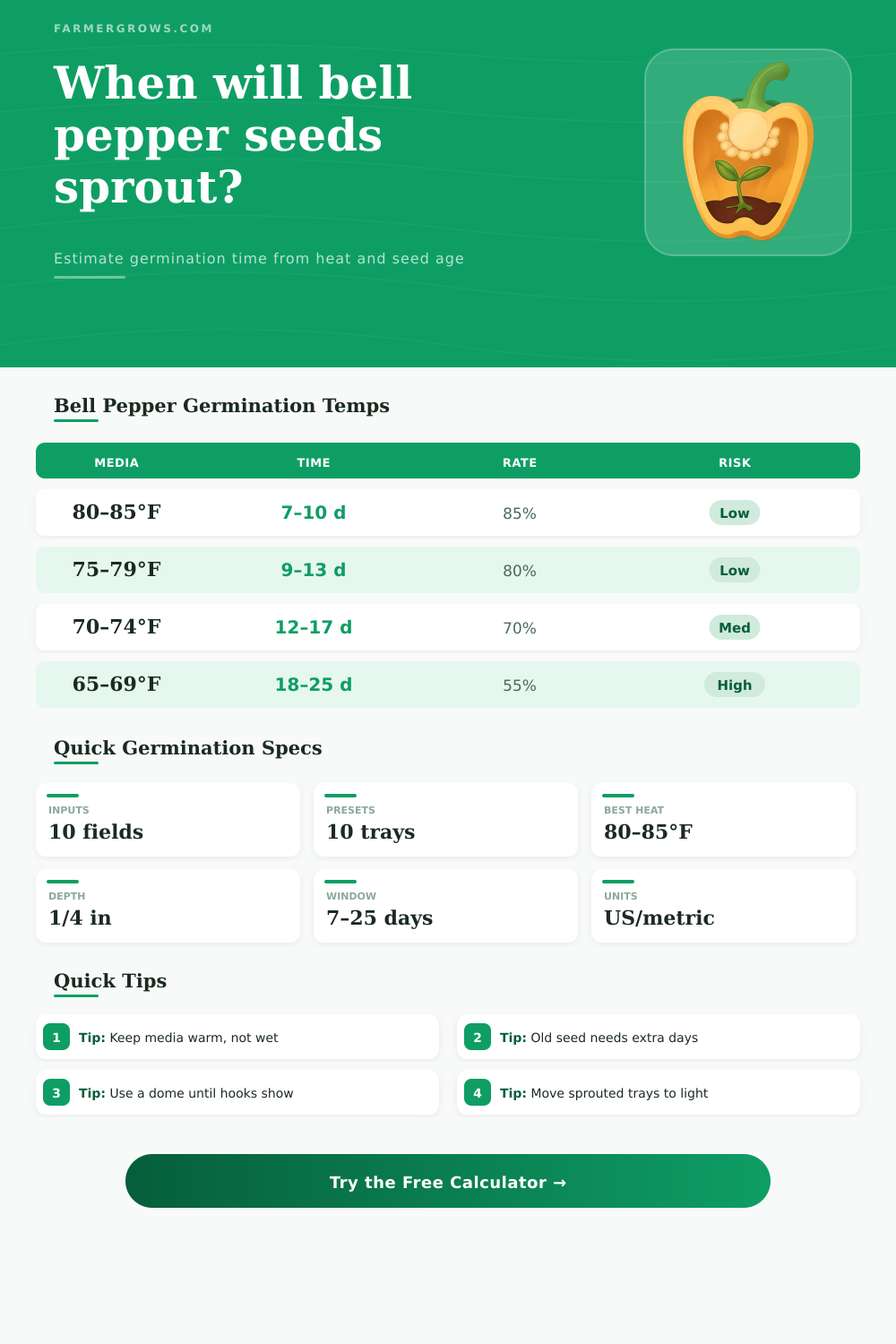
Bell peppers usually germinate best when the seed zone stays near 80 to 85°F. This calculator adjusts that timing for cultivar class, seed age, sowing depth, media type, moisture, humidity cover, pre-soak, and tray temperature stability.
Bell Pepper Germination Estimate
These results use an ideal bell pepper baseline, then adjust for seed-zone heat, cultivar class, media, moisture, depth, humidity, seed age, and pre-treatment.
| Seed-zone temperature | Expected first sprouts | Main emergence window | Typical rate effect | Bell pepper note |
|---|---|---|---|---|
| 60 to 64°F | 20 to 30 days | 24 to 35+ days | Low and uneven | Often not worth sowing unless seed is scarce and time is flexible. |
| 65 to 69°F | 16 to 22 days | 18 to 28 days | Reduced | Common cool-room delay for bell peppers started without bottom heat. |
| 70 to 74°F | 11 to 15 days | 12 to 20 days | Fair | Usable, but slower than the warm propagation range. |
| 75 to 79°F | 8 to 12 days | 9 to 15 days | Good | Reliable range for many sweet bell pepper trays. |
| 80 to 85°F | 6 to 9 days | 7 to 12 days | Best | Fast, even emergence when moisture and air exchange are balanced. |
| 86 to 90°F | 6 to 10 days | 8 to 14 days | Variable | Can work, but dry edges and overheating become easier. |
| Bell pepper seed age | Time adjustment | Rate adjustment | Tray planning note |
|---|---|---|---|
| Fresh, current season | No added delay | Use full expected rate | Best for uniform 72-cell, 98-cell, or plug-tray stands. |
| 1 year old | Add about 1 day | Subtract about 4% | Usually still strong if stored cool and dry. |
| 2 years old | Add about 2 days | Subtract about 10% | Sow extra cells for market-garden starts. |
| 3 years old | Add about 4 days | Subtract about 20% | Use a germination test before filling many trays. |
| 4+ years old | Add about 6 days | Subtract about 35% | Expect a long tail of late sprouts and empty cells. |
| Starting media | Water behavior | Timing effect | Best bell pepper use |
|---|---|---|---|
| Fine sterile seed-starting mix | Even if pre-moistened | Fast baseline | Small lots, home trays, and consistent cell packs. |
| Peat plug or propagation plug | Stable but can dry at edges | Slightly fast | Greenhouse plug trays with a thermostat bench. |
| Coir-based seed mix | Good air space when not packed | Neutral | Warm rooms where peat dries too quickly. |
| Soil block with compost | Can cool after watering | Slower | Organic starts when blocks stay warm and evenly moist. |
| Rockwool cube | Very wet if not drained | Fast when aerated | Hydroponic bell pepper starts and clean bench work. |
| Screened garden soil | Variable drainage | Slow and uneven | Small tests only; disease pressure can be higher. |
| Depth or moisture issue | Delay used | Stand effect used | What to check |
|---|---|---|---|
| Depth near 1/4 in | No penalty | No penalty | Seed is covered but not buried deep. |
| Very shallow surface sowing | Add 1 day | Subtract 5% | Dry seed coats and stuck helmets are more likely. |
| Deeper than 1/2 in | Add 2 to 4 days | Subtract 8% to 14% | Bell pepper seedlings may exhaust energy before emergence. |
| Wet or saturated mix | Add 2 days | Subtract 12% | Look for poor air space and possible damping-off pressure. |
| Dry-to-wet cycling | Add 3 days | Subtract 15% | Re-wetting after seed imbibes can make stands patchy. |
Temperature note: Measure the seed-zone media with a probe. Bell peppers respond to the warmth around the seed, and a tray on a cold bench can lag even in a warm room.
Timing note: Move trays to strong light as soon as hooks appear. The calculator estimates germination, so stretch, damping-off, and transplant readiness still depend on post-sprout care.
Ten days go by and your bell pepper seed has not sprouted. Have they died? Or have you simply forgotten to water the tray of little black seeds pressed onto sterile soil? What’s more annoying: Nothing appears by day five, so who knows? Turns out there’s a tool (or set of tools) to help you model variable for yourself, meaning a rough schedule instead of guesswork.
Spinach and radish get a jump on bell pepper, which loves to grow in warm soils around 80-85°F. Below that range, metabolic processes in the seed stall out. It doesn’t kill them; they’ll keep growing, but slowly. That’s an embryo, by the way. This is why knowing what really happens where you’re growing is more important than just looking at general package directions. Everyone thinks their house is some particular temperature (mine says it’s 70, for instance) but maybe bench with the tray of seeds on it isn’t. Once you key into the actual temperature of the medium, there’s a calculator that can do the rest, and you won’t have to assume room heat is doing the heavy lifting for root growth.
Why Seeds Take Time to Grow
Germination success depends on seed age: Even if a packet is marked “2021,” it can appear perfectly good on the shelf, but is not nearly as viable as it once was. The fresher the seed, the faster it will sprout and force itself up out of the ground, before any rot gets a foothold. Older seed absorbs moisture more gradually and will linger at the soil surface longer. More time soaking wet increases the likelihood of damping off (fungal) trouble taking down trays overnight. Charts shows how germination rates decline as seeds get older each year. This shows why sowing extra seeds is a matter of statistics rather than just being hopeful.
The timing also depends on how deep you plant. Squash or bean seeds are plump with stored-up energy; they can muscle their way up through several inches of soil. Not so with bell peppers, whose seeds are tiny. If planted a quarter inch or deeper, they runs out of steam long before breaching the surface. What appears to be rotting has realy just run out of energy. To get off to a good start, keep the covering light enough so those earliest leaves see daylight fast.
Once the seedlings pop, light trumps warmth. A too-long stay in a humidity dome after emergence results in floppy stem. Go ahead and uncover as soon as any tiniest hook of green appears, then encourage sturdy development.
Media type affects consistency and speed: Sterile fine mix retains an even level of moisture and doesn’t compact. Plugs in peat retain moisture well, but may dry out on the edge unevenly if you don’t check them everyday. Rockwool cubes is aerated nicely but need to be watched carefully so they don’t get soaked. Each of these media affects how fast the water reaches the seed coat. This tool accounts for different media types; it gives you a real-world view rather than a best-case scenario. It factors in both temperature stability and moisture level.
Peppers take time to germinate. Time to grow up. Time to fruit (well, if you’re in my zone). Biology is something we cannot control. We can only set the conditions, when they come out, how deep under the soil, and how hot it gets, and then we wait and see what happens. If you model this ahead of time, the tray of nothing doesn’t make you anxious anymore; it makes you expectant. It’s a waiting game, yes, but you know where it stands, so you don’t check again till you should of.