
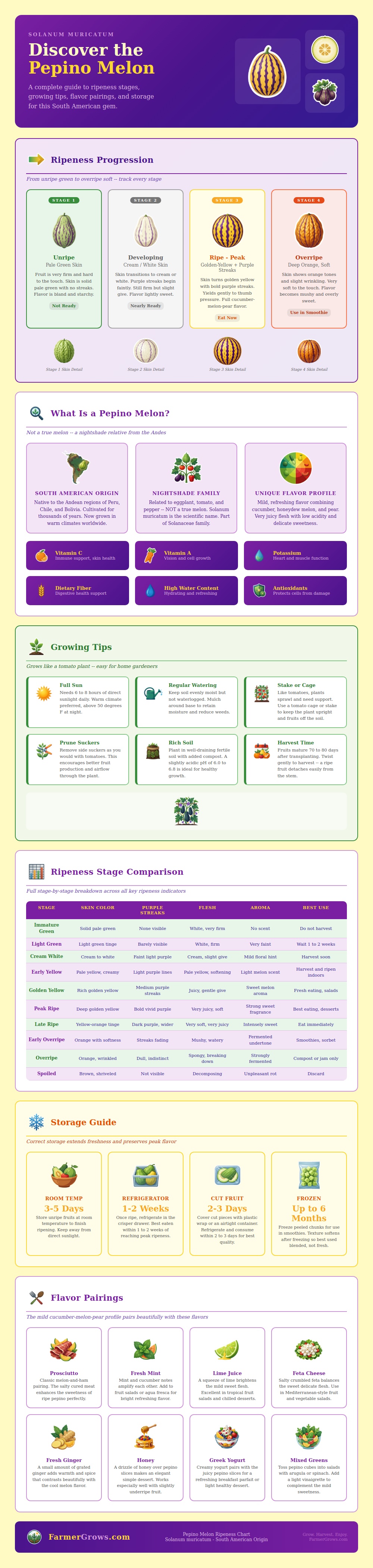
If you’ve ever purchased what appeared to be a promising fruit only to find yourself eating something that tastes like damp cardboard, then you know the pepino melon dilemma. Why, when they’re so highly praised by such a fancy name, don’t these fruits live up to expectations? More often than not, the answer isn’t the fruit at all. Rather, it’s timing. Unlike your usual honeydew or watermelon, these South American nightshade fruits doesn’t work in quite the same way. There’s a rhythm they follow, one that is easy to miss if you don’t want to waste perfectly good fruit. Here is exactly what happens to the skin of a pepino melon, step-by-step, as it changes from that insincere pale green to the real-deal golden yellow we desire right there on the package. Get your expectations in line first thing by understanding what you’re buying.
Yes, this is a fruit. But it’s not remotely related to actual melons. A closer cousin of the cantaloupe and cucumber? No: More closely related to eggplants and tomatoes because those are all members of same family, Solanaceae. So that’s part of why it behaves as it does.
How to Tell When a Pepino Melon Is Ready to Eat
A pepino likes warm weather (no surprise there, given its tomato-cousin connections), and will also require full sun if you are intending to grow it yourself. As with a vining tomato, it is aggressive-spreading and requires some form of substantial support. Have you ever planted one and found it flopping over onto the ground next to time you checked on it? Chances are you didn’t provide any stake at all. It is easy enough to do but it will make quite a difference in how well it performs at harvest.
When you do get around to cracking one open at its prime, however, it’s all up in the kitchen that the magic begins. Despite its mild appearance, this fruit has a surprisingly complex flavor. Somewhere between a pear and a honeydew melon crossed with cucumber, with a definite cut of freshness from the latter. It’s not watery but juicy, and crispy until perfectly ripe, when it becomes soft enough to melt in your mouth.
Because of this versatility, it’s perfect for salads in which you’re looking for something sweet to counterbalance salty cheeses or bitter greens. A classic combination: a couple slices of prosciutto draped over a ripe pepino, the salt brings out the natural sugars without drowning them in the process.
Most folks get tripped up at this point: storage. The fruits are still going to ripen after picking, so placing them in the refrigerator too soon stops all ripening activity. To test whether yours are ready to go into the fridge, place them on the counter (out of the sun) and let nature take its course. The change will occur over a couple of days if there is still some hint of green on the outer skin. When they become slightly soft to gentle pressure and also develop a slight floral aroma, that’s the time. Pop them in the crisper drawer of your fridge and you can expect to enjoy them for about two weeks more.
You can also simply cut into one and find that it’s not quite ripe enough. Just give it another day or two on the counter. The secret ingredient? The secret is patience. For me, there’s a sweet spot; a moment in time where it tastes best ever. As the chart explains, that’s when the color of the fruit develops fully: the stripes turn bright and clear on the golden base of the fruit. That contrast is your clue.
If the color fades (the stripes dissapears) and the fruit starts to get wrinkly, the texture gets gunky and the flavor can start to go off, taking on a fermented quality. Not bad, not good to eat straight up, though it’s not too late to make sorbet or jam with it. But fresh eating is no longer ideal. One year of experience looking at the clues will teach you to read the signs. Buy yourself some at various stages, then taste your way through. Soon enough you’ll know what the golden color looks like.
If you’re in a warm spot or have a very big container with some sun, growing your own is easier than you may imagine. Just sow the seeds and watch them take off. Keep the ground consistently moist, but cut out any side shoots as they form to promote more fruit and less foliage. These guys don’t like getting beat up by the weather, which is why a bit of protection helps.
Wait until the fruit is ready. It will slip gently right off its stem if twisted gently. Don’t yank. No dice? Not ready. A low-maintenance plant that repays you with some seriously good fruit… Nutritious, hydrating, and delicious.
Next time you’re tempted by a pepino melon at the market, don’t dismiss it as something bland-looking that you’ll never try. Examine its skin more closely. Do you spot the purple marks? Gently cradle it in your palm and give it a squeeze. No, it’s not just some other strangely shaped novelty food item. It’s a gem, and a misunderstood one waiting for the right time. Just a little care and attention to detail; and patience until fully ripe, and you’ll find out what all the fuss has been about this Andean fruit that’s been growing on people’s plates for thousands of years.
It’s worth waiting for.