Cucumber Seed Germination Time Calculator
Estimate when cucumber seeds should sprout from soil temperature, seed age, planting depth, moisture, heat support, medium, and days already waited.
This calculator focuses on germination and seedling readiness. It estimates sprout timing from seed-starting conditions, not cucumber harvest dates or full-season growth time.
Cucumber Germination Estimate
Results combine temperature response, seed age, planting depth, moisture, heat support, and medium effects.
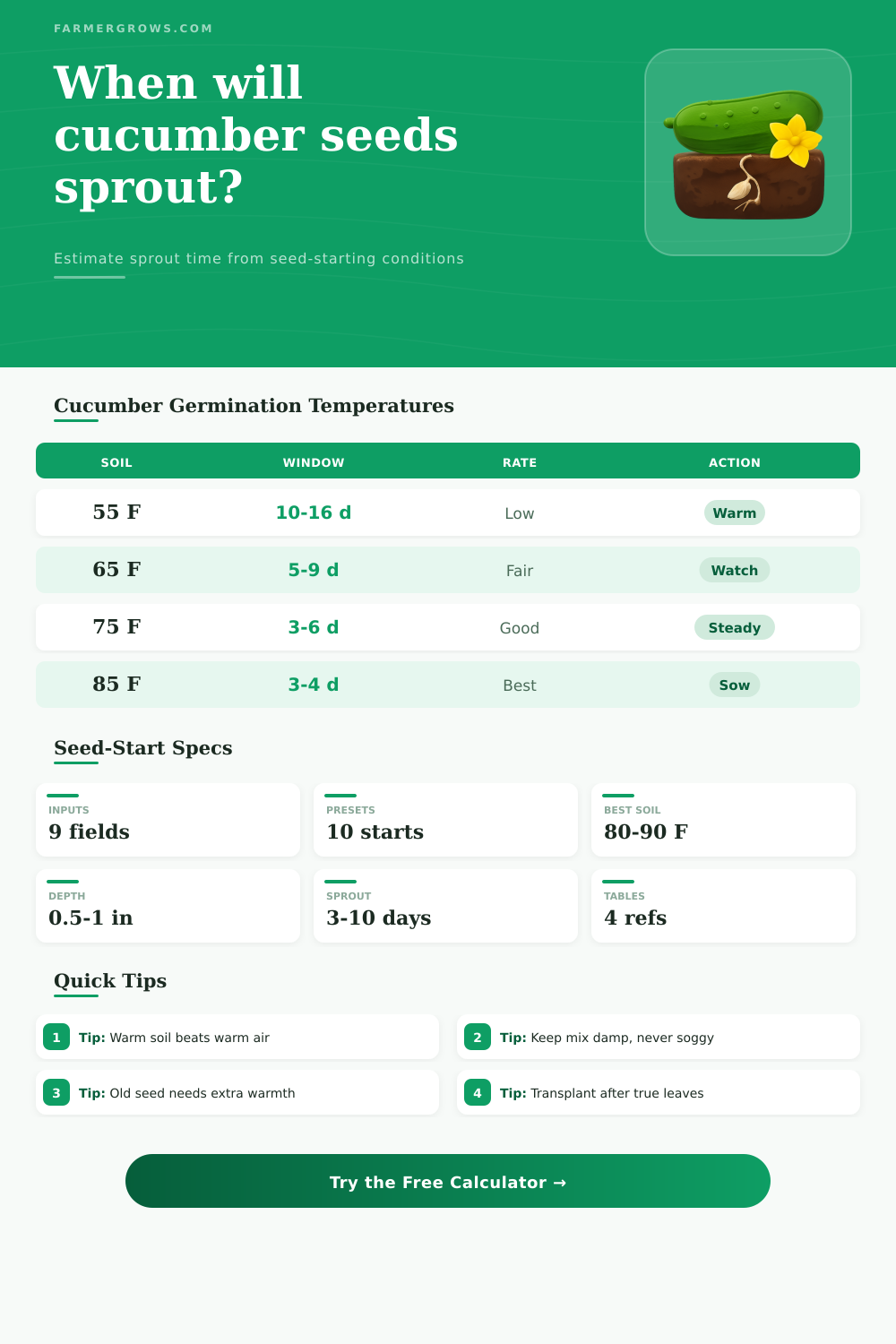
| Soil temperature at seed depth | Estimated sprout time | Reliability | Practical action |
|---|---|---|---|
| Below 50°F / 10°C | Unreliable | Very low | Wait, warm the bed, or start indoors |
| 50 to 54°F / 10 to 12°C | 14 to 21 days | Low | Use fresh seed and avoid soggy medium |
| 55 to 59°F / 13 to 15°C | 10 to 16 days | Fair-low | Bottom warmth is strongly helpful |
| 60 to 64°F / 16 to 18°C | 7 to 12 days | Fair | Keep the medium evenly damp |
| 65 to 69°F / 18 to 21°C | 5 to 9 days | Good | Check cells daily after day 5 |
| 70 to 79°F / 21 to 26°C | 3 to 7 days | Very good | Ideal for indoor starts without excess heat |
| 80 to 90°F / 27 to 32°C | 3 to 4 days | Best | Remove covers as soon as sprouts appear |
| Above 95°F / 35°C | Erratic | Reduced | Shade trays or lower heat mat setting |
| Variety type | Typical germination habit | Seed-starting note | Calculator factor |
|---|---|---|---|
| Standard slicing cucumber | Baseline 3 to 10 day range | Good all-purpose reference for home gardens | Normal |
| Pickling cucumber | Often quick and uniform | Good for succession sowing and small cells | Slightly faster |
| Persian or mini cucumber | Fast under warm tray conditions | Keep seedlings moving to avoid root circling | Fast |
| English greenhouse cucumber | Can be slightly slower | Benefits from stable warmth and clean medium | Slightly slower |
| Burpless cucumber | Usually close to slicing types | Avoid chilling after emergence | Slightly slower |
| Lemon or specialty cucumber | May emerge less uniformly | Sow an extra cell if seed is older | Slower |
| Planting depth | Emergence effect | Moisture risk | Best use |
|---|---|---|---|
| Surface to 0.25 in | Can dry before root grabs | High drying risk | Only for covered sprout tests |
| 0.5 in | Fast and reliable in fine mix | Low if misted evenly | Small trays, plugs, soil blocks |
| 0.75 to 1 in | Strong all-around depth | Moderate if mix is heavy | Indoor cells and direct sowing |
| 1.25 to 1.5 in | Slower, especially in cool soil | Higher rot risk | Warm sandy beds only |
| Over 1.5 in | Delayed or failed emergence | High in dense medium | Usually too deep for cucumbers |
| Seedling stage | Approximate timing after sprout | Transplant readiness | Handling note |
|---|---|---|---|
| Cotyledons open | Day 1 to 3 | Too early | Give bright light and steady moisture |
| First true leaf showing | Day 7 to 12 | Almost ready for protected spaces | Begin gentle hardening if weather allows |
| 2 true leaves | Day 14 to 18 | Good for careful transplanting | Keep root ball intact |
| 3 true leaves | Day 18 to 24 | Strong target window | Plant before roots circle the cell |
| Vining in tray | After 25+ days | Late | Transplant soon or step into a larger pot |
Warm the root zone: Cucumber seeds respond more to soil temperature than room temperature. A thermostat-controlled mat is best when the mix is below 75°F.
Decide when to resow: If warm, fresh seed has not emerged a few days beyond the high end of the estimate, open one cell and check before waiting another week.
When cucumber seedlings emerge, it’s on their timetable… Not the one you marked on your calendar when you planted them. But which date? That vary much more depending off the soil temperature, seed age, planting depth, and moisture than it does to the calendar date you chose to sow.
It often happens just a few days earlier or later, and not always in the same direction. Whether the roots were in that very specific range of temperatures that cucumbers really like can make the difference between an even row of plants, and a patchy one in the tray. You know what this is like if you’ve ever sown seed in one location in your home and gotten very different results from another flat. That flat might have been sitting on a bench next to a vent instead of a windowsill. Yes, it’s all the same air, but somehow it looks as though those cucumbers are days apart.
What Makes Cucumber Seeds Grow Fast or Slow
This happens because the medium itself was cooler or warmer than the air temperature, which is how these guys react. Seeds just hang tight till cool nights suck the soil temperature downward despite the fact that the thermostat reads otherwise. You put in real conditions, and the calculator up top does the math for you.
Beyond the first or second year, seed age are nearly as important because older seed has lost vigor. The “window” expands; and less of it will sprout successfuly. Likewise, planting depth matter. If it is too shallow, the seed may dry out before root penetrates, but if it is too deep, the shoot will have trouble breaking free of darkness (particularly with a heavy or cool mix).
All of that interacts with two other variables: Bottom heat can shaves days off the waiting time if your mix is running cooler than ideal; even moisture support the process by keeping the seed coat cracked but not resealing unevenly. All of this is fed into the tool. It then gives you a transplant readiness range (will the seedling be ready when it’s needed in the tunnel or garden?) and an emergence window. This helps you decide how likely things are to work out given the variables.
I’ve found that running various scenarios can teach other less-sung lessons: small tweaks add up quickly. Planting a half-inch deeper in coarser seed-starting medium instead of garden soil can make a big difference if you’re succession sowing. Using a simple heat mat instead of one with a thermostat can also move things along significanty. The page’s reference tables lays out the patterns, including how depth affects temperatures, so you don’t have to guess.
So does this: When do you call it and resow? In general, if you’re a few days beyond the top end of the range, and the medium’s remained consistently moist, take another peek at one cell before deciding all the flats is dead. Yes, cucumber seed’s cheap; no, you don’t have perfect plants right out of the gate. But what it will teach you is where your manipulable conditions exist versus those that just require more time.
You should of seen how much timing matters.