Zucchini Growth Time Calculator
Estimate zucchini emergence, first flowering, pollination-to-pick timing, first harvest date, frost buffer, plant count, and expected harvest weight from variety, soil temperature, spacing, harvest size, and watering.
Zucchini grows fast once nights are warm, but the useful harvest date depends on more than packet maturity. This planner adjusts for cool soil, transplant recovery, watering, crowding, frost risk, pollination timing, and the size you actually want to pick.
Classic garden zucchini for steady picking at 6 to 8 inches, usually the easiest timing estimate.
Costata types often need a little more room and may trade raw yield for eating quality.
Golden fruit is easy to find before it oversizes, which helps keep new flowers coming.
Pick at tennis-ball size for stuffing or grilling; oversized fruit changes yield math quickly.
Greenhouse or tunnel zucchini can beat outdoor rows when nights are cool or pollinators are scarce.
Zucchini Growth Estimate
Calculated dates will appear here after the inputs are checked.
| Variety preset | Type or habit | Typical days | Harvest size | Planning note |
|---|---|---|---|---|
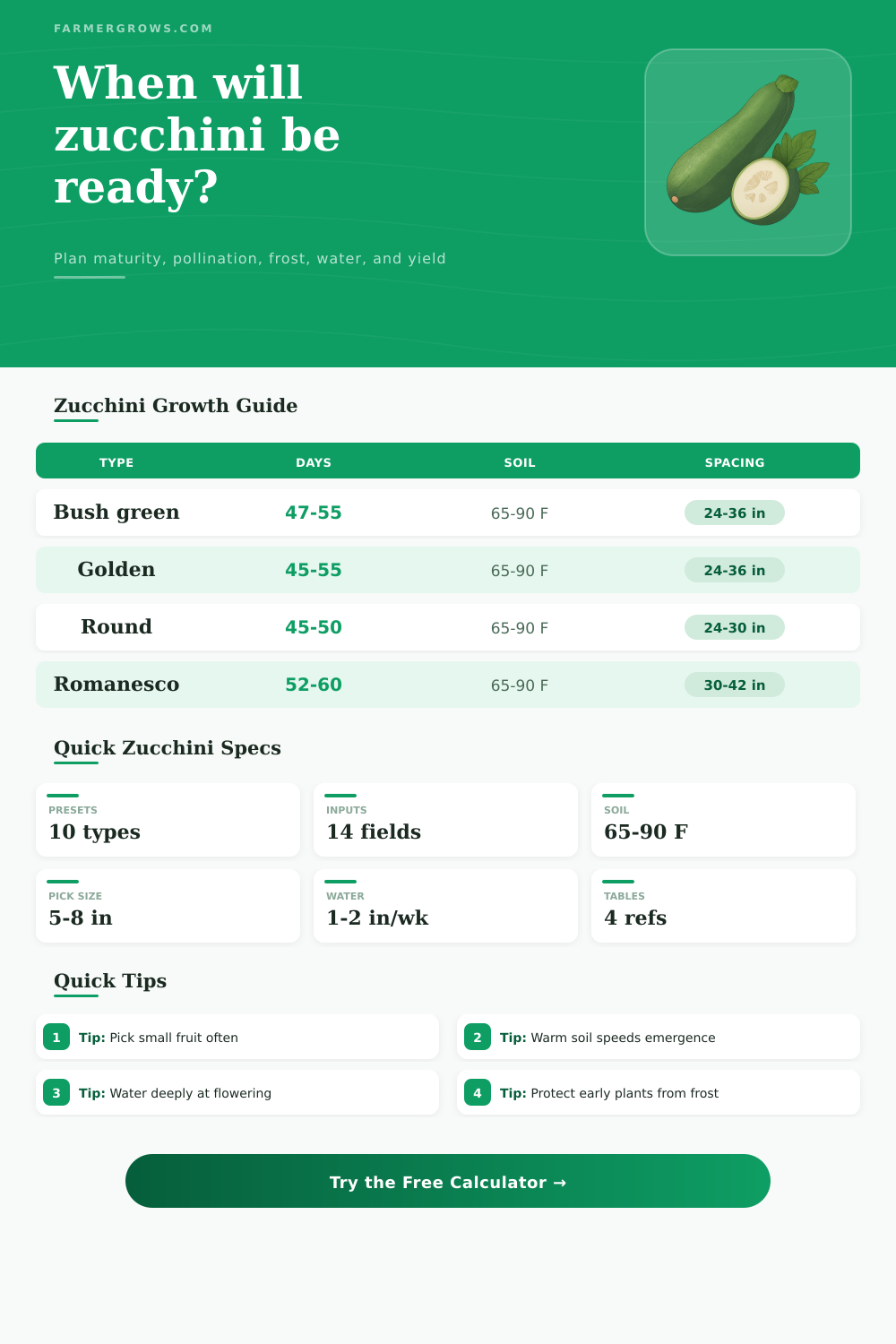
| Black Beauty | Classic green bush | 50 days | 6 to 8 in | Reliable all-purpose garden zucchini. |
| Costata Romanesco | Ribbed Italian | 52 to 58 days | 6 to 10 in | Give wider spacing for large leaves and airflow. |
| Cocozelle | Striped heirloom | 52 to 55 days | 6 to 8 in | Good flavor when picked before seeds enlarge. |
| Gold Rush | Golden zucchini | 45 to 50 days | 5 to 7 in | Bright fruit is easy to spot for frequent picking. |
| Eight Ball | Round bush | 45 to 50 days | 3 to 4 in | Harvest small for stuffing and tender skins. |
| Partenon | Parthenocarpic | 48 to 52 days | 6 to 8 in | Useful in tunnels where pollinator visits are limited. |
| Soil temperature | Expected emergence | Timing adjustment | Stand quality | Grower move |
|---|---|---|---|---|
| Below 55°F | Poor or stalled | Add 12 to 16 days | High rot risk | Wait, warm the bed, or transplant later. |
| 55 to 59°F | 10 to 14 days | Add 8 days | Slow and uneven | Use row cover and avoid wet seedbeds. |
| 60 to 64°F | 7 to 10 days | Add 4 days | Workable | Good early range with protection. |
| 65 to 75°F | 4 to 7 days | No delay | Good | Best balance for direct sowing. |
| 76 to 90°F | 3 to 5 days | Fast start | Strong if moist | Mulch after emergence to hold water. |
| Above 95°F | Variable | Add 4 to 7 days | Heat stress | Shade new seedlings and water carefully. |
| Planting layout | In-row spacing | Row spacing | Best for | Timing effect |
|---|---|---|---|---|
| Compact bush | 24 to 30 in | 36 to 48 in | Raised beds, small gardens | Fast canopy, watch mildew. |
| Standard bush | 30 to 36 in | 48 to 60 in | Most home rows | Balanced airflow and yield. |
| Large heirloom | 36 to 42 in | 60 to 72 in | Costata and wide-leaf types | Better airflow, fewer disease delays. |
| Container plant | One plant | Large pot | Raven or compact types | Water drives most timing risk. |
| Market bed | 24 to 30 in | 48 in | Frequent picking blocks | Productive if irrigation is steady. |
| Maturity and yield factor | Typical range | Fruit per plant | Weight per plant | Harvest note |
|---|---|---|---|---|
| Early hybrids | 45 to 50 days | 8 to 14 | 4 to 8 lb | Pick young to keep new flowers forming. |
| Classic green bush | 48 to 55 days | 10 to 16 | 5 to 10 lb | Works well for regular home harvests. |
| Italian ribbed types | 52 to 60 days | 7 to 13 | 4 to 9 lb | Flavor-focused, often wider plants. |
| Round zucchini | 45 to 50 days | 10 to 18 | 3 to 7 lb | Small harvest size increases picking count. |
| Protected early crop | 48 to 55 days | 12 to 20 | 6 to 12 lb | Pollination method and ventilation matter. |
Once female flowers begin setting, check plants often. A zucchini that is perfect today can become oversized in only a few warm days.
If the first harvest arrives late, update the soil, watering, and harvest-size inputs. The revised window will better match the rest of the season.
Zucchini are fast growers (and therefore should matures rapidly). But that’s just one factor among many that affects the timing of your harvest. Weather, for example, can delay harvest. Incorrect spacing, improper starting methods, and cooler soil can also delay it, knowing the variables means knowing roughly when to expect a crop to mature.
Seedling emergence depend on soil temperature. When it’s cool, things will stall and roots won’t form as well (and entire schedule shifts). Also, overcrowding will mean competition for air and light. That will slow down fruit set and encourage disease that can dooms future crops. Once flowers open, watering style determine whether fruit fills out evenly or not. Squash need sufficient water… But not so much that they invite rot. Such are the tradeoffs when you’re trying to align a harvest with your kitchen needs different than a seed packet date.
How to Predict When Zucchini Will Be Ready
First, enter your variety (and start method), target harvest size, frost dates, and other factors like spacing pressure and water profile. This calculator compute the base maturity number and adds adjustments based off those factors, such as soil condition or transplant shock. It then estimates the date the first female flower appears and calculates how many days later the fruit will be ripe to pick. It will display the estimated yield across the planned area, too, and tell you how far ahead of any fall frost there’s a buffer. This is all good stuff if you’re trying to figure out just how many plant to grow or how heavy your total crop might be.
This is especially true with zukes, since the total weight and plant count change fast depending on whether you prefer big slicing fruit or baby zucchini. I think a lot of gardeners undervalue the fact that the first couple week set the tone for the whole season. Emergence is delayed if soil was cold, which moves the pollination window… And thus pushes peak of picking right up next to frost time. Inconsistent watering and spacing the plants too closely have the same effect: the plants bear fruit, yes, but on a changed rhythm that result in a gap or a glut. Knowing more about the inputs you use and adjusting them helps you predict when you’ll have a reliable supply.
That’s another way the equation depend on what kind of harvest you want. If you pick small fruit, it will continue making more flowers. This extends your season length (more weeks) and your overall crop (more fruit). On the other hand, if you let some fruit get bigger, moving focus from flower-making back toward seed production, the number of subsequent fruits will be fewer. Each option simply result in a very different outcome in both volume and timing.
You can use the calculator to try the trade-off yourself right now, rather than having to guess based off planting decisions after the fact. You’d think zucchini would be an all-or-nothing deal… Not so. Details matter; get your numbers right and see how a row goes from promising to not-so-much in no time flat, thanks to a cool spell of weather or being overly optimistic about spacing.
You should of known that. Because it’s such a short season, the importance of nailing down your timing the very first time around cannot be overstated. Actualy, it naturaly can.