Tomato Seed Germination Time Calculator
Estimate tomato sprout timing, remaining wait, seedling confidence, and transplant readiness using variety type, soil temperature, seed age, planting depth, heat mat, dome, light, and sowing date.
Use this for seed trays, soil blocks, plug flats, and small nursery batches. Tomato seed lots vary, so confirm with packet dates, local disease pressure, and actual media temperature at seed depth.
Tomato Seed Timing Estimate
Estimate updates after calculation.
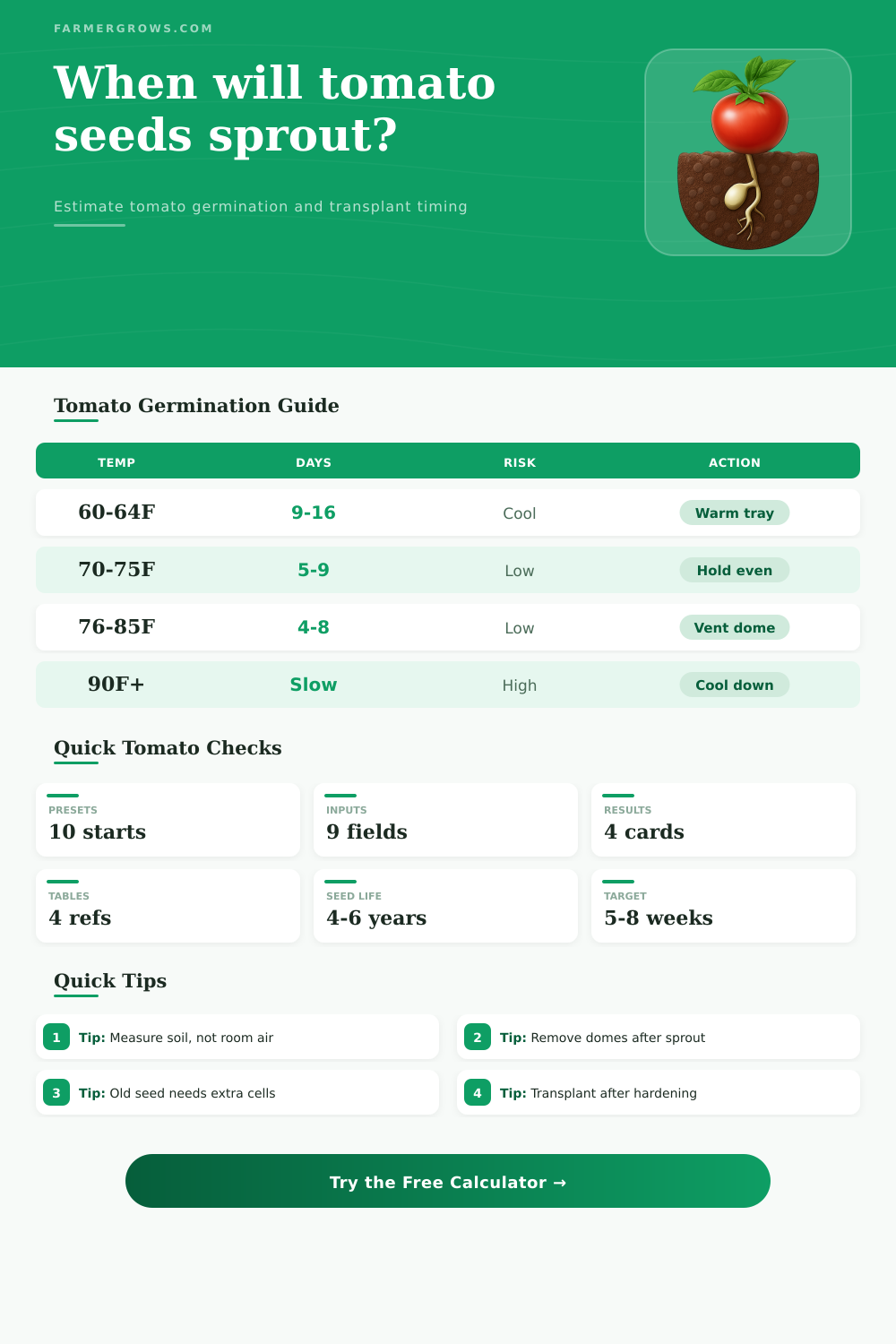
| Seed-zone temperature | Expected tomato sprout time | Tray risk | Best adjustment |
|---|---|---|---|
| Below 55 F | Very slow or no reliable emergence | High rot and delay risk | Move trays to a warmer bench before judging seed quality. |
| 55 to 59 F | 12 to 21+ days | Cool and uneven | Add controlled bottom heat and avoid saturated media. |
| 60 to 64 F | 9 to 16 days | Moderate | Useful for patient starts, but heat improves uniformity. |
| 65 to 69 F | 7 to 12 days | Low to moderate | Acceptable if nights do not drop the seed mix colder. |
| 70 to 75 F | 5 to 9 days | Low | Good home seed-starting range for most tomatoes. |
| 76 to 85 F | 4 to 8 days | Low if vented | Fast range; watch humidity domes and remove after sprouts. |
| 86 to 90 F | 5 to 10 days | Heat and drying risk | Vent, shade the tray surface, or lower thermostat slightly. |
| Above 90 F | Erratic or delayed | High seedling stress | Cool the media and prevent sealed-dome overheating. |
| Tomato type | Typical germination pace | Seedling habit | Planning note |
|---|---|---|---|
| Cherry | Often quick, 4 to 8 days in warm media | Usually vigorous | Good for fast test trays and early confidence checks. |
| Grape | Quick to average | Compact early seedlings | Use strong light soon after hooks appear. |
| Slicer / salad | Average, 5 to 10 days | Balanced early growth | Reliable baseline for most packet instructions. |
| Paste / sauce | Average to slightly slower | Sturdy seedlings | Good candidate for 50-cell or 72-cell trays. |
| Roma determinate | Average | Stocky when light is strong | Useful for synchronized field plantings. |
| Beefsteak | Average to slower | Larger transplant target | Give a little more bench time before hardening. |
| Heirloom | Wider lot-to-lot spread | Variable vigor | Sow extra cells when seed age or storage is unknown. |
| Dwarf / patio | Average | Short internodes | Can wait in small pots better than very tall types. |
| Field determinate | Average | Uniform batch goal | Match sowing date to a hardening and planting window. |
| Greenhouse hybrid | Quick under controlled heat | Strong early growth | Keep records by lot for repeated production cycles. |
| Tomato seed age | Likely germination potential | Timing effect | Practical tray action |
|---|---|---|---|
| Fresh or current season | High if packet was stored dry | Tightest sprout window | Sow normal cell count and expect even hooks. |
| 1 year old | High | Usually little change | Use standard timing and monitor temperature. |
| 2 years old | Good | Slightly wider window | Add a few extra seeds for important varieties. |
| 3 to 4 years old | Fair to good if stored cool | Slower and less uniform | Pre-test or sow extra cells before relying on the lot. |
| 5+ years old | Variable | Late and uneven emergence | Use a germination test and keep humidity steady. |
| Warm or humid storage | Reduced even when seed looks normal | Unpredictable | Run a towel test or start a backup packet. |
| Stage | Typical timing from sowing | Plant cue | Grower note |
|---|---|---|---|
| Germination check | Day 7 to 14 | Hooks or cotyledons visible | Do not dig cells early unless the tray is cold or waterlogged. |
| Dome removal | At first visible sprouts | First hooks breaking surface | Remove or vent hard to prevent damping-off and leggy starts. |
| First feeding | After true leaves begin | One small true leaf pair | Use gentle nutrition only after seedlings are actively growing. |
| Pot up | 2 to 4 weeks | Roots hold plug but are not circling | Plant deeper in the next pot if stems stretched. |
| Harden off | 7 to 10 days before transplant | Stocky plants with several true leaves | Increase outdoor exposure gradually and protect from wind. |
| Outdoor transplant | 5 to 8 weeks | 6 to 10 inch sturdy plant | Plant after frost risk and when soil is warming. |
| Greenhouse transplant | 4 to 7 weeks | Strong plug, active roots | Use warmer root-zone conditions and steady light. |
A cold bench, stone windowsill, or wet tray can hold seed mix far below room temperature. Check the media itself before blaming the seed lot.
Once the first hooks appear, remove or vent the dome, lower heat slightly if needed, and move strong light close enough to prevent stretch.
Getting seeds to sprout on time is one of those things that take some juggling: Will you have an easy start to your season, or will you be scrambling to fill in spaces? I think most gardeners don’t pay attention to the details here until it’s too late, when the tray just won’t come to life.
Timing depends on more than just the seed itself. You must also consider its age, the soil temperature at seeding depth, how deep you plant it, and whether you use a domed lid or no lid. Understanding how all these elements play off each other can help you make it feel like less of a mystery.
How to Get Better Seeds to Sprout
It’s not the air temperature in the room; it’s what the temperature is down where seeds are. You might think a tray feels warm to the touch, but seed-starting medium beneath it could be a few degrees cooler. That makes germination take longer. It also expands range of time from the earliest to latest seedling.
You can overcome these temperature gaps by using a heat mat, but only if it actualy warms the seed zone. Enter your measurement of the soil temperature and your method of heating into calculator, and let it do the math. You will no longer have to guess whether the tray is really warm or simply dissapears that way.
Another thing to consider is seed age. With fresh packets, we know what to expect, predictable, tight emergence. Older seed may still emerge, but range from first-to-last sprout increases, and potential for good stands diminishes. When the packet’s been in a drawer for a couple of seasons, many grower sow a few extra cells. You can use the tool to mark down your seed age so the estimate is based off that broader range, not with each cell acting as if it were fresh seed.
The two keys are depth and moisture management. Seed sown shallower than a quarter-inch will be quick-drying. And seed set deeper than that. Any deeper. Will take more time to force its way up and may rot if you don’t let it dry between wet or dry periods.
Once the first hook emerges, I use a vented dome to keep surface consistently moist but not cooking-hot, though seeds planted deep can still rot if the mix stays saturated. Venting or removing the dome at the right time also helps avoid weak, leggy stems caused by too much humidity.
The second point of control after emerging is light. Give them good light immediately (not necessarily intense; just consistent) and they will grow sturdy and compact. Otherwise, weak lights means stretchy seedlings which are difficult to undo later on. Whatever type of lighting you use, the calculator factors that in by determining how much longer it will take until the plant is ready to be transplanted, because a leggy start requires more care before you expose it to outdoor weather.
On the page, there is a series of reference tables explaining how temperature relates to number of days and level of risk. There is also a chart linking different kinds of tomatoes with their normal seedling behavior. This helps you know if you need to rush something along or give it extra bench time. These charts exist because no one’s real tray ever matches the perfect conditions described on seed packets.
If you’re running it with the tool, you enter in what you control or can measure, and read out as a signal for planning, not a guarantee. The Expected Sprout Window tells you when to begin checking daily. This shows your wait time remaining and whether you’re on track or beginning to lag behind. Build seedling confidence by deciding how much insurance to factor into your cell count. Transplant timing helps line up outdoor soil conditions and hardening space without guesswork.
Nobody should of try to reach a precise day. We want to eliminate the biggest sources of surprise; then we’ll know how to change the light, or the temperature, or the moisture level before it compounds into something else. Eventually that means the calendar doesn’t feel stressful anymore, but feels like a workable map.