Broccoli Growth Time Calculator
Estimate broccoli germination, transplant timing, main head harvest, frost clearance, heat-stress risk, spacing pressure, and side-shoot harvest from your variety and season.
Broccoli timing depends on whether the date is a sowing date or transplant date. This calculator keeps seedling days, packet maturity, frost dates, warm weather, and side-shoot production separate so the harvest window is easier to plan.
Green Magic, Packman, and Belstar help beat early heat when transplants go out on time.
Arcadia, Marathon, and Waltham often improve as nights cool after head formation.
De Cicco and sprouting-stem broccoli trade huge heads for a longer picking rhythm.
Imperial and Green Magic tolerate warmth better, but heads still need protection from hot spells.
Close plants can work for baby heads, while wide spacing supports large crowns and airflow.
Broccoli Growth Timeline
Results update from your variety, soil temperature, spacing, frost dates, and harvest plan.
| Variety | Typical days from transplant | Best season | Head habit | Timing note |
|---|---|---|---|---|
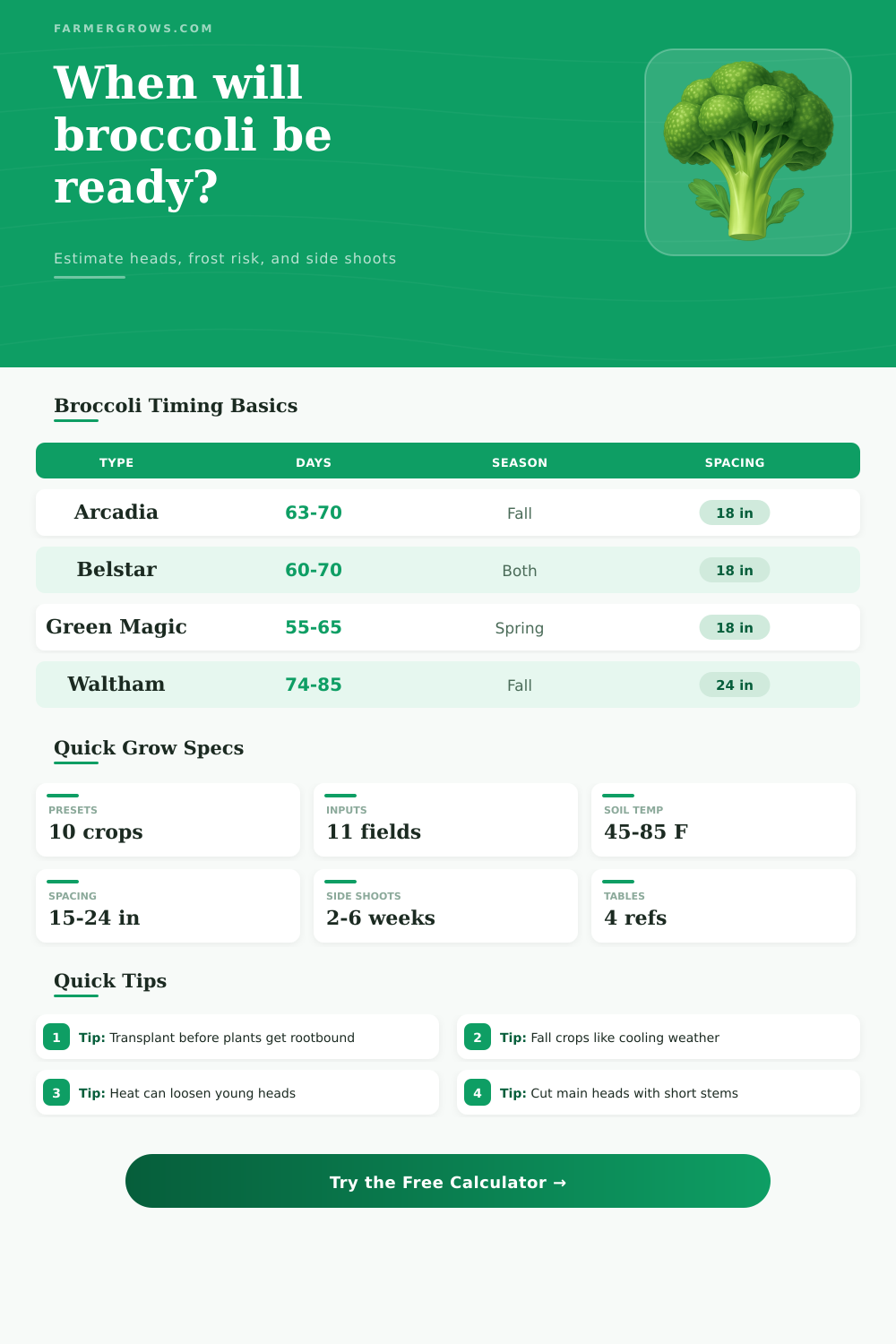
| Green Magic | 55 to 65 days | Spring or early fall | Medium dome, good heat tolerance | Useful where spring turns warm quickly. |
| Belstar | 60 to 70 days | Spring and fall | Steady main head plus side shoots | A flexible hybrid for mixed-season gardens. |
| Arcadia | 63 to 75 days | Fall and overwintered mild zones | Dense, cold-tolerant heads | Often best when heads size during cool nights. |
| Waltham 29 | 74 to 85 days | Fall | Older open-pollinated type | Later crop with dependable side shoots. |
| De Cicco | 48 to 60 days | Spring succession | Small main head, many side shoots | Harvest early and keep cutting tender shoots. |
| Marathon | 68 to 78 days | Fall and coastal winter | Uniform dense heads | Good for cool, steady finishing weather. |
| Imperial | 60 to 70 days | Warm spring or fall | Blue-green dome | Better heat tolerance than many older types. |
| Packman | 50 to 60 days | Early spring | Fast medium head | Good for quick backyard harvests. |
| Premium Crop | 58 to 68 days | Spring or fall | Large single head | Less side-shoot emphasis than De Cicco. |
| Aspabroc / sprouting broccoli | 50 to 65 days | Mild spring or fall | Tender stems and small florets | Pick small stems often instead of waiting for one head. |
| Soil temperature | Germination pace | Seedling effect | Garden note |
|---|---|---|---|
| 40 to 44°F | Slow, uneven | Add 6 to 10 days | Seed may sit; use transplants if season is short. |
| 45 to 54°F | Workable cool range | Add 2 to 5 days | Harden plants well before cold beds. |
| 55 to 75°F | Best practical range | Fast and even | Strong germination with steady moisture. |
| 76 to 85°F | Fast but drying | May need shade and frequent water | Good for fall starts if seed trays stay moist. |
| Above 85°F | Erratic under heat | Add 4 or more days | Start in shade or wait for cooler weather. |
| Spacing plan | Plant spacing | Row spacing | Expected head style | Use case |
|---|---|---|---|---|
| Baby head planting | 12 to 15 in | 18 to 24 in | Smaller heads, quick turnover | Small gardens and succession beds. |
| Standard home garden | 18 in | 24 to 30 in | Medium-large heads | Balanced head size and weed access. |
| Large fall heads | 20 to 24 in | 30 to 36 in | Large crowns and better airflow | Arcadia, Marathon, Waltham, Premium Crop. |
| Side-shoot rows | 15 to 18 in | 24 to 30 in | Moderate heads, more shoot picking | De Cicco, Belstar, and long harvest rows. |
| Maturity window | Stage cue | Typical timing | Harvest action | Risk to watch |
|---|---|---|---|---|
| Seed germination | Cotyledons emerge | 3 to 12 days | Move seedlings into strong light. | Cold soil, heat, drying trays. |
| Transplant-ready | 4 to 6 true leaves | 28 to 42 days from sowing | Harden off and plant deep enough to anchor stems. | Rootbound or leggy seedlings. |
| Main head sizing | Tight dome forms | 45 to 85 days from transplant | Harvest before beads loosen or yellow. | Heat stress and uneven moisture. |
| Side shoots | New shoots below cut | 2 to 6 weeks after main head | Pick often while stems are tender. | Warm weather and plant exhaustion. |
Count backward from your first hot spell, not just forward from the last frost. Transplants can handle cool weather, but heading plants dislike heat.
Cut the main head while beads are tight, leave healthy leaves, water deeply, and pick shoots every few days before they flower.
Broccoli can go wrong by bolting in heat. It can also skip its side-shoot window if planted out of sync. Because of this, it’s important to get your timing right.
That means factoring in not just frost dates, but also soil temperature, and which variety you choose, so that no one hurriedly goes chopping. While most gardeners record their final frost date, what matters most to seed germination are the soil temperature. Even though the air may be behaving mellow, cold soil will slow down roots. Don’t use just calendar dates as your guide.
Timing Your Broccoli Garden
Instead, plug a soil reading into the calculator to shift transplant window. You change the window by tweaking number of days up or down from maturity stated on the seed packet. If variety says 62 days, it may reach full size in 70 if the bed’s still in low fifties. Later harvest: There is a trade-off with spacing (and how it will affect your results): Closer planting yields more heads per bed… But each head has smaller crowns, and less airflow.
The calculator factors this pressure into the adjusted maturity count and climate fit score. Because its effect depends on row density, what you see is a combination of both date and row density. Widely spaced rows allows for bigger heads and better air flow, but they cost more bed space; the tool illustrates this balancing act without you having to do any math yourself.
There’s a second layer of planning: Fall crops. First, check if variety resists chill. Heat-sensitive ones should be harvested early. Others might get shade, or just have their window narrowed for that reason (think Arcadia or Waltham). After the main head forms, cooler nights are good for both density and flavor, and yet, will there be time for side shoots, especially since first frost date affects when they form?
If so: Will you keep the plants intact past the main cut to set side shoots? That’s what the side-shoot setting is about, and it estimates how many additional weeks’ picking remains possible before frost/fatigue shuts down the party. There are broccoli varieties, and they don’t all act alike; hence all those reference tables on the page. Some will send up side shoots for months; others concentrate their efforts into one big head (and stop).
Plan accordingly and know what the plant’s habit is: Are there places in your garden where you can pick longer, or should you just plan to plant in stages? The calculator isn’t a set-in-stone prediction, it’s also a plan, a way to talk through what works and what doesn’t. It can be adjusted for frost dates, variety selection, and the soil test results you actualy got back (versus some average), and it lets you know when it’s going to be safe or doable or dicey.
You won’t have to guess whether to plant in fall or fear being too late in spring. You will have a specific time frame for your harvest. It is concrete, not wishful thinking.