Radish Growth Time Calculator
Estimate radish emergence, crisp harvest dates, peak pulling window, pithiness risk, bolting pressure, and the next succession sowing date from real radish variety behavior.
Radishes move fast, but they punish crowding, hot soil, and dry swings. This planner treats quick salad types, long daikon, storage radishes, and container sowings differently so the dates match the crop.
Radish Growth Timing Results
Dates combine variety maturity, germination temperature, seed depth, thinning space, water regularity, target root size, and harvest style.
| Radish variety | Typical maturity | Best season | Target size | Timing note |
|---|---|---|---|---|
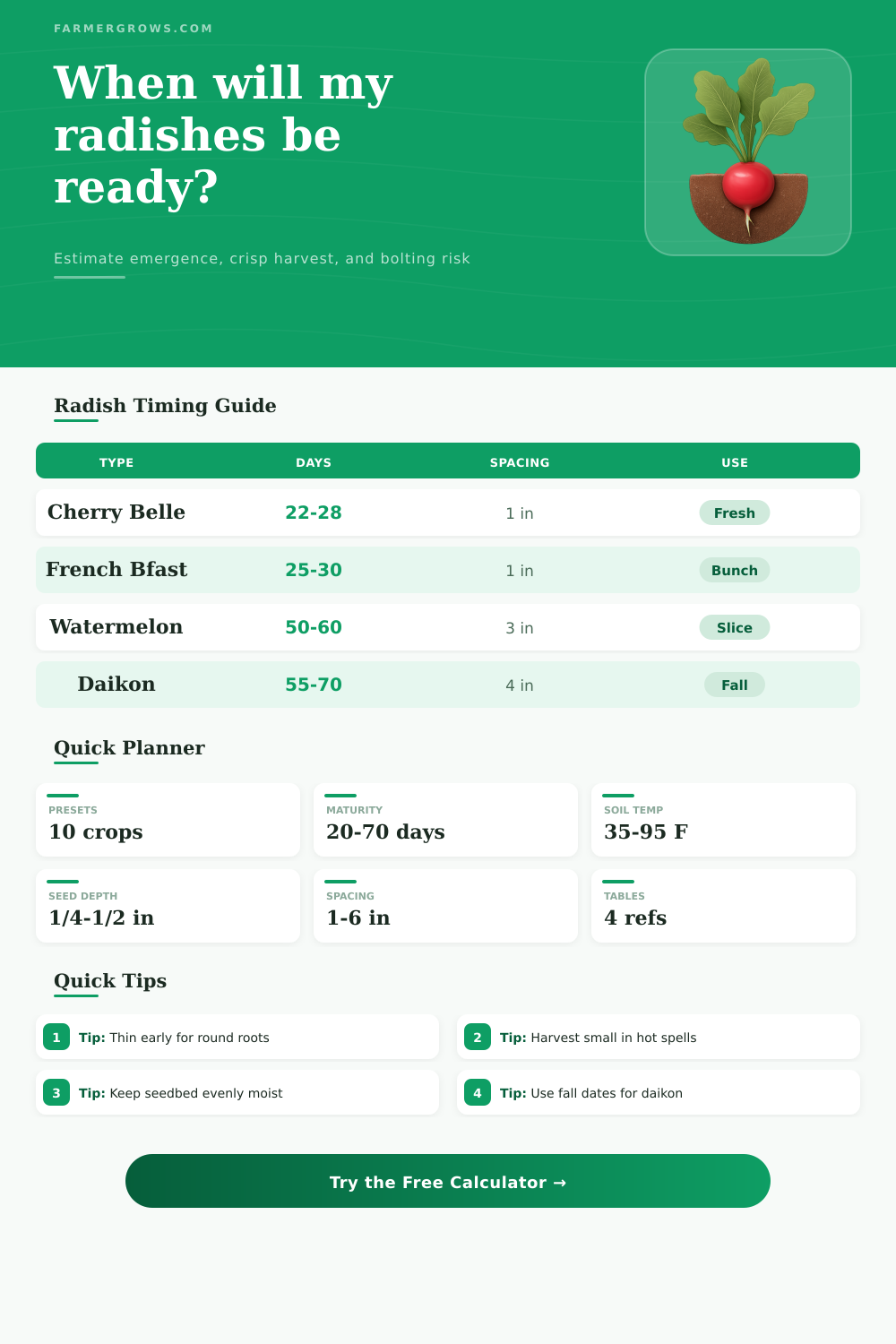
| Cherry Belle | 22 to 28 days | Cool spring or fall | 0.75 to 1 in round | Fastest crisp roots; harvest promptly in heat |
| French Breakfast | 25 to 30 days | Spring succession | 0.75 in wide, 2 to 3 in long | Good bunching type for weekly sowing |
| Easter Egg mix | 25 to 32 days | Spring and fall | 0.8 to 1 in round | Mixed colors size unevenly, so pick over the row |
| Watermelon radish | 50 to 60 days | Late summer to fall | 2.5 to 3.5 in round | Color and sweetness improve with cool finishing weather |
| Daikon | 55 to 70 days | Fall | 2 to 3 in wide | Needs loose soil, wider spacing, and steady moisture |
| Black Spanish | 55 to 65 days | Fall storage | 2.5 to 4 in round | Better mature than young; cure lightly before storage |
| Soil temperature | Expected emergence | Growth effect | Risk signal |
|---|---|---|---|
| 35 to 39°F | 12 to 21 days | Very slow germination | Seed may sit too long in wet soil |
| 40 to 49°F | 5 to 10 days | Slow but workable | Use shallow sowing and avoid crusting |
| 50 to 59°F | 3 to 6 days | Good spring growth | Low heat risk |
| 60 to 75°F | 2 to 4 days | Fast, even emergence | Best salad radish window |
| 76 to 85°F | 3 to 6 days | Fast leaves, root quality drops | Pithiness and pungency rise |
| Above 85°F | 5 to 9 days | Unreliable stand | High bolting and bitter root risk |
| Radish type | Seed depth | In-row spacing | Row spacing | Why it matters |
|---|---|---|---|---|
| Small round salad | 0.25 to 0.5 in | 1 to 1.5 in | 6 to 10 in | Crowding makes tops and skinny roots |
| French Breakfast | 0.25 to 0.5 in | 1 to 2 in | 6 to 10 in | Extra room gives straighter oblong roots |
| Container radish | 0.25 to 0.4 in | 1.5 to 2 in | Broadcast or 4 in bands | Containers dry quickly, so spacing helps quality |
| Watermelon | 0.5 in | 3 to 4 in | 12 to 18 in | Large shoulders need room to color and sweeten |
| Daikon and Mu | 0.5 to 0.75 in | 4 to 6 in | 18 to 24 in | Deep roots need loose soil and wider rows |
| Fresh vs storage type | Examples | Harvest target | Storage behavior | Best calculator setting |
|---|---|---|---|---|
| Quick fresh | Cherry Belle, Sparkler | Small and crisp | Short fridge life once tops wilt | Earliest crisp table harvest |
| Bunching fresh | French Breakfast, Easter Egg | Pick over several days | Best with tops removed after harvest | Peak full-size harvest |
| Specialty slicer | Watermelon, Red Meat | Cool-weather full size | Keeps longer than salad radish | Peak full-size harvest |
| Storage winter | Black Spanish, China Rose | Firm, mature roots | Good in humid cold storage | Storage or winter harvest |
| Long fall root | Daikon, Korean Mu | Full shoulder before hard freeze | Moderate if unbruised | Storage or winter harvest |
For crisp roots: Thin as soon as seedlings are easy to handle. A crowded radish row can look lush while the roots stay stringy.
For succession sowing: Shorten the interval in cool weather and lengthen it when soil climbs above 80°F, especially for round salad radishes.
Of all garden vegetables, radishes is perhaps the most responsive to timing. Plant on time. If you plant three weeks late they will have gone to seed. If you sow too early, they gets woody before you are ready. Three weeks later, they’re crunchy-crisp and ready for eating, but sow just a day or two off target and that same packet of seed will have bolted or become woody.
Typical factors include watering, spacing, choosing the right variety, and initial soil temperature. More importantly, these variables has to matches what is actualy happening in your beds. The typical method of beginning with a calendar date and hoping for the best, hoping the roots will grow up and be big enough before it gets too hot, doesn’t work if the soil’s cooler than anticipated, or you get hit by a warming trend.
Why Radishes Need Careful Planning
The air temperature you see on your weather app doesn’t matter as much than the temperature just below the soil surface where the seeds is. Warmer soil speeds up growth, pushing up leaves and leaving roots behind. Cooler soil slows things down, prolongs the entire process and makes germination take longer, too.
With the calculator above, you don’t need to guess how these two factors interacts, you can simply enter your soil temperature and sowing date into the calculator and let it do math.
Why? They will crowd each other which causes them to grow skinny roots and too many tops instead of having good space between adult-sized sofa. Early thinning is the one habit that separate disappointment from a dependable harvest. With a little math, it tells you how much space to leave between seeds in any given row. It also tells you whether your plan will work out before the seedlings pop up, rather than after.
REMEMBER: Succession planting means one sowing yields an ongoing harvest, but how far apart do you space your plantings? That’s determined by season. Cool conditions allows for sowing every five or six days. Once the soil heats up beyond eighty degrees, you’re in bolting (not rooting) territory, so you need more time to reach next row. The calculator takes succession timing into account, so you can see when to sow again without keeping separate data.
The secret factor that will surprise even the best gardener are water consistency. Radishes require consistent moisture to develop in all their silky smoothness, but not soggy conditions. If you’re watering inconsistently (as I do), the result could of been the same woody texture that heat causes. That’s what the irrigation setting is for. It adjusts the risk score and projected harvest window to match whether you have an inconsistent or reliable moisture supply.
On the page itself is the reference tables that lay it all out for common types, so you can read at a glance what type is tolerant of heat and what requires cool finishing weather. Quick salad radishes (like Sparkler or Cherry Belle) is the fastest to grow and most punishing if you delay planting them. For longer types (daikon or watermelon radish), you get more flexibility with your planting dates. However, you must provides wider spacing and looser, deeper soil to achieve full size without forking.
What makes a tool such as this so valuable for planning: It makes you consider the entire sequence simultaneously. Variety? Target root size? How does the timing of the season (and your watering practices) affects things? And then all those dates appears in one view, replacing both the mental math and scattered notes with which most gardeners plan.
After that, there’s just one task: arriving with the harvest knife at correct time.