Carrot Growth Time Calculator
Estimate carrot germination, thinning, baby harvest, full harvest, storage window, and soil risk from variety type, sowing date, seedbed temperature, spacing, moisture, and root-length goals.
Carrots are slow to sprout and unforgiving of compaction. This calculator separates germination time from root bulking time, then adjusts the harvest window for soil temperature, seed depth, spacing, moisture, frost timing, and the way each carrot type handles depth or clay.
Carrot Growth Time Results
Calculated carrot timing appears here after you enter your bed conditions.
| Carrot type | Typical maturity | Baby pull timing | Target root | Best fit |
|---|---|---|---|---|
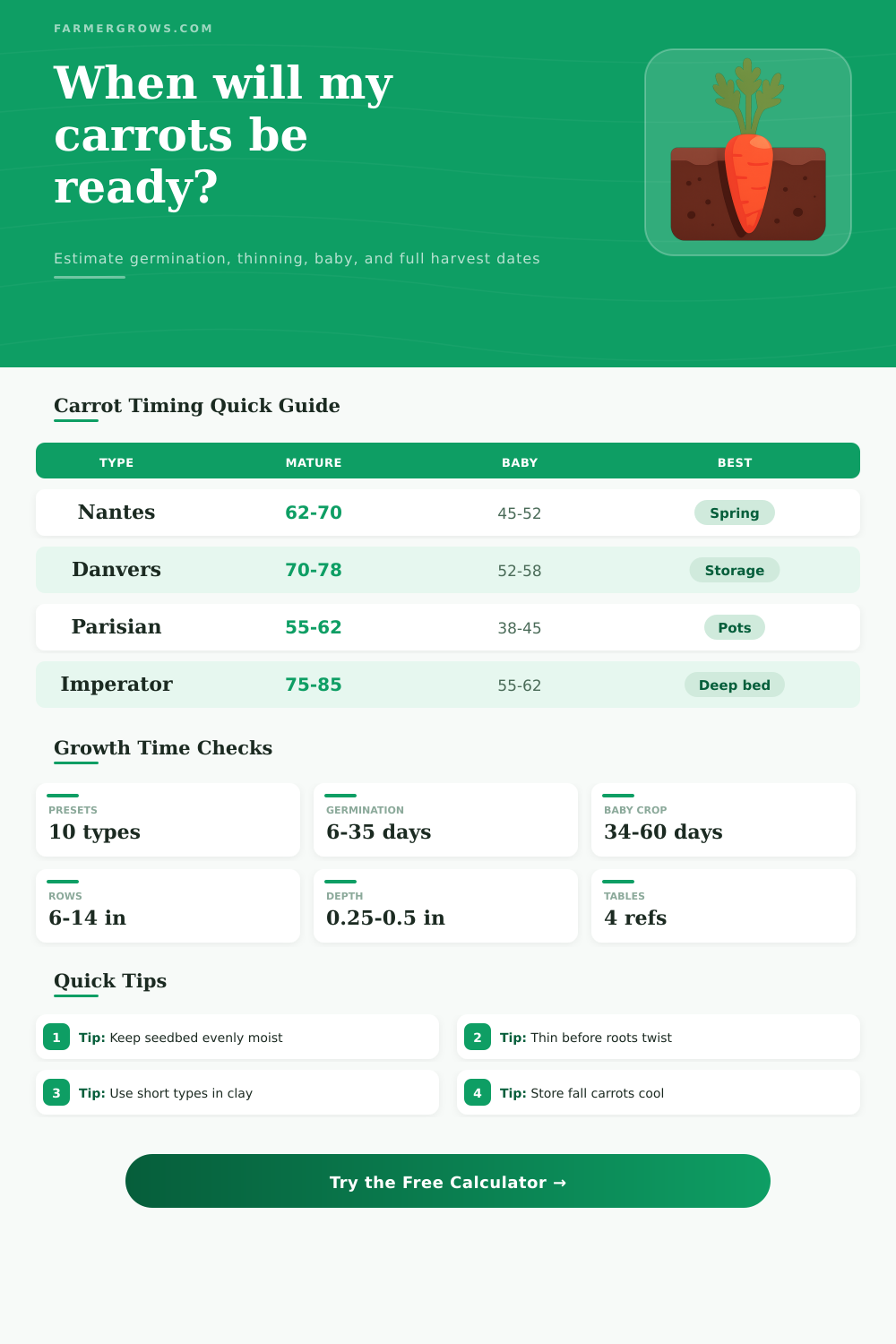
| Nantes cylinder | 62 to 70 days | 45 to 52 days | 6 to 7 in | Spring beds, raised beds, uniform bunching carrots |
| Danvers tapered | 70 to 78 days | 52 to 58 days | 7 to 8 in | Storage, heavier loam, fall crops |
| Imperator long | 75 to 85 days | 55 to 62 days | 9 to 11 in | Deep, stone-free soil with steady moisture |
| Parisian round | 55 to 62 days | 38 to 45 days | 1.5 to 2.5 in | Containers, rocky beds, shallow soil |
| Chantenay wedge | 68 to 75 days | 48 to 55 days | 4 to 5.5 in | Clay soil, compact gardens, storage pulls |
| Soil temperature | Expected germination | Growth effect | Seedbed note |
|---|---|---|---|
| 40 to 44°F | 17 to 28 days | Very slow start | Use patience, row cover, and careful moisture |
| 45 to 50°F | 12 to 21 days | Slow but workable | Good early spring range if soil does not crust |
| 51 to 60°F | 8 to 14 days | Reliable cool crop start | Ideal for many spring carrot sowings |
| 61 to 75°F | 6 to 10 days | Fast emergence | Keep the top half inch constantly moist |
| 76 to 85°F | 8 to 14 days | Heat stress possible | Shade cloth or mulch helps prevent dry seed |
| Crop goal | Seed depth | Row spacing | Thin spacing | Practical note |
|---|---|---|---|---|
| Baby carrot row | 1/4 to 3/8 in | 6 to 8 in | 1 to 1.5 in | Harvest early before shoulders crowd |
| Fresh full-size carrots | 1/4 to 1/2 in | 8 to 12 in | 2 to 3 in | Standard garden spacing for Nantes and Danvers |
| Storage roots | 3/8 to 1/2 in | 10 to 14 in | 3 to 4 in | Wider spacing improves shoulder size and airflow |
| Container carrots | 1/4 in | 4 to 8 in | 1.5 to 2 in | Match the root type to container depth |
| Clay or shallow soil | 1/4 to 3/8 in | 8 to 12 in | 2.5 to 3.5 in | Choose Chantenay, Parisian, or short Nantes types |
| Soil or root issue | Root types that cope | Risk for long carrots | Adjustment to use |
|---|---|---|---|
| Loose raised bed, no stones | All types | Low | Use target length from the seed packet |
| Average loam, few stones | Nantes, Danvers, Chantenay | Moderate | Thin on time and keep moisture steady |
| Amended clay | Chantenay, Danvers, Parisian | High | Pick shorter roots and avoid overlong target length |
| Stony or compacted row | Parisian, Chantenay | Very high | Screen the row or switch to round/short carrots |
| Shallow container | Parisian, baby, short Nantes | High | Set target length below usable container depth |
During germination: Carrot seed is shallow and slow. If the top half inch dries out for a day or two, emergence can stretch by a week even when the calendar looks right.
Before full harvest: Root length is only one clue. Pull a sample carrot, check shoulder width, and harvest storage roots before repeated freeze-thaw cycles damage texture.
Carrots are the patient ones among all the home-grown vegetables. Seeds takes forever to sprout, and then the tiny plants looks like grass until there first true leaves emerge. Perhaps your seed was sown too shallowly (they need to be covered) or thickly (so they don’t fill in). They want proper spacing and steady moisture as they grow; hard things to achieve without a schedule rather than guessing.
That’s where the calculator comes in: Your own garden conditions, such as soil temperature, which affects germination time; moisture, which can lengthen the timeline or keep things right on schedule; and seed depth, are converted into dates for you so that you can plan accordingly (and be warned about the potential for long-roots types to fork in your particular soil type, helping you prevent a dissapointing harvest down the road). It also advises you on spacing: Space rows closely to harvest baby carrots quickly but space them wide enough for storage roots to develop large size without crowding each other.
How to Grow Carrots Successfully
Because carrot seeds are small, even a slight drying of top half-inch of soil while they’re trying to get going can result in uneven emergence; the emerging seedlings is then weakened and won’t make it all the way up, so whole crop is compromised. Consistency is key to being able to thin when you should and keep weeds down. The first couple of weeks’ growing conditions realy set up the rest of the crop.
Another variable are the time of season. Perhaps yours is not the best time for a specific crop. A spring crop may hit unexpected heat halfway through root formation. A late fall crop might be growing along fine until frost hits just before it’s ready to come into baby-stage. The season selector use those variables in adjusting its maturity window, and will tell you if you should of go for early picking at the expense of smallish carrots, or try for bigger storage roots.
You won’t have to memorize what each range of data represent, there’s even a reference table showing how various carrots compare. Quick-growing when the soil is good (as with the Nantes varieties); slow- to medium-growing and needing consistent depth all along their length (as with Imperators, but many home beds simply don’t provide that kind of depth and consistency). Shorter-growing (so-called varieties like Parisians and Chantenays) make sense for containers and also for certain clays; they’d meet resistance from longer roots. Those characteristics of each kind of variety will be built into the calculator after you choose it and then indicate the soil texture. So what comes out will be real-world limitations of your garden bed.
It won’t do away with daily eyeballing (that will tell you whether it’s time for the carrots to come out, or not; a quick look at the shoulder width of a sample root can tell you if they are ready). That visual inspection will also prevent premature digging of roots, or leaving them in the ground so long that they get mealy and ruined by freeze-thaw cycles. But the tool gives you the estimated date range and then it’s up to you to judge when to finally say yes, now is the moment.