🧪 ug/mL to PPM Converter
Convert micrograms per milliliter to parts per million — with multi-unit support and reference tables
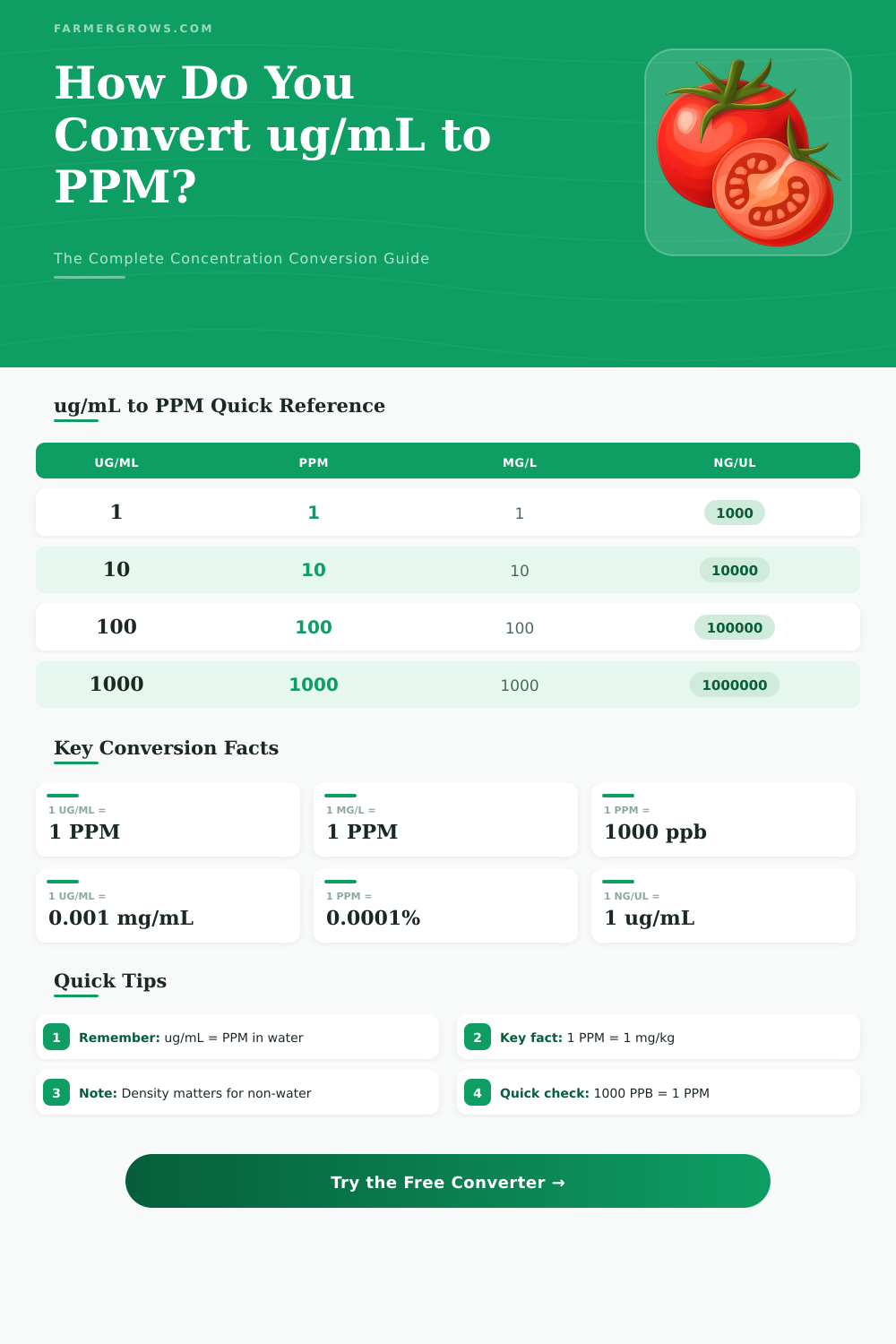
| ug/mL | PPM | PPB | PPT | % | mg/L |
|---|---|---|---|---|---|
| 0.001 | 0.001 | 1 | 1,000 | 0.0000001 | 0.001 |
| 0.01 | 0.01 | 10 | 10,000 | 0.000001 | 0.01 |
| 0.1 | 0.1 | 100 | 100,000 | 0.00001 | 0.1 |
| 1 | 1 | 1,000 | 1,000,000 | 0.0001 | 1 |
| 5 | 5 | 5,000 | 5,000,000 | 0.0005 | 5 |
| 10 | 10 | 10,000 | 1×10⁷ | 0.001 | 10 |
| 50 | 50 | 50,000 | 5×10⁷ | 0.005 | 50 |
| 100 | 100 | 100,000 | 1×10⁸ | 0.01 | 100 |
| 500 | 500 | 500,000 | 5×10⁸ | 0.05 | 500 |
| 1,000 | 1,000 | 1,000,000 | 1×10⁹ | 0.1 | 1,000 |
| 10,000 | 10,000 | 1×10⁷ | 1×10ⁱ⁰ | 1.0 | 10,000 |
| Solvent | Density (g/mL) | 1 ug/mL = PPM | PPM correction vs water |
|---|---|---|---|
| Water | 1.000 | 1.000 | 1.000× |
| Methanol | 0.791 | 1.265 | 1.265× |
| Ethanol | 0.789 | 1.267 | 1.267× |
| Acetone | 0.791 | 1.265 | 1.265× |
| Hexane | 0.659 | 1.517 | 1.517× |
| DMSO | 1.100 | 0.909 | 0.909× |
| Chloroform | 1.489 | 0.672 | 0.672× |
| Acetonitrile | 0.786 | 1.272 | 1.272× |
| Unit | = ug/mL | = PPM (water) | = mg/L | = ng/uL |
|---|---|---|---|---|
| 1 ug/mL | 1 | 1 | 1 | 1 |
| 1 mg/L | 1 | 1 | 1 | 1 |
| 1 mg/mL | 1,000 | 1,000 | 1,000 | 1,000 |
| 1 ng/uL | 1 | 1 | 1 | 1 |
| 1 ug/L | 0.001 | 0.001 | 0.001 | 0.001 |
| 1 ng/mL | 0.001 | 0.001 | 0.001 | 0.001 |
| 1 g/L | 1,000 | 1,000 | 1,000 | 1,000 |
| 1 PPB | 0.001 | 0.001 | 0.001 | 0.001 |
When you read about concentrations in micrograms per milliliter, your next question will typically be: What does that have to do with parts per million? You’ll notice PPM listed on product labels and even some regulatory limits, but without knowing what’s being counted in both unit, they seem unrelated.
Ug/mL indicates amount of solute present in a milliliter of solution, whereas PPM represents the number of parts of that solute out of every million parts of entire mixture. If there are 1000 mg/L of something dissolved in a liter of water, then there is also 1000 ppm of it. These two units becomes straightforward when you visualize what they represent. Water has a density of one gram per milliliter, which is why they matches up. One microgram is one millionth of a gram. Dissolving one microgram of a compound in one milliliter of water create a concentration of one part per million by weight (one microgram divided by one milligram = 0.001).
How to Convert ug/mL to PPM
Change the solvent and math changes. That’s because density changes; same volume but different amount of mass. For example, a lighter liquid has less mass in a given volume so the same concentration is a higher percentage of overall weight.
You can choose a solvent from pull down menu or enter your own density, and calculator will adjust to match. If someone is doing these numbers it’s usually not because they’re interested in theoretical purity. Usually it’s to see if cleaning solution is within residue limit or whether an active ingredient fall within its range. It can also be used to convert an out-of-date protocol to today’s instruments. In all cases the practical question is this: does the number on one side of table equal that listed in the spec when both parties measure in same unit?
That’s where reference tables showing common equivalents come in handy, letting you pick up patterns fast. But even better is to actualy see what happens to your sample when you alter the output unit or solvent. You shouldn’t assume that all PPM values is equal to mg/L. You might want to confirm exactly what test measured. If it’s a mass-per-volume test, then no problem; the units will convert directly. But if it’s a mass-per-mass ratio and the solution contain a solvent more or less dense than water, then you’ll get some drift.
For example, you can use the optional volume field to compute total mass of your batch, eliminating one mental step when figuring out how much material you should of weigh out. And there’s another wrinkle if final answer needs to be expressed not in PPM but percent or even parts-per-billion (PPB). That just shifts decimal place, but switching units can make that same number sound more or less impressive based off context. A 0.05 percent solution seems pretty small till you note that’s equal to five hundred PPM, and may well cross over some residual limit with room to spare. Seeing the same number expressed in a few different ways lets you say whether something is within tolerance or closer to boundary than you’d like.
Instead of remembering how to do all these conversions, just ask yourself what is being measured in order to apply right conversion rule. Once you know if you are dealing with mass per mass or mass per volume, and you know the density of the matrix, arithmetic is simple. You feed it into this tool which does the math for you. But you keep the thinking and that’s where your judgment should live.