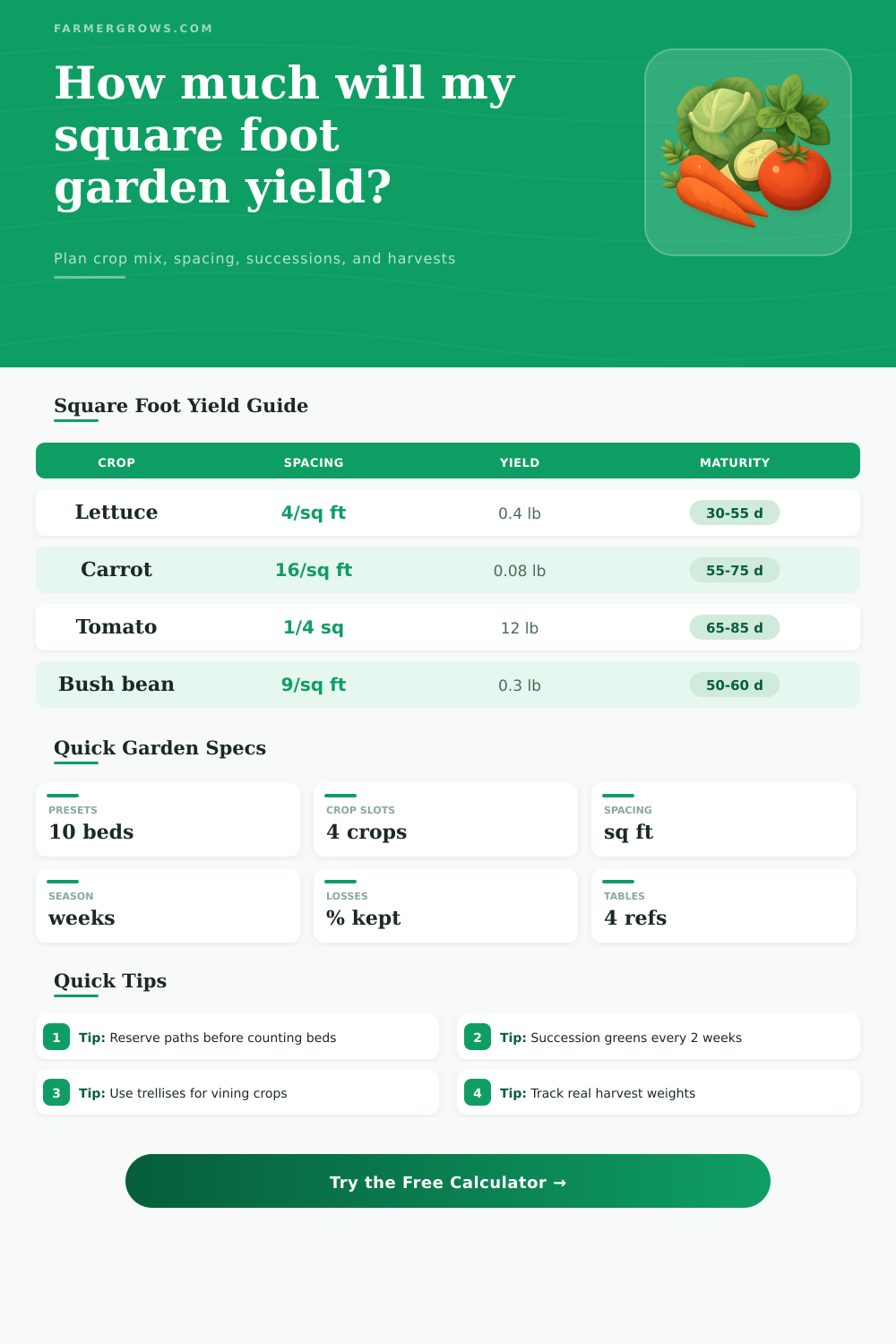
Square Foot Garden Yield Calculator
Estimate plant positions, crop mix allocation, succession rounds, expected harvest weight, loss-adjusted yield, and weekly harvest pace for compact raised beds and intensive square-foot gardens.
Use seed packet data or your own records for the yield fields when possible. The preset values are planning estimates, so local weather, variety, fertility, irrigation, and pest pressure can move the real harvest up or down.
Lettuce, spinach, arugula, and kale give many pounds per bed month when replanted often and harvested young.
Carrots, beets, radishes, and onions convert square feet into steady storage crops, but spacing discipline matters.
Tomatoes, peppers, cucumbers, and squash need more room, then repay it with larger harvests over a long window.
Basil, cilantro, parsley, and dill are light by weight but valuable in small gardens because cuttings repeat quickly.
Yield Estimate
A square-foot garden plan will appear here after calculation.
| Crop | Square-foot spacing | Plants per sq ft | Notes for intensive beds |
|---|---|---|---|
| Head lettuce | 4 per square | 4 | Use loose, staggered planting for airflow in humid weather. |
| Spinach or arugula | 9 per square | 9 | Harvest young leaves or cut whole patches before bolting. |
| Carrot or radish | 16 per square | 16 | Thin early so roots size evenly across the grid. |
| Bush bean | 9 per square | 9 | Blocks support each other and shade soil quickly. |
| Trellised tomato | 1 plant per 4 sq ft | 0.25 | Prune and tie regularly to keep the assigned square usable. |
| Zucchini | 1 plant per 9 sq ft | 0.11 | Best near an edge where leaves can spill outside the bed. |
| Crop | Typical yield basis | Planning yield | Best harvest style |
|---|---|---|---|
| Head lettuce | Per plant | 0.35 to 0.60 lb | Whole heads or heavy outer-leaf cuts. |
| Carrot | Per plant | 0.06 to 0.12 lb | Pull in batches after full color and size. |
| Bush bean | Per plant | 0.20 to 0.40 lb | Pick every few days while pods are tender. |
| Trellised tomato | Per plant | 8 to 18 lb | Long picking window after first ripe fruit. |
| Pepper | Per plant | 1.5 to 4 lb | Harvest green early or mature colored fruit later. |
| Basil | Per plant | 0.4 to 1.2 lb | Pinch tops often to delay flowering. |
| Crop group | Days to maturity | Harvest window | Planning note |
|---|---|---|---|
| Radish and baby greens | 22 to 35 days | 1 to 3 weeks | Fastest gaps to refill during cool weather. |
| Lettuce, spinach, arugula | 30 to 55 days | 2 to 5 weeks | Multiple small sowings beat one large flush. |
| Carrot, beet, onion | 55 to 110 days | 2 to 6 weeks | Storage roots hold in soil if weather is mild. |
| Beans and peas | 50 to 70 days | 2 to 4 weeks | Frequent picking extends production. |
| Tomato, pepper, cucumber | 55 to 90 days | 6 to 12 weeks | Trellis crops often dominate the late-season yield. |
| Succession pattern | Replant interval | Works best for | Season math cue |
|---|---|---|---|
| Single planting | Once | Tomato, pepper, zucchini, long roots | Use 1 succession for long-season crops. |
| Two rounds | 4 to 8 weeks | Beans, beets, carrots, cucumbers | Useful when spring and late-summer windows fit. |
| Three rounds | 2 to 4 weeks | Lettuce, spinach, cilantro, arugula | Requires quick turnover and steady irrigation. |
| Cut-and-come-again | 7 to 14 days | Kale, basil, herbs, loose greens | Use harvest frequency to smooth expected supply. |
| Relay planting | As beds empty | Mixed square-foot beds | Move high-value seedlings into open squares fast. |
For better estimates: Weigh harvests by crop for one season, then replace the preset yield values with your own bed records.
For steady eating: Put fast greens and herbs in several small successions instead of using the whole bed on one sowing date.
With square foot gardening, you can get alot of food from small area. But it all depends on matching your growing and harvesting habits with the way plants will grow. How you do the math (so to speak) before planting makes the difference between a soon-empty bed or one that sustains a family’s table. A yield calculator can help.
This is where the math get interesting. The numbers come in as inputs, not outputs. How big is that bed? What’s the usable percentage? What’s your season length, and how frequently do you harvest? And what about loss percentage (the difference between potential on a seed packet versus what ever makes it to the kitchen)? All these things affects how many successions you’ll realisticly plant, and thus what the expected total yield should of be; and whether the plan will sustain weekly meals, or require prolonged gaps.
Why You Should Use a Garden Planner First
Likewise, the crop mix and number of successive plantings affects the timing. Tomatoes or peppers takes up their space all season long; fast greens can goes back in same square multiple times. The calculator takes your mix of crops and spreads the planted surface among them based off the percentage figures. It then multiplies each part by its spacing value and it yield. That tells you how much weight should be coming off the beds, and what number of plants would be, too.
You also decide whether you have set an ambitious or a more conservative level of intensity, which means deciding if you want to increase fertility or live with less. The tool doesn’t account for all the real-world variables that a garden bring: an unusually hot or cold soil temperature; some unforeseen pest outbreak; failure to water consistently. So, the yield range (and reference spacing) shown at top of page should be considered planning guidelines (not guarantees). Better to work through the calculation; plant as suggested; weigh several harvests; then tweak your yield figures going forward. By the end of a season or two, you’re getting closer to bed’s true output.
But most important, working out all these figures ahead of time focuses attention on where the plan tends to go south. And gives you time to adjust succession counts or mix up the proportions before you sow anything. It allows you to consider: Do I want to spend energy on more-severe protection (or an extra set of seedling) if my estimated crop loss is higher then I like? Do I need to ramp up harvesting speed based on how many bellies this thing will feed? That’s what the calculator does: It puts the tradeoffs into plain view, so we don’t have to wing it as the season unfolds.
Once everything is actualy in the ground, initial calculation is more of a starting point than a prediction. The math keeps your plot laid out sensibly; it grounds expectations, but ultimately it’s the harvest that fills in the blanks.