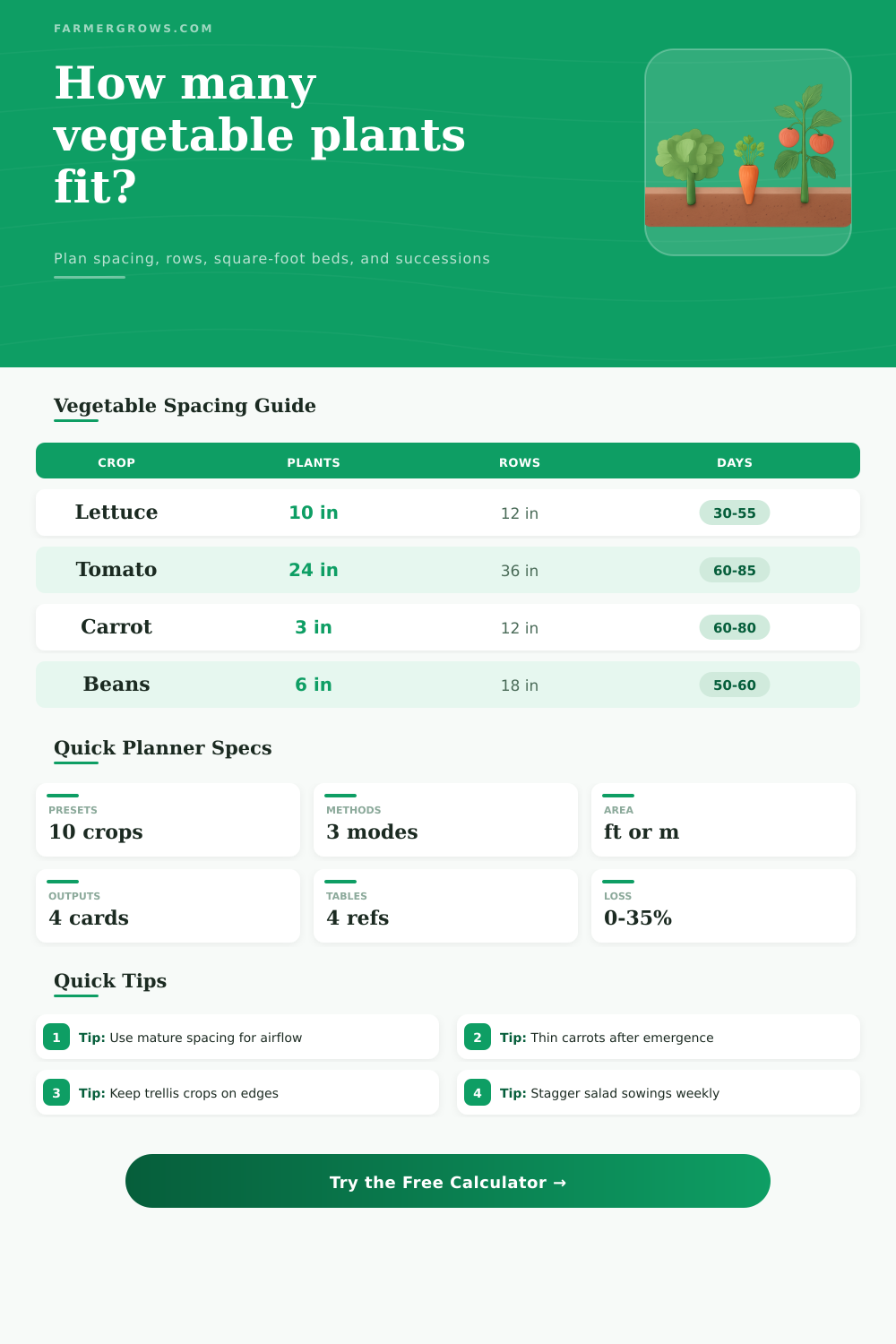
Vegetable Plant Spacing Calculator
Estimate vegetable plant counts from crop spacing, bed area, row spacing, plant spacing, square-foot density, succession count, walkway allowance, and thinning loss.
Use the calculator for raised beds, market-garden rows, kitchen gardens, and square-foot boxes. Crop presets load common spacing, then you can tighten or loosen the numbers for your variety, fertility, airflow, and harvest style.
Vegetable spacing snapshot
Plant counts update from usable bed area, crop density, spacing method, successions, and expected thinning loss.
| Crop | Plant spacing | Row spacing | Square-foot count | Spacing note |
|---|---|---|---|---|
| Lettuce | 8 to 12 in | 10 to 14 in | 4 per sq ft | Use closer spacing for baby leaf and wider spacing for heads. |
| Tomato | 24 to 30 in | 36 to 48 in | 1 per sq ft with support | Give indeterminate plants trellis height and airflow. |
| Pepper | 15 to 18 in | 18 to 24 in | 1 per sq ft | Close blocks support fruiting stems but still need light. |
| Carrot | 2 to 3 in | 10 to 12 in | 16 per sq ft | Final thinning determines root size more than seed rate. |
| Bush beans | 4 to 6 in | 18 to 24 in | 9 per sq ft | Double rows work well when there is picking access. |
| Kale | 15 to 18 in | 20 to 24 in | 1 per sq ft | Harvest leaves longer with room for mature crowns. |
| Cucumber | 10 to 12 in | 30 to 36 in | 2 per sq ft trellised | Put vines on an edge trellis to keep paths open. |
| Radish | 2 to 3 in | 6 to 10 in | 16 per sq ft | Best as short successions before warm weather. |
| Spinach | 4 to 6 in | 10 to 12 in | 9 per sq ft | Baby leaf can be tighter than full-size plants. |
| Zucchini | 36 to 48 in | 48 to 60 in | 1 per 9 sq ft | Use generous spacing for leaf spread and harvest. |
| Crop | Typical days to maturity | Succession interval | Best repeat strategy | Harvest window |
|---|---|---|---|---|
| Lettuce | 30 to 55 days | 7 to 14 days | Sow small blocks often in cool weather. | Cut baby leaf early or harvest heads when firm. |
| Radish | 22 to 35 days | 5 to 10 days | Use quick gaps before larger crops need the space. | Pull promptly before roots get woody. |
| Spinach | 35 to 50 days | 10 to 14 days | Repeat in cool windows or under shade cloth. | Baby leaf first, larger leaves later. |
| Bush beans | 50 to 60 days | 14 to 21 days | Plant two or three waves for steady picking. | Pick young pods to keep plants producing. |
| Carrot | 60 to 80 days | 14 to 21 days | Sow fewer rows more often for fresh roots. | Harvest once shoulders size up. |
| Kale | 50 to 65 days | 21 to 30 days | Usually fewer successions, longer harvest life. | Pick outer leaves repeatedly. |
| Pepper | 65 to 85 days | Single warm-season set | Start transplants early instead of tight repeat sowings. | Green first, colored fruit later. |
| Tomato | 60 to 85 days | Single warm-season set | Choose early and main-season varieties. | Harvest as fruit colors fully. |
| Square-foot density | Common vegetables | Approximate center spacing | Best use | Airflow caution |
|---|---|---|---|---|
| 16 per sq ft | Carrot, radish, small onion | 3 in grid | Root crops with careful thinning | Do not var tops mat in humid weather. |
| 9 per sq ft | Spinach, bush beans, beets | 4 in grid | Compact leaf and root crops | Harvest outer leaves before crowding. |
| 4 per sq ft | Lettuce, Swiss chard starts | 6 in grid | Salads and small heads | Widen for full-size summer heads. |
| 2 per sq ft | Trellised cucumber | 8 to 10 in grid | Vertical vines on edge panels | Train vines early to keep paths open. |
| 1 per sq ft | Pepper, kale, tomato with pruning | 12 in grid | Supported or pruned crops | Large varieties need more than one square. |
| 1 per 4 sq ft | Eggplant, cabbage, determinate tomato | 24 in grid | Large-canopy vegetables | Leave room for spray, harvest, and airflow. |
| 1 per 9 sq ft | Zucchini, winter squash hills | 36 in grid | Sprawling vines and bush squash | Give leaves dry edges and picking access. |
| Crop | Helpful companions | Avoid crowding with | Trellis or support | Practical placement note |
|---|---|---|---|---|
| Tomato | Basil, lettuce edge, marigold | Potatoes in disease-prone beds | Cage, stake, or string | Keep tall rows north of low crops where possible. |
| Cucumber | Dill, radish, lettuce edge | Dense squash vines | Panel or net trellis | Use bed edge so vines do not shade center crops. |
| Bush beans | Carrot, cucumber, radish | Very tall shade crops | Usually none | Leave a picking lane for repeated harvests. |
| Lettuce | Carrot, radish, tomato shade | Hot crowded pepper centers | None | Works as a quick filler before big crops expand. |
| Carrot | Onion, lettuce, radish marker rows | Heavy-rooted transplants | None | Keep soil loose and avoid transplant disturbance. |
| Kale | Onion, herbs, lettuce | Other brassicas in tight blocks | Light stake in wind | Wider spacing helps reduce pest hiding spots. |
| Zucchini | Nasturtium edge, herbs nearby | Small greens inside its canopy | Usually none | Put near a path where leaves can spill outward. |
For airflow: Use the wider end of the spacing range for humid sites, large-fruited varieties, and crops that stay in the bed for months.
For successions: Repeat quick crops in smaller blocks instead of filling the whole bed at once. That keeps harvests steady and reduces bolting waste.
It seems like it should be easy: How hard is it to get your spacing correct in the vegetable garden? Then you lay out the beds and math changes. A little closer or farther away can make all the difference between a lettuce patch that will yield continuous salads versus a head of bolted lettuce you’ll be eating in a week. Not when canopy closes.
Planting them too close together causes problems, too. You lose air circulation, increase risk of disease, and your roots fights over water. If they are farther apart, you is wasting space that could of been used for another crop. This is another succession.
Why Plant Spacing Matters
That’s where this calculator comes in: Enter your beds’ sizes, how you’ll plant them (above), and your estimates of what will be lost, and it do the math. No one’s real garden aligns with the textbook grid, as walkways eat up space more quicker than many people think. Radishes or carrots may get eaten down by germination loss of twenty percent. Or more; before they even sprouts their first true leaf.
Succession planting means changing your planting schedule completely, especially if you prefer to replant these quick crops every ten days different than just once in the spring. Spacing: That’s the hard lesson most gardeners have to learn the hard way. By watching their plants either sardine themselves or leave big gaping holes between them. The page show the typical ranges for all crops; the real question is whether to use wide or narrow spacing.
In general, warmer soils (dry) and cooler air (humid summers) will push you to plant cucumbers and tomatoes more tightly. However, cool, dry springs mean you can pack lettuce and spinach in a little more tightly without worrying about rot. It’s also a surprise how thinning loss can be. Because tiny seeds vary in where they grow, carrots requires the harshest editing of all. Root size depends on how many survived to make final stand. You can tweak that percentage with the calculator, and order just as much seed as you’ll end up with, instead of what the packet claims you will have. That’s real life, not fantasy.
A second factor: When your bed size is a square foot, the math changes because each square is its own little grid. Staggered, four lettuces to a square are tight but doable; whereas those same plant would need a dozen inches apart between rows in a conventional layout. Then as things warm up, their leaves touch, and you just pick off outer ones rather than wait for a head.
This is a perfect reason to plan not just how many plants to have overall, but also when they will happen. It calculates your buffer percentage (cells skipped because a transplant was weak or not there at all) so that you don’t run out mid-season. A late frost can knock out the first bean plantings. Cutworms might hits one bed. Who knows what else could happen?
It’s no substitute for walking the beds and observing what happens to the plants themselves, but it eliminates the very worst guesswork before you’ve even opened those seed packets. The actual measure of spacing is how many resources a square of soil offers compared to size your plant will be at harvest time. And if you look at the diagram the calculator generates, how do those plants uses the space you provided? Adjust accordingly for the next round.