Grow Tent Fan Size Calculator
Estimate exhaust fan CFM from tent volume, target air exchanges, light heat, carbon filter restriction, duct length, bends, humidity load, and safety margin.
Use this as a sizing estimate before choosing inline fans, carbon filters, controllers, and duct layouts. Final airflow depends on real fan curves, filter condition, duct diameter, intake area, room temperature, and canopy readings.
Fan Sizing Results
Recommended airflow updates as inputs change.
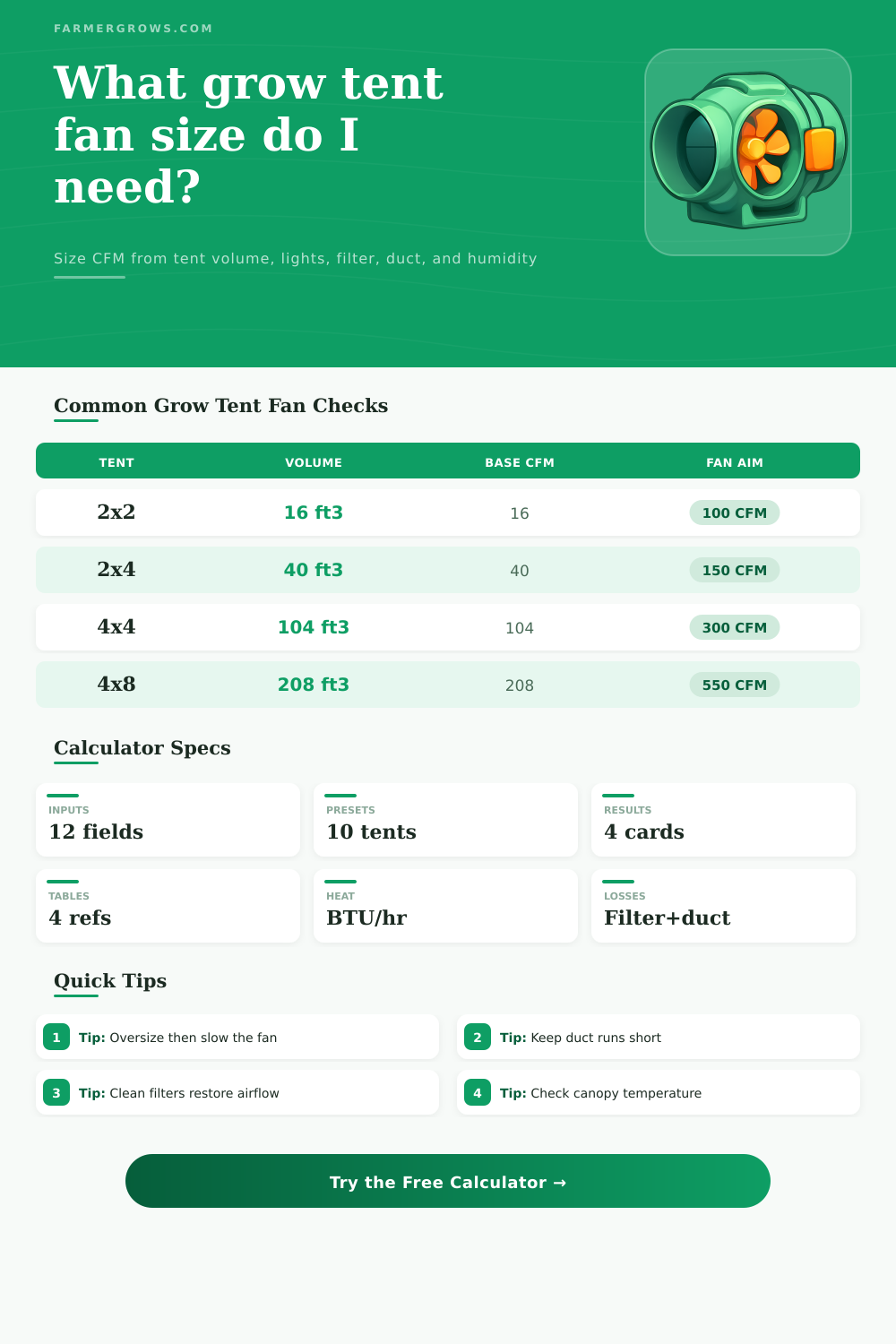
| Tent footprint | Typical height | Volume | 1 exchange/min | Usual fan class |
|---|---|---|---|---|
| 2 x 2 ft | 4 ft | 16 ft³ | 16 CFM | 4 in fan, often 80 to 150 CFM rated |
| 2 x 4 ft | 5 ft | 40 ft³ | 40 CFM | 4 or 6 in fan after filter losses |
| 3 x 3 ft | 6 ft | 54 ft³ | 54 CFM | 4 or 6 in fan depending on lights |
| 4 x 4 ft | 6.5 ft | 104 ft³ | 104 CFM | 6 in fan commonly 250 to 400 CFM rated |
| 5 x 5 ft | 6.5 ft | 163 ft³ | 163 CFM | 6 or 8 in fan for heavy canopies |
| 4 x 8 ft | 6.5 ft | 208 ft³ | 208 CFM | 8 in fan commonly 500 to 800 CFM rated |
| 8 x 8 ft | 7 ft | 448 ft³ | 448 CFM | 8 or 10 in fan with short ducting |
| Filter condition | Planning loss | When to use | Calculator effect |
|---|---|---|---|
| No carbon filter | 0% | Propagation, outdoor exhaust, or odor not relevant | Fan rating mainly follows heat and duct losses |
| Oversized clean filter | 15% | Filter CFM is comfortably above fan airflow | Best odor-control choice for quiet fan speed |
| Matched clean filter | 25% | Filter and fan are in the same nominal class | Good default for most indoor tents |
| Dense or aging filter | 35% | Small carbon bed, dusty prefilter, or older media | Recommended fan rating rises noticeably |
| Restrictive filter stack | 45% | Filter plus silencer, reducer, or tight cabinet exhaust | Needs strong fan curve, not only a high free-air rating |
| Duct item | Planning loss | Lower-loss choice | Calculator input |
|---|---|---|---|
| Straight smooth duct, 5 ft | About 5% to 8% | Use the shortest practical route | Enter measured duct length |
| Flexible duct, 10 ft | About 10% to 20% | Pull flex duct tight and avoid sagging | Length plus diameter factor |
| Each sharp 90-degree bend | About 5% to 10% | Use sweep bends or gentler turns | Count as one bend each |
| Reducer or crushed section | Can exceed 15% | Match fan, filter, and duct diameter | Add extra bend equivalent if severe |
| Roof, wall, or soffit cap | About 5% to 15% | Choose a low-resistance exterior vent | Add to safety factor if unknown |
| Crop stage | Canopy temperature | Relative humidity | Ventilation note |
|---|---|---|---|
| Seedlings and clones | 72 to 78 F | 65% to 80% | Gentle exchange is enough if lights are cool |
| Vegetative growth | 72 to 82 F | 55% to 70% | Higher transpiration may drive humidity CFM |
| Early flowering | 70 to 80 F | 45% to 60% | Odor filter and heat load usually control fan size |
| Late flowering | 68 to 78 F | 40% to 50% | Use extra reserve for dense canopy humidity |
| Drying tent | 60 to 68 F | 55% to 62% | Slow, steady exhaust is better than harsh airflow |
Tip 1: Compare the adjusted CFM against the fan curve, not just the free-air number on the box. Carbon filters, reducers, bends, and long flex duct can move the real operating point far below the advertised maximum.
Tip 2: Keep the tent under light negative pressure, then tune speed from canopy temperature and humidity readings. If the lung room is hot or humid, bigger exhaust alone cannot create cool, dry intake air.
A grow tent’s exhaust fan is an essential component for maintaining healthy plants, as opposed to letting them overheat or become too humid. An inadequate fan will let temps rise rapidy; on the other hand, excessive airflow waste electrical energy and also draws in unconditioned air from nearby spaces. To determine the right fan, you need more than its free-air rating printed on the box; you must know what it needs to counteract.
The first metric is tent volume… Every cubic foot of space must be replenished with fresh air constanty. So if you have a tiny 2×2 area, it might only need a modest fan when lights are cool, but that same footprint can double the fan requirement under high-wattage lamp. Once you enter your measurements into the calculator, it’ll do all the math for you (so no more converting by hand).
How to Pick the Right Exhaust Fan for Your Grow Tent
But volume isn’t always the complete picture when determining airflow demands. In most tents, light heat is the dominant load. All of those watts turns into warmth in the space under canopy. All of that warmth needs to be removed through the exhaust pathway. How much air is needed is directly related to how great a difference you want between what’s going on in your tent versus the surrounding room. What many folks miss when they size their fan based off solely on footprint is that a loose 10-degree window requires less air movement than a tighter 6-degree window.
Fans rate their output at full power, however, real-world airflows will be less due to things like duct runs and carbon filters which adds resistance. An average fan may run 25% less efficient if your filter is clean and well-matched to it, and then another 15 to 20% loss depending on how long your flex duct run is, and how many sharp turns there is along the way. These reductions are built into the calculator’s recommendation, otherwise you’d be taken off-guard when performance decrease following installation. The reference table shows this effect for typical scenarios; different numbers won’t change the principle.
Most growers don’t realize how much humidity load actualy matters. A thick canopy will dump multiple pints of water per day into the air; it’s got to escape with the exhaust stream. By late flower, the demand for humidity can match or even surpass the need for heat (which is why the calculator requires an estimate of daily water loss). If you ignore this variable, you risk growing mold even when temperatures looks fine.
That safety margin is your protection against aging filters, hot summers, and reduced fan performance with any resistance. Typically, that means a 20 percent safety margin (meaning it runs on a quieter setting but still has reserve capacity when things warm up). So really the output isn’t exactly a hard minimum, it’s a realistic rating that considers your active grow space.
Typically, running a marginally big enough fan at top speed results in more noise and less control than using one just a bit bigger and slowing it way back. You want steady airflow through canopy to keep humidity in range, but you shouldn’t cause wind burn on leaves or move insect onto them. Your objectives are to keep a consistent negative pressure, a stable canopy temperature, and enough airflow to circulate the air inside the canopy.