Lawn Coverage Calculator
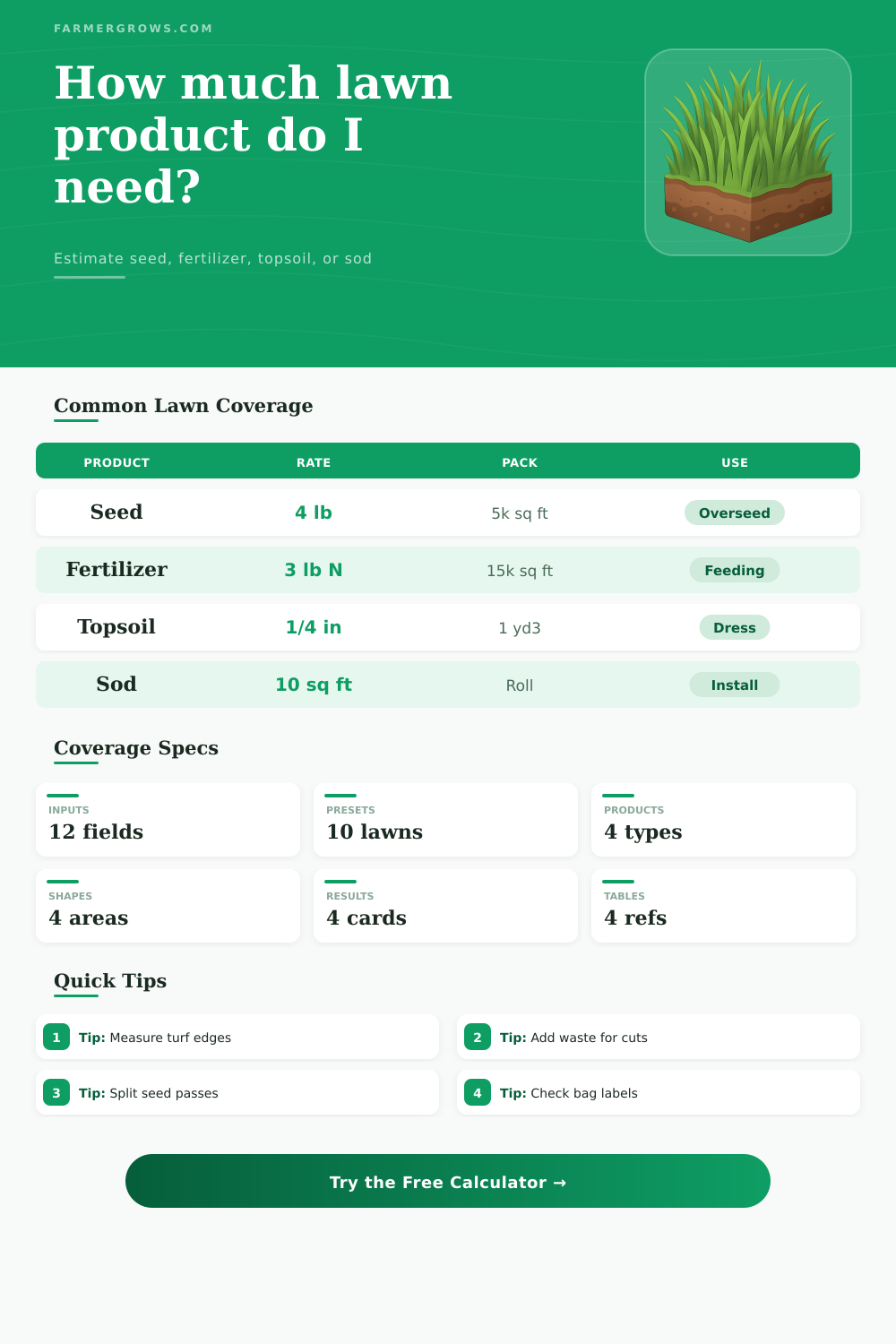
Estimate how much seed, fertilizer, topsoil, or sod your lawn project needs after shape area, application rate, overlap, waste, and package coverage are included.
Use measured lawn dimensions and the product label rate. The calculator keeps the base turf area separate from overlap and waste so you can see the true treated area, the adjusted purchase amount, and the expected package count.
Lawn Coverage Results
Results show measured turf area, adjusted treated area, product quantity, package count, and waste or overlap amount.
| Seed job | Typical rate | Coverage from 20 lb bag | Coverage from 50 lb bag | Use note |
|---|---|---|---|---|
| Light overseeding | 2 lb per 1,000 sq ft | 10,000 sq ft | 25,000 sq ft | Thin but living turf |
| Standard overseeding | 4 lb per 1,000 sq ft | 5,000 sq ft | 12,500 sq ft | Common cool-season refresh |
| Heavy repair | 6 lb per 1,000 sq ft | 3,333 sq ft | 8,333 sq ft | Thin turf or many bare spots |
| New lawn seeding | 8 lb per 1,000 sq ft | 2,500 sq ft | 6,250 sq ft | Fresh seedbed or renovation |
| Fine rye touch-up | 10 lb per 1,000 sq ft | 2,000 sq ft | 5,000 sq ft | Temporary dense cover |
| Fertilizer bag | Label coverage | Product per 1,000 sq ft | Bags for 5,000 sq ft | Planning note |
|---|---|---|---|---|
| 12 lb bag | 4,000 sq ft | 3.0 lb | 2 bags | Small urban lawns |
| 15 lb bag | 5,000 sq ft | 3.0 lb | 1 bag | Common single lawn bag |
| 32 lb bag | 10,000 sq ft | 3.2 lb | 1 bag | Half bag for mid-size lawns |
| 40 lb bag | 12,500 sq ft | 3.2 lb | 1 bag | Measure carefully to avoid excess |
| 50 lb bag | 15,000 sq ft | 3.3 lb | 1 bag | Large lawn or split applications |
| Sod format | Coverage each | Pieces for 500 sq ft | Waste to add | Best fit |
|---|---|---|---|---|
| Small roll | 5 sq ft | 100 rolls | 8% to 12% | Patch work and small vehicles |
| Standard roll | 10 sq ft | 50 rolls | 10% to 15% | Most homeowner installs |
| Large slab | 16 sq ft | 32 slabs | 8% to 12% | Open rectangles and fewer seams |
| Mini pallet | 225 sq ft | 3 pallets | 10% to 15% | Medium repair zones |
| Full pallet | 450 sq ft | 2 pallets | 10% to 20% | Whole lawn replacement |
| Topdress depth | Cu ft per 1,000 sq ft | Cu yd per 1,000 sq ft | Sq ft per cubic yard | Common use |
|---|---|---|---|---|
| 1/8 in | 10.4 | 0.39 | 2,592 | Light smoothing or compost dusting |
| 1/4 in | 20.8 | 0.77 | 1,296 | Routine topdress pass |
| 1/2 in | 41.7 | 1.54 | 648 | Low spots staged carefully |
| 3/4 in | 62.5 | 2.31 | 432 | Renovation grade correction |
| 1 in | 83.3 | 3.09 | 324 | Soil prep before new sod |
Rate check: Product labels sometimes list both overseeding and new-lawn rates. Pick the rate that matches the job before adding overlap or waste.
Package check: For sod and topsoil, curves and trimming can matter more than the math. Round up before delivery day so small gaps do not stop the work.
Ordering enough (or not enough) sod, seed, topsoil or fertilizer for a lawn seems simple, until it comes down to quantites. How do I know how many bags to order? I look at package and measure my area, but I am still not sure. Will there be leftovers that I don’t want? Or will the area be too thinly covered? Enter the magic number, the calculator, above. Once you input your lawn dimensions and the specifics about your product, it does all the math. No more guessing.
The first true decision point is lawn shape. Many yards has angled beds, trees, and other features that make actual area more than just a simple rectangle. To account for that, the calculator allows you to draw custom measured area or use one of 4 shapes (triangle, circle, rectangle). So your base number will reflect what you have.
How to Order the Right Amount for Your Lawn
That base number is then adjusted up/down based off the coverage goal you select and the waste/overlap. Waste and overlap occur because spreaders miss edges, sod seams needs trimming, and topsoil depths varies based on how level the ground is. The inputs are interpreted differently based on product type. For seed and fertilizer (pounds per thousand sq ft), the rate is how much of that material falls onto each area of your land. For topsoil (cubic yards), it’s different because the goal is to cover up low places; it’s all about volume rather then weight. For sod (square footage), the calculator shows how many slab or rolls are needed to cover an area, since they are sold in set amounts. To avoid mistaking cubic yard with pounds, the calculator maintains separate units.
There are good reasons why there is overlap and waste. For example, some seed falls at intersection of two passes, and spreader makes an extra pass along edges. Waste includes small spills during loading, torn sod pieces, and amount trimmed away from beds. Typical amounts of each is shown on the page’s reference tables to give you some idea if you think “five percent” sounds conservative, or “fifteen” fits the shape of your yard better.
Two areas will display on your output cards: First is measured area of the lawn. Second is the adjusted area based on the amount of waste, overlap, and any coverage goal you enter. It’s a lot easier to grasp real quantity when you see both numbers. From there, package count is rounded up based on the amount of coverage per bag or roll that you entered. This last number is what tells you how much to order, not merely what math says.
There are some common pitfalls: People read the label as the only important number. So a package say it covers five thousand square feet? That is under ideal conditions with no overlaps. This calculator reinserts those overlaps, so adjusted square footage will likely be bigger than your actual lawn measurement. Also, it parses out package vs. Product, so you know if you round up there’s still good leftover to use rather than just more weight to carry.
That’s true with any condition. A light touch-up reduces the adjusted area. A heavy repair job requires more paint to do the work which creates a greater coverage goal and raises the adjusted area. Small changes of inches in topsoil depth result in a big difference in cubic yard, as the depth multiplies quickly. With this calculator, you can play out these adjustments without repeating all your math manually.
It also prevents you from stopping midway when you realizes you have run out of something. Order based on the revised calculations; assume some waste will occur onsite and therefore should of have just enough left over for the final cut, or the final low spot. Nothing changes about the measured-out lawn. But at least now the purchase numbers align with the task ahead.