Lawn Fertilizer Rate Calculator
Estimate how many pounds of fertilizer to spread from a nitrogen target, product grade, slow-release share, season, soil P/K status, and spreader pass width.
Use soil-test recommendations when available. This calculator turns a planned nitrogen rate into a product rate and shows whether the same fertilizer also adds phosphorus or potassium your lawn may not need.
Fertilizer Rate Results
Results are based on lawn area, nitrogen target, N-P-K grade, slow-release share, and a calibration strip equal to 100 linear feet of your spreader pass width.
| Turf type | Annual N range | Typical single app | Best timing | Notes |
|---|---|---|---|---|
| Tall fescue | 2 to 4 lb N / 1,000 ft² | 0.5 to 1.0 lb N | Early fall and late fall | Keep spring rates modest where summers are hot. |
| Kentucky bluegrass | 2 to 5 lb N / 1,000 ft² | 0.5 to 1.0 lb N | Fall, light spring | Higher maintenance lawns need more N for density. |
| Fine fescue | 1 to 2 lb N / 1,000 ft² | 0.25 to 0.75 lb N | Fall | Use lean rates for shade, drought, and low-input sites. |
| Perennial ryegrass | 2 to 4 lb N / 1,000 ft² | 0.5 to 1.0 lb N | Fall and recovery periods | Responds quickly after traffic or overseeding. |
| Bermuda grass | 3 to 6 lb N / 1,000 ft² | 0.5 to 1.0 lb N | Late spring through summer | Apply after greenup and stop before dormancy. |
| Zoysia | 1 to 3 lb N / 1,000 ft² | 0.25 to 0.75 lb N | Late spring and summer | Dense turf often needs less N than Bermuda. |
| St. Augustine | 2 to 4 lb N / 1,000 ft² | 0.5 to 1.0 lb N | Warm active growth | Watch local limits and disease pressure in humid weather. |
| Centipede | 0.5 to 2 lb N / 1,000 ft² | 0.25 to 0.5 lb N | Late spring to early summer | Too much N can weaken this low-input turf. |
| Fertilizer grade | Product for 1 lb N / 1k | P₂O₅ added | K₂O added | Common use |
|---|---|---|---|---|
| 32-0-4 | 3.13 lb / 1,000 ft² | 0.00 lb | 0.13 lb | High-N feeding where soil P is already sufficient. |
| 29-0-5 | 3.45 lb / 1,000 ft² | 0.00 lb | 0.17 lb | Slow-release maintenance lawn fertilizer. |
| 24-0-11 | 4.17 lb / 1,000 ft² | 0.00 lb | 0.46 lb | Extra potassium when soil test calls for K. |
| 20-0-10 | 5.00 lb / 1,000 ft² | 0.00 lb | 0.50 lb | Balanced N and K with no phosphorus. |
| 18-24-12 | 5.56 lb / 1,000 ft² | 1.33 lb | 0.67 lb | Starter fertilizer for establishment, only when P is needed. |
| 16-4-8 | 6.25 lb / 1,000 ft² | 0.25 lb | 0.50 lb | Complete lawn feed for soils that need some P and K. |
| Season | Cool-season lawn | Warm-season lawn | N target guide | Timing caution |
|---|---|---|---|---|
| Early spring | Light greenup only | Wait for active growth | 0.25 to 0.5 lb N | Avoid forcing lush growth too early. |
| Late spring | Light to moderate | First main feeding after greenup | 0.5 to 1.0 lb N | Reduce if heat or drought is near. |
| Summer | Low or skip during stress | Main feeding window | 0.25 to 1.0 lb N | Water correctly and avoid dormant turf. |
| Early fall | Prime recovery feeding | Slow feeding as growth declines | 0.5 to 1.0 lb N | Best cool-season establishment window. |
| Late fall | Strong cool-season timing | Usually stop | 0.5 to 1.0 lb N | Apply while grass is green, not frozen. |
| Calibration step | Formula | Example | What to adjust | Field note |
|---|---|---|---|---|
| Product rate | Target N divided by N percent | 1.0 / 0.29 = 3.45 lb | Choose a grade or target N | This is product pounds per 1,000 ft². |
| 100 ft strip area | Pass width x 100 | 10 ft x 100 = 1,000 ft² | Effective spread width | Overlap reduces the real pass width. |
| Strip catch weight | Rate x strip area / 1,000 | 3.45 lb for 10 ft pass | Gate opening and walking speed | Weigh what leaves the hopper over 100 ft. |
| Cross-pass split | Half rate each direction | 1.72 lb then 1.72 lb | Use two lighter passes | Improves evenness and reduces striping. |
| Bag coverage | Bag size / rate x 1,000 | 32 / 3.45 = 9,280 ft² | Check leftover product | Bag labels often round coverage numbers. |
Use nitrogen as the anchor: Set the product rate from the N percent first, then check whether the same product adds phosphorus or potassium your soil test actually needs.
Calibrate with a short run: Mark 100 feet, walk at normal pace, weigh the material used, and adjust the spreader before treating the full lawn.
Instead of guessing at what’s needed which might mean wasting product or hurting soil, get the precise right amount of fertilizer by converting desired nitrogen level into pounds of whatever brand of product you are using.
Why? You’ll see three numbers on the bag but you don’t want to use an amount of product that matches your actual weight. A little math is good; it protects the water supply, not then storm drain. Growth and color comes from nitrogen; all the other component need to be matched to what’s in the soil.
How to Use Fertilizer Correctly
When you plug in the N-P-K grade, lawn size and the amount of desired nitrogen, it does the math for you with the calculator. And if there’s a slow release percentage listed, it will tell you how much N is available immediately and how much later.
Check if phosphorus and potassium levels is also adequate in soil test fields; if they are not, do not waste money or harm water quality by applying more fertilizer to fix them.
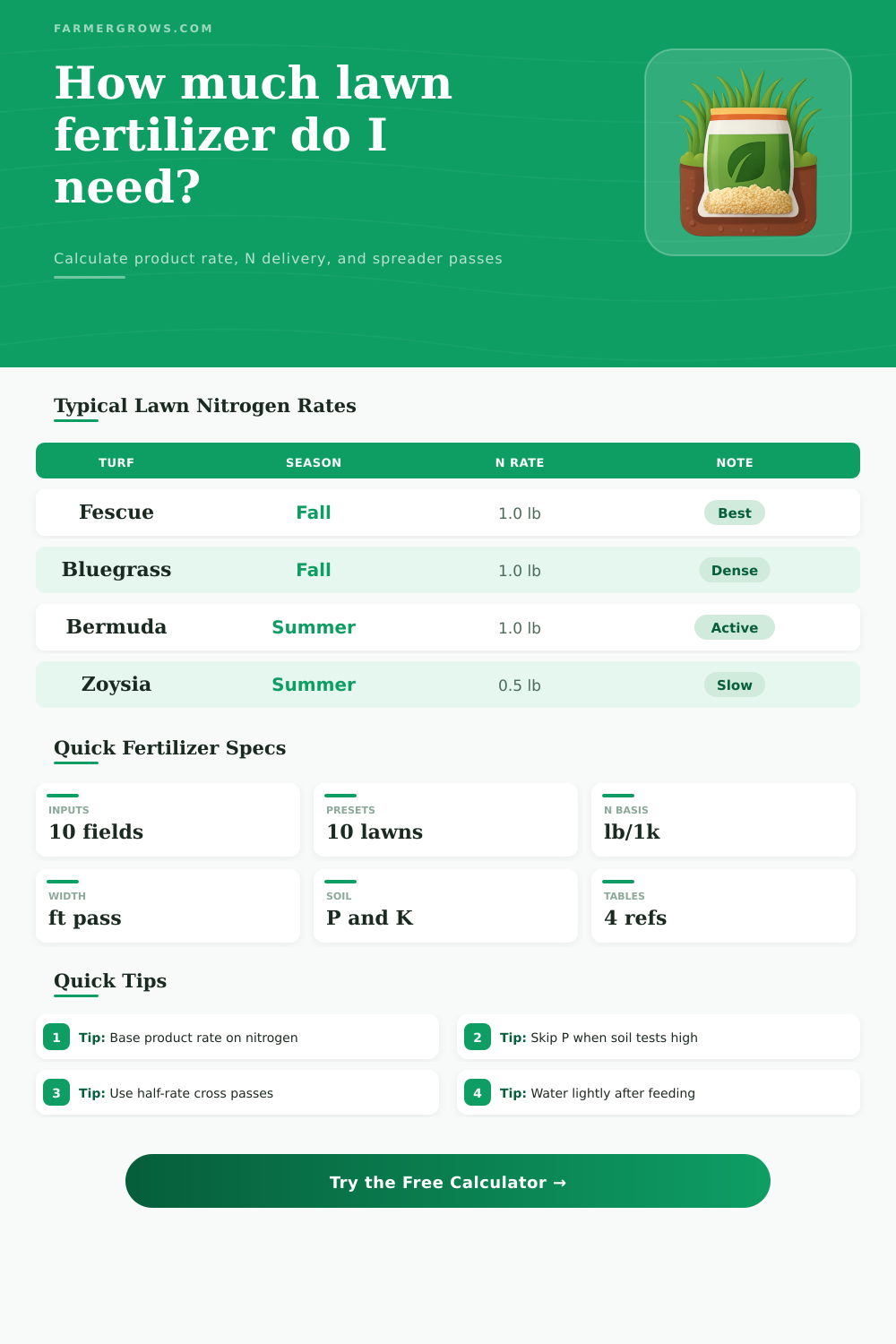
Throughout the season, grass doesn’t consume nitrogen evenly. Turf type matter, too. Roots of cool-season grasses is most active while their top growth is slowing (fall), making fall application ideal for best recovery. When a warm-season lawn is fully green and growing toughest, it’s summer. Use the tool to select both, keeping recommended target realistic. Avoid feeding at the wrong time so you don’t risk thin, weak turf.
Calibrating a spreader is the step people skip and then regret. This calculator converts the product rate you want to apply into ounces applied on a 100-foot test strip using the pass width you prefer. Then you weigh what comes out of the hopper. You compare math to your walking speed and how the gate was set. Applying half-rate via a cross-pass will typically yield more even coverage than just one heavy pass, although this tool provide results for both choices so you can determine which works best.
Do I have a reasonable rate for my grass? Reference tables answer that question by showing single application targets and their annual range. You can use them to determine if your plan falls within normal limits. The tables let you compare common fertilize grades, as well. It’s helpful to know whether a lower-phosphorus product (or no phosphorus at all) make sense based off your soil test.
Without running the numbers first, there’s nothing but fertilizer in the spreader (and that’s no good). Because then you’re out of control: Do I have enough for another pass? How far will it go? Did I add something my lawn doesn’t need nutritionally? Running the numbers first makes it a measured decision, no more wasting time or product on a routine chore. A healthy lawn is a happy lawn, and a happy lawn would of needed a measured decision.