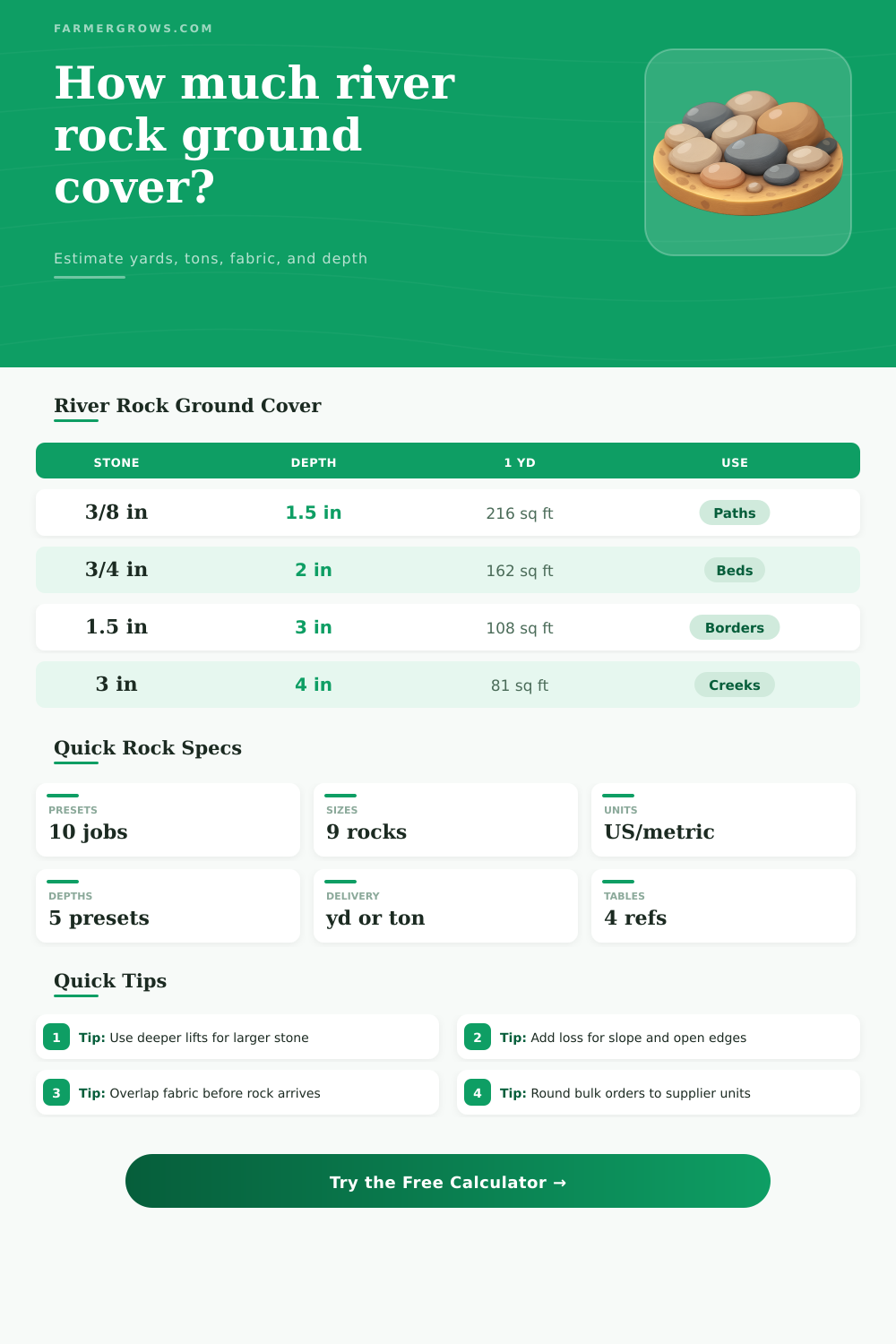
River Rock Ground Cover Calculator
Estimate smooth river rock coverage by shape, stone size, depth, density, slope loss, edging loss, landscape fabric overlap, and bulk delivery by cubic yard or ton.
Rounded river rock spreads differently from angular gravel. Use a thicker layer for larger stone, add a loss factor for slopes and open edges, and confirm local bulk density with the supplier when the rock is wet or blended.
River Rock Estimate
Results include base volume, river-rock loss factors, overage, delivery rounding, estimated load weight, and fabric overlap allowance.
| River rock size | Typical installed depth | Bulk density used | Best fit | Field note |
|---|---|---|---|---|
| 3/8 in pea river pebbles | 1.5 to 2 in | 2850 lb/cu yd | Walkways, patios, tight planting gaps | Needs firm edging because rounded pea stone rolls easily. |
| 1/2 in creek pebbles | 2 in | 2900 lb/cu yd | Low beds, courtyard strips, decorative drains | Small enough to rake smooth after settling. |
| 3/4 to 1 in river jack | 2 to 3 in | 2825 to 2850 lb/cu yd | Foundation beds and low-maintenance borders | The common ground-cover size for visible coverage. |
| 1 to 1.5 in river jack | 3 in | 2775 lb/cu yd | Planting beds, pool edges, utility strips | Shows fewer bare spots than larger cobbles at modest depth. |
| 1.5 to 2 in drainage river rock | 3 to 4 in | 2725 lb/cu yd | Downspout splash zones and drainage borders | Leave enough depth so the fabric does not flash through. |
| 2 to 3 in creek cobble | 4 to 6 in | 2675 lb/cu yd | Dry creek beds and runoff swales | Use a deeper channel and bigger overage for curves. |
| 3 to 5 in river cobble | 5 to 7 in | 2625 lb/cu yd | Accent ribbons and visible drainage edges | Often placed by hand after a smaller base stone. |
| 4 to 8 in accent river stone | 6 in or more | 2550 lb/cu yd | Feature stones, dry stream faces, boulder transitions | Order by visual coverage as much as calculated volume. |
| Installed depth | Coverage per cubic yard | Metric coverage per m3 | Good river rock size | Common use |
|---|---|---|---|---|
| 1.5 in | 216 sq ft | 8.0 m2 per m3 | 3/8 in to 1/2 in | Decorative skim where fabric is already covered |
| 2 in | 162 sq ft | 6.0 m2 per m3 | 1/2 in to 3/4 in | Small bed refresh or light path topping |
| 3 in | 108 sq ft | 4.0 m2 per m3 | 3/4 in to 1.5 in | Standard river rock ground cover |
| 4 in | 81 sq ft | 3.0 m2 per m3 | 1.5 in to 3 in | Drainage border or sloped bed |
| 6 in | 54 sq ft | 2.0 m2 per m3 | 2 in to 5 in | Dry creek bed and wash channel |
| Bulk unit | At 2 in depth | At 3 in depth | At 4 in depth | Weight assumption |
|---|---|---|---|---|
| 1 cubic yard | 162 sq ft | 108 sq ft | 81 sq ft | About 1.3 to 1.45 tons for most river rock |
| 1 ton, 2600 lb/cu yd stone | 125 sq ft | 83 sq ft | 62 sq ft | Larger cobble with more void space |
| 1 ton, 2800 lb/cu yd stone | 116 sq ft | 77 sq ft | 58 sq ft | Common mixed river jack |
| 1 ton, 3000 lb/cu yd stone | 108 sq ft | 72 sq ft | 54 sq ft | Dense wet or polished pebble loads |
| 5 cubic yard delivery | 810 sq ft | 540 sq ft | 405 sq ft | Check truck payload if stone is wet |
| Landscape use | Suggested river rock | Depth target | Loss factor to consider | Why it matters |
|---|---|---|---|---|
| Foundation planting bed | 3/4 to 1.5 in river jack | 2.5 to 3 in | 5% edging loss | Enough depth hides fabric without burying plant crowns. |
| Dry creek or swale | 2 to 5 in cobble mix | 4 to 6 in | 10% to 20% slope loss | Water rearranges rounded stones during heavy runoff. |
| Walkable garden path | 3/8 to 1/2 in pebbles | 1.5 to 2 in | 8% edging loss | Small rock is easier to walk on but rolls outside edges. |
| Pool or patio border | 1 to 2 in smooth river rock | 3 in | 5% splash loss | Rounded stone is comfortable near hardscape edges. |
| Downspout splash zone | 1.5 to 3 in drainage river rock | 4 in | 10% wash loss | Depth helps keep fabric covered under concentrated flow. |
Before ordering: Ask whether the supplier sells river rock by cubic yard, short ton, or loader bucket. Rounded stone density changes with size blend and moisture.
Before spreading: Pin fabric seams with the specified overlap first, then keep river rock slightly below edging height so smooth stones do not roll into turf.
Between planting and hardscape: River rock ground cover isn’t a lawn that needs constant mowing and watering, or mulch that must be replenished annually as it breaks down. It’s a permanent surface that still feels naturaly underfoot. Stone doesn’t move after installation, but allows free drainage. That’s why people love it, and use it in their landscapes.
They use it under trees where grass won’t grow, in dry creek beds, and around foundation.
How to Choose River Rock and Use the Calculator
What do I choose? First choice: Size. How big or little? Small ones fits together tightly and form an even surface for walking on, but tend to move around along the edge. They may also work their way under turf. Big ones hold better on slopes, and appear more purposeful in a swale. However, gaps will shows between them unless there is enough thickness to hide underlying fabric.
Use the calculator (above) to determine how deep your finished lift needs to be. This will ensure it covers entire area. The other variable that trips people up is depth. One-and-a-half inches sounds like an adequate skim coat in theory, but what happens if someone walks on it or a hose wash away some of the stones?
For most planting bed, three inches has become standard fare: deep enough to hide landscape fabric, not so deep as to break the bank. Deeper lifts makes sense in areas where water tends to collect, such as drainage channels or places prone to puddling; they act as both a reservoir and armor. To accommodate these variations, the tool resets the volume automatically whenever the user adjusts the depth preset. You no longer need to do mental math to translate inches into cubic yards.
Until the rain comes, and the stones tumble down hill, or the round pebble rolls over edge, it is all too easy to forget loss factors. If your beds has an open edge, or are on a slope, then adding a small percentage for the open edge/slope will prevent under-ordering just based off what is measured. Maybe you want your bed to look full after a season? Add that bit in too, because it might not look very full without some extra padding. The calculator includes those %s in the final order…no guessing at how much extra to ask for.
Step back to fabric planning, where tuck allowances and overlap seams matter. Fabric creeping up onto the stone will be a maintenance headache down the road. Once you input your bed dimensions along with how much you want to overlap seams, the tool calculates the total amount of fabric required. You won’t have to play a separate fabric-ordering guessing game.
A silent variable is bulk density, which varies from supplier to supplier. The weight of washed river rock can varies by several hundred pounds per cubic yard, depending on the mix of sizes and moisture content. The calculator’s default density can be overridden, allowing for an estimate of how much it weighs based on what the quarry actualy loads into the truck. That change alone will often account for why a load felt heavier then the previous one despite having the same volume number.
Before the truck arrives to pick it up, you run the numbers to turn a guess into a specific amount you can measure. Suddenly the size of the stone, its depth and the percentage lost are trading off against each other and you end up with a quantity that fits the job rather than next round number on a price sheet.