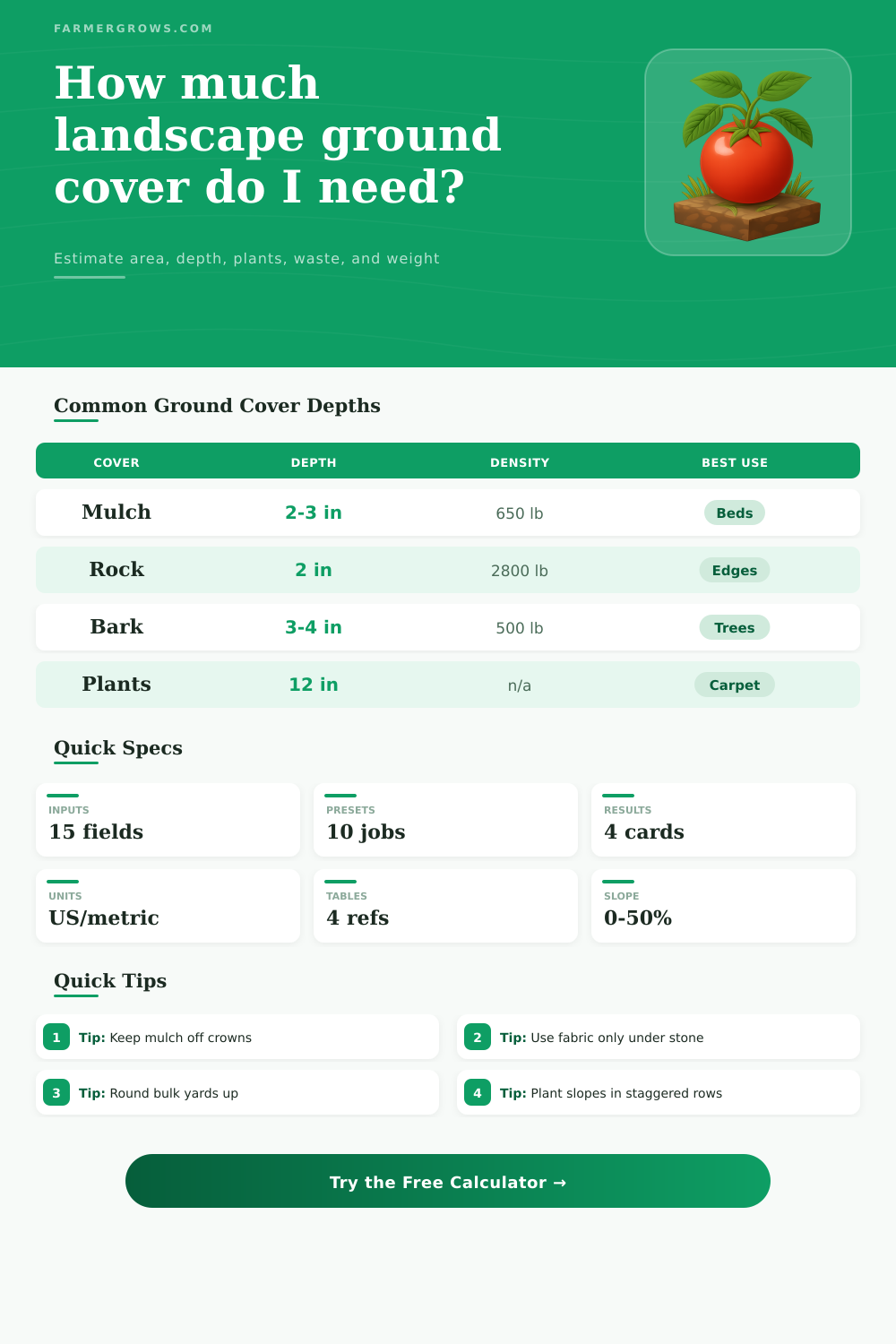
Landscape Ground Cover Calculator
Estimate landscape bed area, cover depth, plant spacing, slope adjustment, edging waste, maintenance clearance, density, order units, and installed weight for mixed ground-cover projects.
Use this planner for landscape ground cover where the order is not only plants or only rock. It combines shape area, loose-cover depth, plant spacing, slope, maintenance zones, edge loss, density, and overage into one practical material takeoff.
Good for shrub beds and vegetable edges. Use moderate depth, keep crowns clear, and expect seasonal settling.
Best for permanent dry edges, drainage swales, and low-litter spots. Weight and edging control matter most.
Useful around trees and shade islands where slower breakdown, visual texture, and root oxygen are priorities.
Orders plants from spacing and coverage share. Thin mulch between starts helps limit weeds while crowns expand.
Your Landscape Ground Cover Estimate
Results include slope-adjusted surface area, maintenance-zone subtraction, edging waste, overage, density, order units, and plant spacing where used.
| Material depth | Best for | Coverage per cubic yard | Field note |
|---|---|---|---|
| 1 inch | Top refresh, light compost mulch | 324 sq ft | Does not hide old fabric or deep weeds well. |
| 2 inches | Rock, pea gravel, yearly mulch refresh | 162 sq ft | Good balance for decorative stone and established beds. |
| 3 inches | New mulch beds, bark mini nuggets | 108 sq ft | Common depth for broad shrub beds after soil prep. |
| 4 inches | Bark nuggets, chips, coarse texture | 81 sq ft | Use around trees with trunk flare kept open. |
| 6 inches | Play chips, rough traffic zones | 54 sq ft | Settling and safety depth usually need extra overage. |
| Plant spacing | Square rows per 100 sq ft | Staggered rows per 100 sq ft | Use when |
|---|---|---|---|
| 8 inches | 225 plants | 260 plants | Fast carpet from small plugs or slow spreaders. |
| 12 inches | 100 plants | 116 plants | Most ground-cover plugs and 4 inch starts. |
| 15 inches | 64 plants | 74 plants | Moderate fill with airflow in humid beds. |
| 18 inches | 45 plants | 52 plants | Larger starts, spreading vines, or mixed shrub edges. |
| 24 inches | 25 plants | 29 plants | Wide-spreading woody or drought-tolerant covers. |
| Cover density | Typical lb per cu yd | Metric kg per cu m | Order caution |
|---|---|---|---|
| Shredded hardwood mulch | 550 to 750 | 326 to 445 | Wet loads can weigh much more than dry mulch. |
| Pine bark nuggets | 400 to 600 | 237 to 356 | Large nuggets bridge and settle unevenly. |
| Arborist wood chips | 600 to 850 | 356 to 504 | Fresh chips settle quickly; use extra depth. |
| River rock or gravel | 2600 to 3000 | 1542 to 1779 | Confirm by ton when ordering from a quarry. |
| Decomposed granite | 2400 to 2900 | 1423 to 1720 | Compacted paths need base prep, not only cover depth. |
| Coverage rate | Equivalent volume | Covers at 2 inches | Good use |
|---|---|---|---|
| 1 cubic yard bulk | 27 cubic ft | 162 sq ft | Medium to large beds with easy dumping access. |
| 2 cubic ft bag | 0.074 cubic yd | 12 sq ft | Small touch-ups and tidy urban projects. |
| 3 cubic ft bag | 0.111 cubic yd | 18 sq ft | Mulch beds where bags are easier than bulk. |
| Pine straw bale | surface bundle | 45 sq ft | Southern shrub beds and slopes. |
| 1 ton rock at 2800 lb/yd | 0.714 cubic yd | 116 sq ft | Stone jobs quoted by quarry weight. |
Subtract stepping stones, meter boxes, clean trunk flare circles, drip emitters, and service paths before adding overage. Otherwise the final order can look right on paper but leave piles where maintenance access should stay open.
Rock usually performs at shallower depth than bark, while coarse chips need more depth because they bridge and settle. Living covers often need only a thin mulch layer until the canopy closes.
With landscape ground cover, ordering enough avoids these little mistakes turning into big headaches. Ordering too little material mean bare spots and having to go back to the supplier. Too much material ordered means a lot of it will shift or settle, leaving you with leftover material.
It often boils down to accurately measuring not only flat space but also actual surface area. Most folks get off course here based off the actual numbers: A seemingly harmless-looking bed on paper gets dramatic when viewed in three dimensions against sloped terrain. With each percent of grade, the surface area increase. This extra area needs to be covered, just like level portion. The calculator above computes it for you, based on the slope you input, so you don’t have to guesstimate what all that added length will require.
How to Calculate Your Ground Cover Needs
Don’t forget other maintenance zones, around trunks, valve boxes, and paths. Open these areas up, so you won’t be ripping into a lovely surface whenever something needs servicing, which make the whole task practical.
Once there, various types of material do different things. Rock doesn’t move, although it’s much heavier than mulch. This change how you plan your delivery. It also tells you how much edging you need to hold it in place. Mulches (bark nuggets or even shredded) will settle and compact; that three-inch depth might become two inches after a year. And bark nuggets is airier than shredded mulch (good for tree circles); but you might need more depth to create an equally weed-smothering barrier.
Add living ground cover to the equation, and you have yet another element of planning: How fast will surface close? How closely should those plant be spaced to each other? You’ll also want to know how much mulch to apply among the young plants as canopy develops. This is all spelled out on the page’s reference tables (which show plant count at common spacings, and coverage rates at various depths).
The math are predictable, given the variables; but the variable change from one site to another. An exact calculation translates into a useable order when you account for edging loss, curve waste, and the little bit required for touch-ups. A modest overage percentage accommodates these facts of life while ensuring that you don’t overbuy.
When you run the numbers. Really, the payoff is that they stop making you treat your purchases of ground cover as a one-off. They begin to make you think about them not as an individual decision but as a series of connected ones: How much do I have to add, and what kind? What’s the best way to get up a steep hill? What can be planted into that depth of soil?
Once you see those connection, placing an order no longer feels like a shot in the dark. It begins to feel like a calculated step toward something bigger.