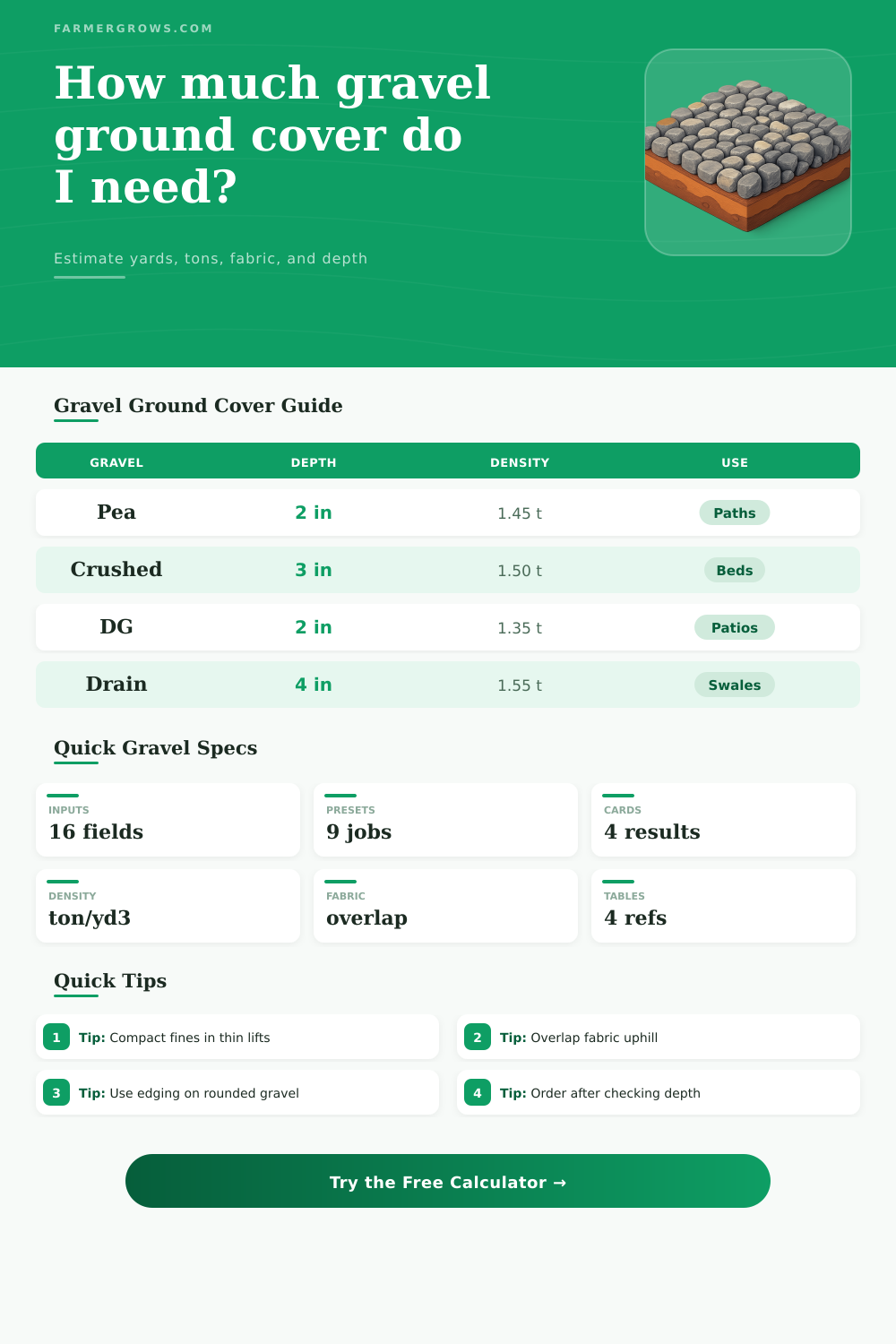
Gravel Ground Cover Calculator
Estimate bulk gravel yards, tons, finished depth, compaction allowance, edging migration, geotextile overlap, and coverage for paths, garden beds, dog runs, utility strips, and drainage covers.
Use the depth you want after raking and settling. Supplier density can vary by quarry, moisture, and fines content, so the calculator lets you enter the actual tons per cubic yard from your yard ticket.
Gravel Estimate
Calculated from finished depth, density, compaction, edge movement, overage, and geotextile overlap.
| Gravel material | Typical tons per yd3 | Approx lb per yd3 | Compaction behavior | Best ground-cover use |
|---|---|---|---|---|
| Pea gravel, 3/8 in | 1.40 to 1.50 | 2,800 to 3,000 | Low compaction, high migration | Paths, beds, tree circles, play edges |
| 3/4 minus crushed gravel | 1.45 to 1.55 | 2,900 to 3,100 | Moderate to high compaction | Walks, utility strips, refreshed lanes |
| Decomposed granite | 1.30 to 1.45 | 2,600 to 2,900 | High compaction after watering | Patios, sitting areas, fine paths |
| Clean 3/4 in drain stone | 1.50 to 1.60 | 3,000 to 3,200 | Low binding, open voids | Drip edges, wet strips, swale covers |
| Crusher fines | 1.35 to 1.50 | 2,700 to 3,000 | High compaction, smooth finish | Dog runs, equipment pads, neat paths |
| Bank run gravel | 1.55 to 1.70 | 3,100 to 3,400 | Variable fines and stones | Farm lanes, rough utility cover |
| Application | Finished depth | Size fit | Fabric recommendation | Field note |
|---|---|---|---|---|
| Decorative bed refresh | 1 to 1.5 in | Fines to 3/8 in | Only if soil is exposed | Works best over existing gravel or fabric. |
| General gravel ground cover | 2 in | 3/8 to 3/4 in | Usually yes | Common depth for beds and low-traffic strips. |
| Walking path | 2.5 to 3 in | 3/8 to 3/4 in | Yes under loose gravel | Use edging, especially with rounded gravel. |
| Dog run or poultry run | 3 to 4 in | Fines or small crushed | Use separator fabric | Keep grade pitched so fines do not stay wet. |
| Drainage strip or drip edge | 4 to 6 in | Clean 3/4 to 1-1/2 in | Use nonwoven fabric | Open stone needs depth to stay functional. |
| Driveway top refresh | 1.5 to 3 in | 3/4 minus or crusher run | Usually no on old gravel | Compact in thinner lifts to avoid rutting. |
| Finished depth | 1 cubic yard covers | 1 ton covers at 1.45 ton/yd3 | 1 ton covers at 1.60 ton/yd3 | Best use |
|---|---|---|---|---|
| 1 in | 324 sq ft | 223 sq ft | 203 sq ft | Refresh skim |
| 1.5 in | 216 sq ft | 149 sq ft | 135 sq ft | Thin bed |
| 2 in | 162 sq ft | 112 sq ft | 101 sq ft | Ground cover |
| 3 in | 108 sq ft | 74 sq ft | 68 sq ft | Walkway |
| 4 in | 81 sq ft | 56 sq ft | 51 sq ft | Utility cover |
| 6 in | 54 sq ft | 37 sq ft | 34 sq ft | Drainage |
| Project surface | Suggested base below gravel | Separator layer | Compaction pass | When to upgrade |
|---|---|---|---|---|
| Decorative garden bed | Firm native soil, weeded smooth | Woven landscape fabric | Rake only | Use edging if gravel meets turf. |
| Foot path | 2 to 3 in compacted road base | Fabric under base in soft soil | Plate compact base and top | Add base where soil pumps or gets muddy. |
| Dog or poultry run | 2 in compacted fines over slope | Nonwoven separator fabric | Light compaction | Add drain tile in wet pens. |
| Drip edge or drainage strip | Shaped soil trench or swale | Nonwoven drainage fabric | Settle by raking | Use clean stone when water must pass through. |
| Driveway refresh | Existing compacted gravel | Usually none | Roll or plate compact | Add base if potholes return quickly. |
| Patio sitting area | 3 to 4 in compacted aggregate base | Fabric under base as needed | Compact in lifts | Use stabilizer grid for chairs or carts. |
Depth tip: For gravel that contains fines, compact a sample patch and measure the settled depth before ordering a large load.
Fabric tip: Overlap seams in the direction water will shed, then pin edges before spreading gravel so the fabric does not wrinkle into the finish layer.
The Gravel Ground Cover Calculator seems straightforward enough … till you try it out: What is my size? Where do I put it? How deep? How many bags will I need? How much settles out? How much more should I gets for coverage past the edge? Do I overlap onto fabric below? And so on.
The gravel calculator does all this for you when you enter in your density, shape, and depth, using a little bit of math to calculate usable roll. It eliminates having to guess at conversion factors and coefficients; no longer is a weekend project a complicated one.
How the Gravel Calculator Helps You
Where folks usually run into trouble is with density. One type of gravel might weigh different than another even if the piles look the same; for example, one might have more fines or a different moisture content. When a half-ton makes its way onto your delivery invoice, the ability to input the number right off your quarry ticket saves a guess, especially since two gravels can weigh quite differently per cubic yard.
From there, the calculator include an allowance for compaction. This assumes you’ll tamp it down, have some traffic, and wait a few weeks for things to settle to depth you want. It’s the same with edging loss. On slopes and particularly where edge is adjacent to lawn, rounded pea gravel creeps out. Angular crushed stone holds its shape somewhat better but you will lose some material around the perimeter.
Instead of hoping your final bag goes as far, the percentage of edge input turns this real-world behavior into a volume adjustment. Similar reasoning apply to fabric overlap. That seam allowance isn’t decoration, it prevents soil from pumping upward between rolls as water passes through and ground shifts.
This is all organized in reference tables on the page according to application, check out whether the depth you’ve picked seems reasonable for how you’re using it. Light decorative cover may only require an inch or two; something like a drainage strip or dog run probably will get chewed up over time and need something deeper to function propery.
That’s still judgment, which the calculator won’t substitute for; but it can make the math solid after you determine what kind of conditions the gravel will have to endure.
There are a handful of options on which we tend to over- and under-order. You under-order by forgetting about compaction and the fact that some of fill will dissapears, such as along the edges. Over-ordering happens when you think you can skip overlapping fabric then ask yourself in the spring why weeds all seem to run north-south or east-west. Those variables come up when you enter them into tool, and show up as a surprise before truck does.
Forcing one type of gravel to do all these jobs isn’t really what this is about; the value is in matching the material to the job. For example, clean drain stone works great wherever you want water to go through, but it won’t lock together and hold steady on a firm walking surface like crusher fines will once compacted down several times. Decomposed granite looks nice and tidy for patios, but only if you’re willing to accept that it takes more effort to pack down and you water it in right so it doesn’t just wash away.
Instead of just wondering if your pile will be enough, the calculator shows those tradeoffs clearly in the final number. So by the time the order has arrived and surface settled to the desired depth, the up-front decisions don’t feel much like guesswork anymore. And that’s the difference between ordering gravel versus getting the ground cover you meant to get.